
The Council of Europe is an international organisation with the goal of upholding human rights,democracy and the rule of law in Europe. Founded in 1949,it is Europe's oldest intergovernmental organisation,representing 46 member states,with a population of approximately 675 million as of 2023;it operates with an annual budget of approximately 500 million euros.

The European Convention on Human Rights is an international convention to protect human rights and political freedoms in Europe. Drafted in 1950 by the then newly formed Council of Europe,the convention entered into force on 3 September 1953. All Council of Europe member states are party to the convention and new members are expected to ratify the convention at the earliest opportunity.

The European Court of Human Rights (ECtHR),also known as the Strasbourg Court,is an international court of the Council of Europe which interprets the European Convention on Human Rights (ECHR). The court hears applications alleging that a contracting state has breached one or more of the human rights enumerated in the convention or its optional protocols to which a member state is a party. The court is based in Strasbourg,France.

Iulia Antoanella Motoc is a Romanian judge and international law expert,currently a Judge of the International Criminal Court. Before beginning her service at the Court,she was a Judge at the European Court of Human Rights,a professor at the University of Bucharest and a Judge at the Constitutional Court of Romania.
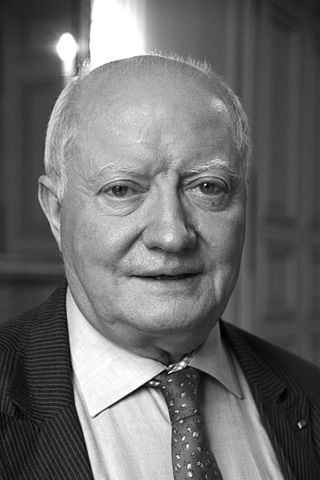
Jean-Paul Costa was a French jurist and was the President of the European Court of Human Rights from 19 January 2007 until his term at the Court ended on 3 November 2011. He was first appointed a judge of the Court on 1 November 1998,and in 2009 was elected to serve an additional three years as President.

Róbert Ragnar Spanó is an Icelandic-Italian jurist,judge,and former president of the European Court of Human Rights. He has been a partner at the multinational law firm of Gibson,Dunn &Crutcher since the end of this tenure as president of the court in October 2022. He started his tenure as president of the court on 18 May 2020,succeeding Judge Sicilianos from Greece. Before beginning his service on the court on 1 November 2013,he served provisionally as parliamentary ombudsman of Iceland and dean of the Faculty of Law,University of Iceland. Spano's mandate as a judge and president of the court ended on 31 October 2022 when he was succeeded by Judge Siofra O'Leary.

Guido Raimondi is an Italian judge born in Naples and former judge and President of the European Court of Human Rights (ECHR). Raimondi was nominated to the court by Italy and began his 9-year term as ECHR judge on 5 May 2010. He was the president of ECHR from 1 November 2015 until 4 May 2019.
Nebojša Vučinić is a Montenegrin judge born in Cetinje,Montenegro,and was the judge of the European Court of Human Rights in respect of Montenegro until July 2018.
Paulo Pinto de Albuquerque is a Portuguese judge born in Beira,Mozambique and was the judge of the European Court of Human Rights in respect of Portugal from April 2011 to March 2020.
Lorraine Schembri Orland is a Maltese judge at the European Court of Human Rights.
Síofra O’Leary is an Irish lawyer and judge who served as president of the European Court of Human Rights from November 2022 to July 2024 and as a judge of the European Court of Human Rights since July 2015. She previously served as a vice-president of the European Court of Human Rights in 2022.
The Judiciary of Cambodia is independent from the rest of the government of Cambodia,as specified by the Cambodian Constitution. The judiciary follows civil law tradition,the instruction being entrusted to a judge and the prosecutors contenting themselves with requesting the application of the law.
Anja Seibert-Fohr is a German jurist who serves as a judge at the European Court of Human Rights.

Gabriele Kucsko-Stadlmayer is a jurist and a current judge of the European Court of Human Rights for Austria.
Ksenija Turković is a Croatian jurist and current vice-president and was judge at the European Court of Human Rights (ECHR).
Azerbaijan has been a member of the Council of Europe,an international organization that focuses on strengthening democracy and human rights,since 2001. As a member,it has attracted attention for holding political prisoners,low implementation of verdicts of the European Court of Human Rights (ECtHR),and bribing Council of Europe parliamentarians to suppress negative information about its human rights record. In 2017,the Committee of Ministers launched the first ever infringement proceeding against Azerbaijan after it refused to release opposition politician Ilgar Mammadov after a 2014 ECtHR verdict that his imprisonment was unlawful. There has also been criticism of Azerbaijan's continued membership by those who believe its lack of human rights protection undermines the credibility of the Council of Europe.
Andreas Zünd,is a Swiss jurist who has served as a judge at the European Court of Human Rights since 2021.

Carlo Ranzoni is a Swiss jurist and judge at the European Court of Human Rights,representing the Principality of Liechtenstein.
Marko Bošnjak is a Slovenian jurist,judge of the European Court of Human Rights,attorney and academic. He has worked as a researcher and lecturer before becoming an attorney and subsequently a judge. Bošnjak’s mandate as a judge at the European Court of Human Rights began on 30 May 2016. In 2024,he became the President of the Court.

