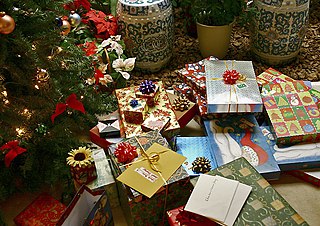
A gift or a present is an item given to someone, without the expectation of payment or anything in return. An item is not a gift if that item is already owned by the one to whom it is given. Although gift-giving might involve an expectation of reciprocity, a gift is meant to be free. In many countries, the act of mutually exchanging money, goods, etc. may sustain social relationship and contribute to social cohesion. Economists have elaborated the economics of gift-giving into the notion of a gift economy. By extension, the term gift can refer to any item or act of service that makes the other happier or less sad, especially as a favour, including forgiveness and kindness. Gifts are often presented on occasions such as birthdays and holidays.

Owatonna is a city and the county seat of Steele County, Minnesota, United States. The population was 26,420 at the 2020 census. Owatonna is home to the Steele County Fairgrounds, which hosts the Steele County Free Fair in August.
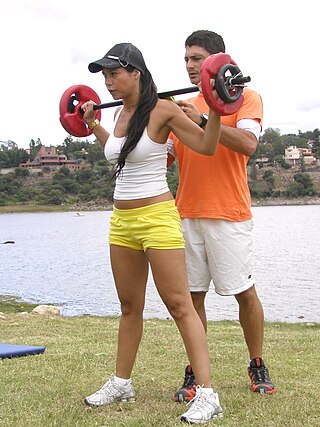
Shorts are a garment worn over the pelvic area, circling the waist and splitting to cover the upper part of the legs, sometimes extending down to the knees but not covering the entire length of the leg. They are called "shorts" because they are a shortened version of trousers, which cover the entire leg, but not the foot. Shorts are typically worn in warm weather or in an environment where comfort and airflow are more important than the protection of the legs.

Overalls or bib-and-brace overalls, also called dungarees in British English, are a type of garment usually used as protective clothing when working. The garments are commonly referred to as a "pair of overalls" by analogy with "pair of trousers".

Bell-bottoms are a style of trousers that become wider from the knees downward, forming a bell-like shape of the trouser leg.

Chaps are sturdy coverings for the legs consisting of leggings and a belt. They are buckled on over pants with the chaps' integrated belt, but unlike trousers, they have no seat and are not joined at the crotch. They are designed to provide protection for the legs and are usually made of leather or a leather-like material. Their name is a shortened version of the Spanish word chaparajos. Chaparajos were named after the chaparral, from which they were designed to protect the legs while riding on horseback. Like much of western American horse culture, the origin of chaparajos was in the south of Spain, from which it then passed on to the part of New Spain that later became Mexico, and has been assimilated into cowboy culture of the American West. They are a protective garment to be used when riding a horse through brushy terrain. In the modern world, they are worn for both practical work purposes and for exhibition or show use. Chaps have also been adopted for use on motorcycles, particularly by cruiser-style motorcycle riders.

Hallaca is a traditional Venezuelan dish. Its origin is indigenous, but raisins, capers, olives, and sometimes bits of bacon were added in the 16th Century and after by settlers from the Iberian peninsula. Hallaca consists of corn dough stuffed with a stew of beef, pork, or chicken and other ingredients such as raisins, capers, and olives, fresh onion rings, red and green bell pepper slices. There are vegetarian hallacas, made with black beans or tofu. Hallacas are folded in plantain leaves, tied with strings, and boiled. The dish is traditionally served during the Christmas season and has several regional variants. It has been described as a national dish of Venezuela. Some speculate it originated from the Orinoquia. Characteristic of the hallaca is the delicate corn dough made with consommé or broth, and lard colored with annatto. Hallacas are also commonly eaten in eastern Cuba, Trinidad where it is called pastelle, and parts of Colombia, Ecuador, Aruba, and Curaçao.
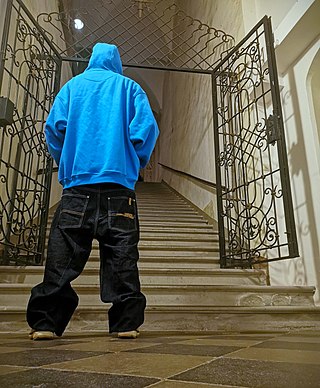
Sagging is a manner of wearing trousers that sag so that the top of the trousers or jeans is significantly below the waist, sometimes revealing much of the wearer's underpants.

A cuff is a layer of fabric at the lower edge of the sleeve of a garment at the wrist, or at the ankle end of a trouser leg. The function of turned-back cuffs is to protect the cloth of the garment from fraying, and, when frayed, to allow the cuffs to be readily repaired or replaced, without changing the garment. Cuffs are made by turning back (folding) the material, or a separate band of material can be sewn on, or worn separately, attached either by buttons or studs. A cuff may display an ornamental border or have lace or some other trimming. In US usage, the word trouser cuffs refers to the folded, finished bottoms of the legs of a pair of trousers. In the UK, while this usage is now sometimes followed, the traditional term for the turned up trouser hem is 'turnup'.

The Yule goat is a Scandinavian and Northern European Yule and Christmas symbol and tradition. Its origin is from Germanic paganism and has existed in many variants during Scandinavian history. Modern representations of the Yule goat are typically made of straw.
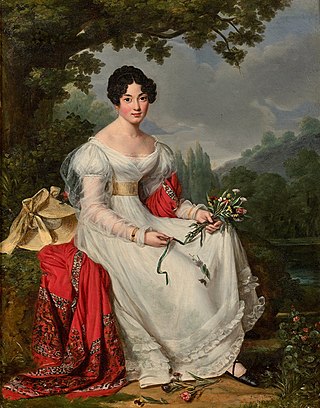
During the 1820s in European and European-influenced countries, fashionable women's clothing styles transitioned away from the classically influenced "Empire"/"Regency" styles of c. 1795–1820 and re-adopted elements that had been characteristic of most of the 18th century, such as full skirts and clearly visible corseting of the natural waist.
The Amazing Adrenalini Brothers is a Flash animated television series created by Dan Chambers, Mark Huckerby, and Nick Ostler. Starting off as online shorts in 2002, it was eventually commissioned as a full series by CITV and Cartoon Network in the United Kingdom, S4C in Wales, YTV and VRAK.TV in Canada. It is an international co-production between UK studio Pesky and Studio B Productions in Vancouver, British Columbia. A total of 26 episodes were produced.

A practical joke or prank is a trick played on people or people, generally causing the victim to experience embarrassment, perplexity, confusion, or discomfort. The perpetrator of a practical joke is called a "practical joker" or "prankster". Other terms for practical jokes include gag, rib, jape, or shenanigan. Some countries in western nations make it tradition to carry out pranks on April Fools' Day and Mischief Night.

Slim-fit pants or skinny jeans are tight trousers that have a snug fit through the legs and end in a small leg opening that can be anywhere from 9" to 20" in circumference, depending on size. Other names for this style include drainpipes, stovepipes, tight pants, cigarette pants, pencil pants, skinny pants, gas pipes, skinnies, and tight jeans.
Pantsing, also known as depantsing, debagging, dacking, flagging, sharking, and scanting, is the act of pulling down a person's trousers and sometimes underpants, usually against their wishes, and typically as a practical joke or a form of bullying, but in other instances as a sexual fetish.

April Fools' Day or All Fools' Day is an annual custom on 1 April consisting of practical jokes and hoaxes. Jokesters often expose their actions by shouting "April Fools!" at the recipient. Mass media can be involved with these pranks, which may be revealed as such the following day. The custom of setting aside a day for playing harmless pranks upon one's neighbour has been relatively common in the world historically.

Gift wrapping is the act of enclosing a gift in some sort of material. Wrapping paper is a kind of paper designed for gift wrapping. An alternative to gift wrapping is using a gift box or bag. A wrapped or boxed gift may be held closed with ribbon and topped with a decorative bow.

Trousers, slacks, or pants are an item of clothing worn from the waist to anywhere between the knees and the ankles, covering both legs separately. In the United Kingdom, the word pants generally means underwear and not trousers. Shorts are similar to trousers, but with legs that come down only to around the area of the knee, higher or lower depending on the style of the garment. To distinguish them from shorts, trousers may be called "long trousers" in certain contexts such as school uniform, where tailored shorts may be called "short trousers" in the UK.

Low-rise is a style of clothing designed to sit low on, or below, the hips. The style can also be called lowcut, hipster, or hip-hugger, and can apply to garments worn by males or females. The term can be applied to all garments that cover the wearer's crotch area, including trousers, jeans, shorts, skirts, panties, briefs, bikinis, pantyhose, and tights.

Christmas in Mexico is observed from December 12 to January 6, with one additional celebration on February 2. Traditional decorations displayed on this holiday include nativity scenes, poinsettias, and Christmas trees. The season begins with celebrations related to the Virgin of Guadalupe, the Patroness of Mexico, followed by traditions such as Las Posadas and Pastorelas.


