Related Research Articles
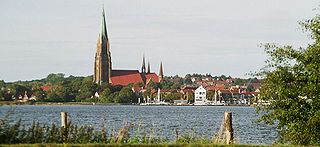
Schleswig is a town in the northeastern part of Schleswig-Holstein, Germany. It is the capital of the Kreis (district) Schleswig-Flensburg. It has a population of about 27,000, the main industries being leather and food processing. It takes its name from the Schlei (Slien), an inlet of the Baltic Sea at the end of which it sits, and vik or vig which means "bay" in Old Norse and Danish. Schleswig or Slesvig therefore means "bay of the Schlei".
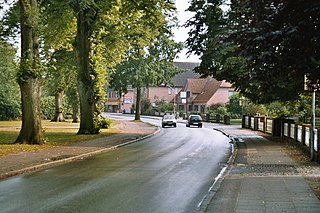
Trittau is a municipality in Schleswig-Holstein, Germany, located 30 km east of Hamburg. It is the economical and administrative center of Amt Trittau, which is part of the Stormarn district. Other villages in the county are Grönwohld, Lütjensee, Großensee, Rausdorf and Grande.

Norddeutscher Rundfunk, commonly shortened to NDR, is a public radio and television broadcaster, based in Hamburg. In addition to the city-state of Hamburg, NDR broadcasts for the German states of Lower Saxony, Mecklenburg-Vorpommern and Schleswig-Holstein. NDR is a member of the ARD organisation.

Schönkirchen is a municipality in the district of Plön, in Schleswig-Holstein, Germany.

The Duchy of Holstein was the northernmost state of the Holy Roman Empire, located in the present German state of Schleswig-Holstein. It originated when King Christian I of Denmark had his County of Holstein-Rendsburg elevated to a duchy by Emperor Frederick III in 1474. Members of the Danish House of Oldenburg ruled Holstein – jointly with the Duchy of Schleswig – for its entire existence.

Schülp bei Rendsburg is a municipality in the district of Rendsburg-Eckernförde, in Schleswig-Holstein, Germany.
Holstein-Glückstadt or Schleswig-Holstein-Glückstadt is the historiographical name, as well as contemporary shorthand name, for the parts of the duchies of Schleswig and Holstein that were ruled by the Kings of Denmark in their function as dukes of Schleswig and Holstein, thus also known as Royal Schleswig-Holstein. Other parts of the duchies were ruled by the Dukes of Schleswig-Holstein-Gottorp. The territories of Holstein-Glückstadt are located in present-day Denmark and Germany. The main centre of administration was Segeberg and from 1648 Glückstadt on the River Elbe.

Princess Oskar of Prussia, Countess of Ruppin was a German aristocrat and the wife of Prince Oskar of Prussia.

The House Order of Albert the Bear was founded in 1836 as a joint House Order by three dukes of Anhalt from separate branches of the family: Henry, Duke of Anhalt-Köthen, Leopold IV, Duke of Anhalt-Dessau, and Alexander Karl, Duke of Anhalt-Bernburg.

The Evangelical Lutheran Church in Northern Germany is a Lutheran member church of the Protestant Church in Germany.
Johann Georg Rist was a Danish author, diplomat and statesman, originally from Holstein.
Countess Sabine Elisabeth Oelgard von Bassewitz was a German writer.
Joachim Otto von Bassewitz or Bassewiß was a statesman and politician from the Holy Roman Empire. He was a Geheimrat of Holstein-Gottorp, president of the chamber and bailiff (amtmann) at Kiel.
The Schleswig-Holsteinische Wörterbuch is a regional dictionary of the Low German language in the dialects used in the state of Schleswig-Holstein i.e. Schleswig, Holsteinish and Hamburger Platt and their sub-dialects. The publisher and co-editor was the Germanist, Otto Mensing.
Rudolf Bülck was a German librarian.

Ingo Kühl is a German painter, sculptor and architect.

Johann Casimir Benicken was a jurist and judge from the Duchy of Schleswig who also took an interest in the birds and natural history of the region. He was also a city secretary for the city of Schleswig, Duchy of Schleswig.
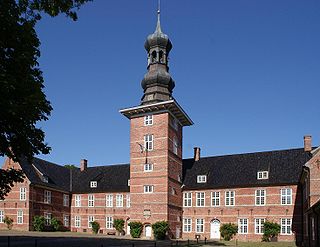
The Castle in front of Husum, originally named due to its location in front of the city boundaries when it was built, is situated in Husum, in the district of North Frisia in the state of Schleswig-Holstein. It was initially a secondary residence of the ducal house of Schleswig-Holstein-Gottorf and served as an occasional residence for the Danish royal family during the 18th and 19th centuries. It also accommodated administrative offices, which gradually expanded and eventually occupied most of the building after 1864. These offices remained there until the 20th century, and the castle came to be known as the "royal palace".

Reinbek Castle, located in Reinbek in southern Schleswig-Holstein, was built in the 16th century as a secondary residence for the ducal house of Schleswig-Holstein-Gottorf. It is one of the oldest buildings from the reign of Duke Adolf I and is regarded as the best example of the Renaissance style in Schleswig-Holstein. The castle was restored from 1977 to 1987 and now serves as an art and cultural center for the town of Reinbek.
References
- 1 2 3 4 5 6 Emil Julius Hugo Steffenhagen (1875), "Arpe, Peter Friedrich", Allgemeine Deutsche Biographie (in German), vol. 1, Leipzig: Duncker & Humblot, pp. 608–609
- ↑ (in German) Karl Heinz Jügelt in Deutsch-dänischer Kulturtransfer Im 18. Jahrhundert von York-Gothart Mix, Carsten Zelle, Wolfenbüttel 2001, S. 287 Google Books
- ↑ (in German) Johann Anselm Steiger (ed.) 500 Jahre Theologie in Hamburg: Hamburg als Zentrum Christlicher Theologie, Berlin, 2003, S.102f. Google Books
- 1 2 (in German) Hubertus Neuschäffer, Henning Friedrich Graf von Bassewitz, Schwerin 1999
- ↑ (in German) Robert Pries: Das geheime Regierungs-Conseil in Holstein Gottorf 1716-1773, Neumünster, 1955
| International | |
|---|---|
| National | |
| Academics | |
| People | |
| Other | |
