
Vitoria-Gasteiz is the seat of government and the capital city of the Basque Country and of the province of Álava in northern Spain. It holds the autonomous community's House of Parliament, the headquarters of the Government, and the Lehendakari's official residency. The municipality—which comprises not only the city but also the mainly agricultural lands of 63 villages around—is the largest in the Basque Country, with a total area of 276.81 square kilometres (106.88 sq mi), and it has a population of 253,093. The dwellers of Vitoria-Gasteiz are called vitorianos or gasteiztarrak, while traditionally they are dubbed babazorros.
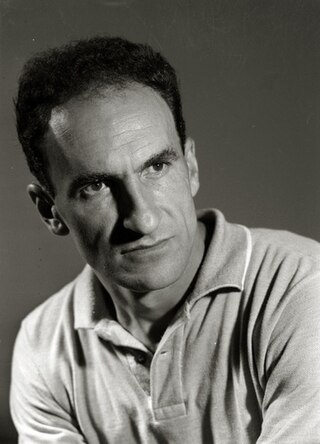
Eduardo Chillida Juantegui, or Eduardo Txillida Juantegi in Basque, was a Spanish Basque sculptor notable for his monumental abstract works.

Agurain is a town and municipality located in the province of Álava in the Basque Autonomous Community, northern Spain. The municipality, numbering 4,986 inhabitants (2015), is in turn the head town of the district or Cuadrilla of Salvatierra. The gross income per family amounts to 6,784 €. With reference to workforce by economic sectors, 10.36% are employed in agriculture, 35.78% in the industry sector, 47.92% in the service sector and 5.95% in the construction industry.

The University of the Basque Country is a Spanish public university of the Basque Autonomous Community.

Miranda de Ebro is a city on the Ebro river in the province of Burgos in the autonomous community of Castile and León, Spain. It is located in the north-eastern part of the province, on the border with the province of Álava and the autonomous community of La Rioja. According to the 2008 census conducted by Spain's National Institute of Statistics, it has a population of 39,589 inhabitants, making it the second most populous city in the province after the capital, Burgos.

The Treviño Enclave in northern Spain is part of the territory of the province of Burgos, but is completely surrounded by the territory of the Basque Country province of Álava. Thus, it is an enclave of the Basque Country and an exclave of Castile and León. It consists of two municipalities—Condado de Treviño and La Puebla de Arganzón—and is part of the Judicial district of Miranda de Ebro in the province of Burgos.

Abetxuko is a neighborhood and concejo in the municipality of Vitoria-Gasteiz in Álava, Basque Country, Spain. It is located north of the Zadorra river, which separates it from the rest of the city.

Antezana or Andetxa is a hamlet and concejo located in the municipality of Vitoria-Gasteiz, in Álava province, Basque Country, Spain. It is located next to the terminal of Vitoria Airport, so it has good access via expressways.
Tourism in the Basque Autonomous Community has increased considerably in recent years, and is a popular destination for tourists from Spain and France. According to data from the Eustat the number of tourists entering the region in the year 2009 was 1,991,790, with the final result still pending. 71% of the yearly visitors come from the rest of Spain; the greatest number from Madrid Autonomous Community (14.2%), and Catalonia (11.1%). International visitors make up the remaining 29% - the largest percent come from France (7.2%). 62% of the people who come to the Basque Autonomous Community visit one of the three capitals, 27% visit inland and 11% visit the coast. The average stay of the visitors is 2 days.

The Museum of Contemporary Art of the Basque Country-Artium Museoa is a contemporary art museum located in Vitoria-Gasteiz, the capital of the province of Álava in northern Spain. Designed by the architect José Luis Caton, it is owned by the Provincial Council of Álava and opened 26 April 2002 and its director is Daniel Castillejo. The Museum was a created by the initiative of the Provincial Council of Alava, which is the owner of most of the works that are in the museum, and it's the owner of the building too. The aim of this museum is to develop the critical view of the society and to make Alava be associated with art and culture.

The Fiestas de la Virgen Blanca have been celebrated every year, since 1884. It is held on 5 August, but the celebrations begin the day before, on the 4th, and end on 9 August. It honours the patron saint of the city, and features a programme of special events, activities and free open-air concerts.
Celedón is a character central to the Virgen Blanca Festivities of Vitoria-Gasteiz, in the Basque province of Álava in Spain. He is portrayed wearing a beret and dressed in a traditional blouse, always carrying an umbrella.

The sequoia of Vitoria-Gasteiz was an individual sequoia tree located in Vitoria-Gasteiz, the capital city of the Basque Country, Spain. It was declared a singular tree by the Basque Government in 1995 and died in 2014.

The festival of San Prudencio, in the city of Vitoria-Gasteiz, Álava, Spain, is held around the saint's feast day. Due to its popularity, the city organizes a number of activities. The festival begins on 27 April in Plaza de la Diputación, where a stage is prepared for the traditional Basque dance groups.

The Museum of Fine Arts of Álava is located in Vitoria-Gasteiz, the capital of the Basque Country, Spain. The museum is dedicated to Spanish art from the 18th to the 20th century, and particularly to Basque art from the 1850–1950 period. Opened in 1942, it is located at the Augustin Zulueta Palace.
Luis Peña Ganchegui was a Spanish architect. He is considered one of the first to introduce contemporary architecture to Spain.

Errekaleor is a neighbourhood on the periphery of Vitoria-Gasteiz, in the Basque Country, Spain. It sits on the plateau created by the Errekaleor river, which is part of the Green Belt of Vitoria-Gasteiz. From 2013 onwards, the area was occupied by squatters and became known as Errekaleor Bizirik. The project is based on the principles of workers' self-management, consensus based decision making, feminism, anti-capitalism and Basque cultural re-invigoration. The neighbourhood is the largest occupied space of its type on the Iberian Peninsula, with over 10 hectares of land and 150 inhabitants. Residents include children, the elderly, blue-collar workers, the unemployed, students, and teachers. The project includes an organic farm of 2 hectares, a bakery, a bar, a social centre, a library, a theatre, a free shop, a recording studio, and other projects.
The Betoño Sports Complex, also known as El Glorioso, is a football training ground and match venue located in the city of Vitoria-Gasteiz, Álava.
The Ciudad Deportiva José Luis Compañón, also known as Instalaciones de Ibaia after the name of its semi-rural location, is the primary training ground of Spanish professional football club Deportivo Alavés, located in the city of Vitoria-Gasteiz, Álava.

The Lantern Museum is located in Vitoria-Gasteiz, Álava, Basque Country, Spain. It houses the lanterns used in the Rosary of the Lanterns procession, celebrated every 4th of August during the Virgen Blanca Festivities.

