
Look up pocketbook in Wiktionary, the free dictionary.
Pocketbook may refer to:
Pocketbook may refer to:

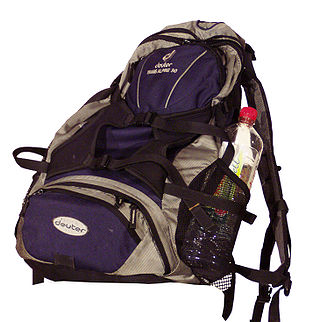
A backpack—also called knapsack, schoolbag, rucksack, pack, booksack, bookbag, haversack, packsack, or backsack—is, in its simplest frameless form, a fabric sack carried on one's back and secured with two straps that go over the shoulders; but it can have an external or internal frame, and there are bodypacks.
A paperback book is one with a thick paper or paperboard cover, and often held together with glue rather than stitches or staples. In contrast, hardback (hardcover) books are bound with cardboard covered with cloth, leather, paper, or plastic.
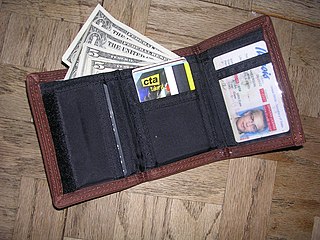
A wallet is a flat case or pouch, often used to carry small personal items such as physical currency, debit cards, and credit cards; identification documents such as driving licence, identification card, club card; photographs, transit pass, business cards and other paper or laminated cards. Wallets are generally made of fabric or leather, and they are usually pocket-sized and foldable.

Pocket Books is a division of Simon & Schuster that primarily publishes paperback books.

A handbag, commonly known as a purse in North American English, is a handled medium-to-large bag used to carry personal items. It has also been called a pocketbook in parts of the U.S.
Pouch may refer to:

A waist bag, fanny pack, belt bag, moon bag, belly bag, or bumbag is a small fabric pouch worn like a belt around the waist by use of a strap above the hips that is secured usually with some sort of buckle. The straps sometimes have tri-glide slides, making them adjustable in order to fit properly. It can be considered as a purse worn around the waist.

Book design is the art of incorporating the content, style, format, design, and sequence of the various components and elements of a book into a coherent unit. In the words of renowned typographer Jan Tschichold (1902–1974), book design, "though largely forgotten today, [relies upon] methods and rules upon which it is impossible to improve, [and which] have been developed over centuries. To produce perfect books, these rules have to be brought back to life and applied". Richard Hendel describes book design as "an arcane subject", and refers to the need for a context to understand what that means.
A pocket is a bag- or envelope-like receptacle, most commonly in clothing.

A purse or pouch, sometimes called coin purse for clarity, is a small money bag or pouch, made for carrying coins. In most Commonwealth countries it is known simply as a purse, while "purse" in the United States usually refers to a handbag. An obsolete variant is a porte-monnaie. "Purse" can also be a synonym to bursary, i.e. a monetary prize in a competition.
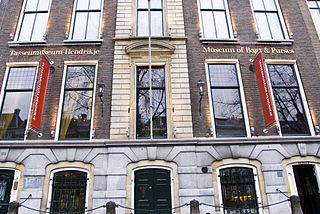
The Museum of Bags and Purses, was a museum devoted to the history of bags, purses, and their related accessories. Located in Amsterdam's historic central canal belt, the museum's collection included over 5,000 items dating back to the sixteenth-century.
A purse is a small bag that may refer to:

A money bag is a bag normally used to hold and transport coins and banknotes, often closed with a drawstring. When transported between banks and other institutions, money bags are usually moved in armored cars or money trains. It is a type of currency packaging. Money bags are often portrayed in cartoons and other light popular culture.
Tagalog romance novels, sometimes collectively referred to as Tagalog pocketbooks, Tagalog paperbacks, Tagalog romance paperbacks, Tagalog romance pocketbooks, Philippine romance novels, Filipino romance novels, Pinoy pocketbooks, Tagalog popular novels, or Tagalog popular romance literature are commercialized novels published in paperback or pocketbook format published in the Tagalog or the Filipino language in the Philippines. Unlike the formal or literary romance genre, these popular romance novels were written, as described by Dominador Buhain in the book A History of Publishing in the Philippines as a form of traditional or conventional romance stories of "rich boy meets poor girl or vice versa who go through a series of obstacles and finally end up in each other's arms".

A bag is a common tool in the form of a non-rigid container, typically made of cloth, leather, bamboo, paper, or plastic. The use of bags predates recorded history, with the earliest bags being lengths of animal skin, cotton, or woven plant fibers, folded up at the edges and secured in that shape with strings of the same material. Bags can be used to carry items such as personal belongings, groceries, and other objects. They come in various shapes and sizes, often equipped with handles or straps for easier carrying.

A shell purse is a type of coin purse that is made from whole or trimmed mollusk shells, especially from bivalve mollusc shells. These purses are of mainly novelty use and purchased as souvenirs of visits, etc. In the past, some were engraved or painted with floral or other decorations, sentimental messages, personal or place names. In many cases there was extra working of the shell, either grinding down and polishing to expose the mother of pearl or filing to form patterns such as criss-cross designs.

A reticule, also known as a ridicule or indispensable, was a type of small handbag or purse, similar to a modern evening bag, used mainly from 1795 to 1820.
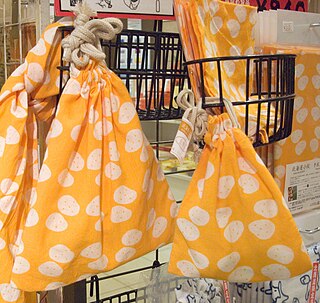
Kinchaku is a traditional Japanese drawstring bag, used like a handbag for carrying around personal possessions; smaller ones are usually used to carry loose coinage, cosmetics, lucky charms, hand warmers and other small items. Larger versions can be used to carry bento and utensils, as well as other larger possessions. The bags traditionally carried by maiko and geisha are a variant on kinchaku, and are called kago (篭) after their woven basket base.

Bruce Purse is an American musician, composer, producer, vocalist, bandleader, arranger, performer, music educator, and guest lecturer. Proficient at various wind instruments, including the trumpet, pocket trumpet, bass trumpet, and flugelhorn, Purse has performed with many well known artists, such as Lester Bowie, Amy Winehouse, Jennifer Hudson, Alicia Keys, Faith Evans, Nas, Leona Lewis, and Johnny Kemp. He has also assembled large ensembles from a 11-piece bands to 30 piece orchestras, including his premiere ensemble called Bruce Purse and the Pocketbooks. The band performs originals in various genres such as; jazz, reggae, R&B, and heavy blues.
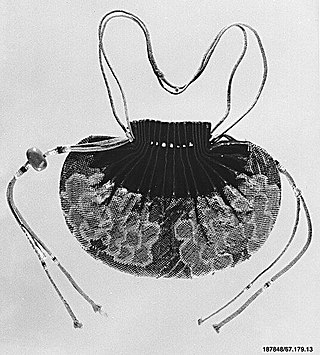
Hebao, sometimes referred as Propitious pouch in English, is a generic term used to refer to Chinese embroidery pouches, purses, or small bags. When they are used as Chinese perfume pouch, they are referred as xiangnang, xiangbao, or xiangdai. In everyday life, hebao are used to store items. In present-days China, xiangbao are still valued traditional gifts or token of fortune. Xiangbao are also used in Traditional Chinese medicine.