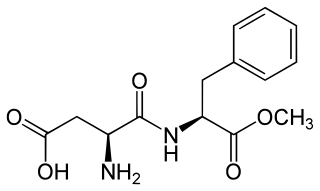
Aspartame is an artificial non-saccharide sweetener 200 times sweeter than sucrose and is commonly used as a sugar substitute in foods and beverages. It is a methyl ester of the aspartic acid/phenylalanine dipeptide with brand names NutraSweet, Equal, and Canderel. Aspartame was approved by the US Food and Drug Administration (FDA) in 1974, and then again in 1981, after approval was revoked in 1980.

Stevia is a sweet sugar substitute that is about 50 to 300 times sweeter than sugar. It is extracted from the leaves of Stevia rebaudiana, a plant native to areas of Paraguay and Brazil in the southern Amazon rainforest. The active compounds in stevia are steviol glycosides. Stevia is heat-stable, pH-stable, and not fermentable. Humans cannot metabolize the glycosides in stevia, and therefore it has zero calories. Its taste has a slower onset and longer duration than that of sugar, and at high concentrations some of its extracts may have an aftertaste described as licorice-like or bitter. Stevia is used in sugar- and calorie-reduced food and beverage products as an alternative for variants with sugar.

Sucralose is an artificial sweetener and sugar substitute. As the majority of ingested sucralose is not metabolized by the body, it adds very little food energy. In the European Union, it is also known under the E number E955. It is produced by chlorination of sucrose, selectively replacing three of the hydroxy groups—in the C1 and C6 positions of the fructose portion and the C4 position of the glucose portion—to give a 1,6-dichloro-1,6-dideoxyfructose–4-chloro-4-deoxygalactose disaccharide. Sucralose is about 600 times sweeter than sucrose, 3 times as sweet as both aspartame and acesulfame potassium, and 2 times as sweet as sodium saccharin.

Fructose, or fruit sugar, is a ketonic simple sugar found in many plants, where it is often bonded to glucose to form the disaccharide sucrose. It is one of the three dietary monosaccharides, along with glucose and galactose, that are absorbed by the gut directly into the blood of the portal vein during digestion. The liver then converts both fructose and galactose into glucose, so that dissolved glucose, known as blood sugar, is the only monosaccharide present in circulating blood.

A sugar substitute is a food additive that provides a sweetness like that of sugar while containing significantly less food energy than sugar-based sweeteners, making it a zero-calorie or low-calorie sweetener. Artificial sweeteners may be derived through manufacturing of plant extracts or processed by chemical synthesis. Sugar substitute products are commercially available in various forms, such as small pills, powders, and packets.
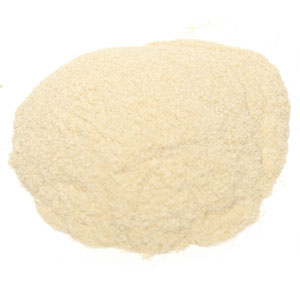
Pectin is a heteropolysaccharide, a structural polymer contained in the primary lamella, in the middle lamella, and in the cell walls of terrestrial plants. The principal chemical component of pectin is galacturonic acid which was isolated and described by Henri Braconnot in 1825. Commercially produced pectin is a white-to-light-brown powder, produced from citrus fruits for use as an edible gelling agent, especially in jams and jellies, dessert fillings, medications, and sweets; as a food stabiliser in fruit juices and milk drinks, and as a source of dietary fiber.

Food coloring, color additive or colorant is any dye, pigment, or substance that imparts color when it is added to food or beverages. Colorants can be supplied as liquids, powders, gels, or pastes. Food coloring is commonly used in commercial products and in domestic cooking.

Xylitol is a chemical compound with the formula C
5H
12O
5, or HO(CH2)(CHOH)3(CH2)OH; specifically, one particular stereoisomer with that structural formula. It is a colorless or white crystalline solid that is freely soluble in water. It is classified as a polyalcohol and a sugar alcohol, specifically an alditol. The name derives from Ancient Greek: ξύλον, xyl[on] 'wood', with the suffix -itol used to denote it being a sugar alcohol.

Neohesperidin dihydrochalcone, sometimes abbreviated to neohesperidin DC or simply NHDC, is an artificial sweetener derived from citrus.

Stearic acid is a saturated fatty acid with an 18-carbon chain. The IUPAC name is octadecanoic acid. It is a soft waxy solid with the formula CH3(CH2)16CO2H. The triglyceride derived from three molecules of stearic acid is called stearin. Stearic acid is a prevalent fatty-acid in nature, found in many animal and vegetable fats, but is usually higher in animal fat than vegetable fat. It has a melting point of 69.4 °C (156.9 °F) °C and a pKa of 4.50.

Sunset yellow FCF is a petroleum-derived orange azo dye with a pH-dependent maximum absorption at about 480 nm at pH 1 and 443 nm at pH 13, with a shoulder at 500 nm. When added to foods sold in the United States, it is known as FD&C Yellow 6; when sold in Europe, it is denoted by E Number E110.

Xanthan gum is a polysaccharide with many industrial uses, including as a common food additive. It is an effective thickening agent and stabilizer that prevents ingredients from separating. It can be produced from simple sugars by fermentation and derives its name from the species of bacteria used, Xanthomonas campestris.

Flavin mononucleotide (FMN), or riboflavin-5′-phosphate, is a biomolecule produced from riboflavin (vitamin B2) by the enzyme riboflavin kinase and functions as the prosthetic group of various oxidoreductases, including NADH dehydrogenase, as well as a cofactor in biological blue-light photo receptors. During the catalytic cycle, a reversible interconversion of the oxidized (FMN), semiquinone (FMNH•), and reduced (FMNH2) forms occurs in the various oxidoreductases. FMN is a stronger oxidizing agent than NAD and is particularly useful because it can take part in both one- and two-electron transfers. In its role as blue-light photo receptor, (oxidized) FMN stands out from the 'conventional' photo receptors as the signaling state and not an E/Z isomerization.

Allura Red AC, also known as FD&C Red 40 or E129, is a red azo dye commonly used in food. It was developed in 1971 by the Allied Chemical Corporation, who gave the substance its name.

Betanin, or beetroot red, is a red glycosidic food dye obtained from beets; its aglycone, obtained by hydrolyzing the glucose molecule, is betanidin. As a food additive, its E number is E162. As a food additive, betanin has no safety concerns.

Caramel color or caramel coloring is a water-soluble food coloring. It is made by heat treatment of carbohydrates (sugars), in general in the presence of acids, alkalis, or salts, in a process called caramelization. It is more fully oxidized than caramel candy, and has an odor of burnt sugar and a somewhat bitter taste. Its color ranges from pale yellow to amber to dark brown.

Polyglycerol polyricinoleate (PGPR), E476, is an emulsifier made from glycerol and fatty acids. In chocolate, compound chocolate and similar coatings, PGPR is mainly used with another substance like lecithin to reduce viscosity. It is used at low levels, and works by decreasing the friction between the solid particles in molten chocolate, reducing the yield stress so that it flows more easily, approaching the behaviour of a Newtonian fluid. It can also be used as an emulsifier in spreads and in salad dressings, or to improve the texture of baked goods. It is made up of a short chain of glycerol molecules connected by ether bonds, with ricinoleic acid side chains connected by ester bonds.
High-maltose corn syrup (HMCS) is a food additive used as a sweetener and preservative. The majority sugar is maltose. It is less sweet than high-fructose corn syrup and contains little to no fructose. It is sweet enough to be useful as a sweetener in commercial food production, however. To be given the label "high", the syrup must contain at least 50% maltose. Typically, it contains 40–50% maltose, though some have as high as 70%.

Added sugars or free sugars are sugar carbohydrates added to food and beverages at some point before their consumption. These include added carbohydrates, and more broadly, sugars naturally present in honey, syrup, fruit juices and fruit juice concentrates. They can take multiple chemical forms, including sucrose, glucose (dextrose), and fructose.
Hydroxypropyl starch is a type of modified starch used as a food additive. I has the E number E1440. Hydroxyl propyl starch is not absorbed intact by the gut, but are significantly hydrolyzed by intestinal enzymes and then fermented by intestinal microbiota.


