
Dalit is a term first coined by the Indian social reformer Jyotirao Phule for untouchables and outcasts, who represented the lowest stratum of the castes in the Indian subcontinent. Dalits were excluded from the fourfold varna of the caste hierarchy and were seen as forming a fifth varna, also known by the name of Panchama. Several scholars have drawn parallels between Dalits and the Burakumin of Japan, the Baekjeong of Korea and the peasant class of the medieval European feudal system.

Indian Institute of Management Bangalore is a reputed business school and an Institute of National Importance located in Bangalore, Karnataka, India. Founded in 1973, it was chronologically the third in the first generation of IIMs to be established, after IIM Calcutta and IIM Ahmedabad, thereby forming the elite Indian B-School trio colloquially known as 'ABC', or 'IIM A/B/C'.
The Other Backward Class (OBC) is a collective term used by the Government of India to classify communities that are "educationally or socially backward". It is one of several official classifications of the population of India, along with general castes, Scheduled Castes and Scheduled Tribes. The OBCs were found to comprise 52% of the country's population by the Mandal Commission report of 1980 and were determined to be 41% in 2006 when the National Sample Survey Organisation took place. There is substantial debate over the exact number of OBCs in India; it is generally estimated to be sizable, but many believe that it is higher than the figures quoted by either the Mandal Commission or the National Sample Survey.
Events in the year 1968 in the Federal Republic of India.

Madiga is a Telugu caste from southern India. They mainly live in the states of Andhra Pradesh, Telangana and Karnataka, with a small minority in Tamil Nadu. Madigas are historically associated with the work of tannery, leatherwork and small handicrafts. Today, most are agricultural labourers. They are categorized as a Scheduled Caste by the Government of India. Within the Madiga community, there are various sub-castes include Bindla they work mostly known to make shoes, Chindu They are nomadic performing caste, Chindus constantly travel to different villages and live with Madigas they can be identified as worshippers of Yellamma diety, Dakkali, Dakkala or Dakkali is the name of a class of mendicants who beg from Mādigas only, Mashti, a nomadic tribe with martial art skills has by and large gone unnoticed in this part of East Godavari. They are unknown to many beyond the district and deprived of any support from the authorities. They are known as ‘Mala Mashtis’, Sangaris they are known for making handicrafts and wood carving. The priestly class is known as Madiga Dasu they are associated with temple worships and have had a long history of being agricultural land owners they are also worshippers of Venkateswara or Narasimha dieties.

In India, a caste although it's a western stratification arrived from Portuguese word Casta and Latin word castus ,is a social group where membership is decided by birth. Broadly, Indian castes are divided into the Forward Castes, Other Backward Classes, Scheduled Castes, and Scheduled Tribes. Indian Christians and Indian Muslims are also function as castes. With castes separating individuals into different social groups, it follows that each group will have conflicting interests; oftentimes putting those with lower social standing in less favorable positions. An attempt to address this inequality has been the reservation system, which essentially acts as affirmative action to provide representation to caste groups that have been systematically disadvantaged. There have also been other cases where political parties, like the Bahujan Samaj Party (BSP), was formed to challenge the power of the upper castes.

Caste-related violence in India has occurred and continues to occur in various forms.

Chockalingam Raj Kumar is an Indian academic administrator who is the Founding Vice-Chancellor of O.P. Jindal Global University in Sonipat, Haryana, India, and the Dean of the Jindal Global Law School.

Dinesh Gundu Rao is an Indian politician of Indian National Congress from Karnataka. He is serving as the Minister for Health and Family Welfare in the Government of Karnataka. He is also the Incharge of All India Congress Committee of Tamil Nadu and Puducherry. He was the President of Karnataka Pradesh Congress Committee and the member of Karnataka Legislative Assembly.
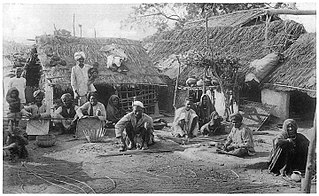
Achieving Universal Health Care has been a key goal of the Indian Government since the Constitution was drafted. The Government has since launched several programs and policies to realize ‘Health for All’ in the nation. These measures are in line with the sustainable development goals set by the United Nations. Health disparities generated through the Hindu caste system have been a major roadblock in realizing these goals. The Dalit (untouchables) community occupies the lowest stratum of the Hindu caste system. Historically, they have performed menial jobs like - manual scavenging, skinning animal hide, and sanitation. The Indian constitution officially recognizes the Dalit community as ‘Scheduled Castes’ and bans caste-based discrimination of any form. However, caste and its far-reaching effects are still prominent in several domains including healthcare. Dalits and Adivasis have the lowest healthcare utilization and outcome percentage. Their living conditions and occupations put them at high risk for disease exposure. This, clubbed with discrimination from healthcare workers and lack of awareness makes them the most disadvantaged groups in society.
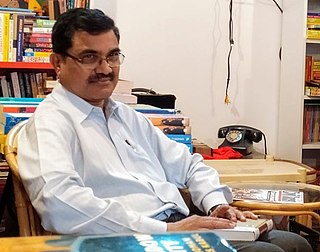
Anand Teltumbde is an Indian scholar, writer, and human rights activist who is a management professor at the Goa Institute of Management. He has written extensively about the caste system in India and has advocated for the rights of Dalits.

Ravish Kumar is an Indian journalist, author, media personality and YouTuber. He was the Senior Executive Editor of NDTV India. He hosted a number of programmes including the channel's flagship weekday show Prime Time, Hum Log, Ravish Ki Report, and Des Ki Baat.

Pa. Ranjith is an Indian film director, film producer and screenwriter who primarily works in Tamil cinema. He made his directorial debut with the 2012 romantic comedy Attakathi, before earning positive reviews for his second film, the political action-drama Madras (2014). He wrote and directed the action-drama films Kabali in 2016 and Kaala in 2018, both starring Rajinikanth.
Events in the year 2018 in the Republic of India.
The J. H. Patel cabinet was the Council of Ministers in the Indian state of Karnataka headed by Chief minister J. H. Patel that was formed after the 1994 Karnataka Legislative Assembly elections.

The Ramnath Goenka Excellence in Journalism Awards are one of the awards in India in the field of journalism. Named after Ramnath Goenka, the awards have been held annually since 2006, with the 12th edition being held in 2017. The awards are given for both print journalism as well as broadcast journalism, with a total of 25 different prizes being awarded in 2017 for excellence in journalism during 2016. In Fact Indian Express group started, Ramnath Goenka India Press Photo Award in 2004. This award was only for media photographers and the winners was announced in December 2004 at Nariman House, Express tower in Mumbai and Photo Journalist Shailendra Pandey won The First Picture of the year award.
Rajputs in Bihar are members of the Rajput community living in the eastern Indian state of Bihar. They traditionally formed part of the feudal elite in Bihari society. Rajputs were pressed with the Zamindari abolition and Bhoodan movement in post-independence India; along with other Forward Castes, they lost their significant position in Bihar's agrarian society, leading to the rise of Other Backward Classes (OBCs).
Dalit music or Bahujan music is music created, produced, or inspired by Bahujans and Dalits, people often discriminated against on the basis of caste, including Dalit rock, Bhim rap and Dalit pop as well as the music genres of the Ravidasis, including Chamar pop, Bhim Palana, Bhim geet and Punjabi Ambedkarite music.
Two tumbler system or Double tumbler system is a practice of discrimination against Dalits where Dalits are not allowed to drink in the same tumblers used by members of caste. Tea store owners maintain separate cups for Dalits and members of caste. The practice is prevalent in parts of Tamil Nadu, Karnataka and Andhra Pradesh.

