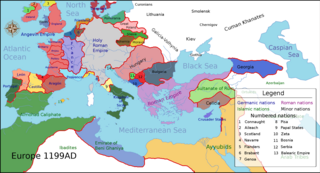
Year 1199 (MCXCIX) was a common year starting on Friday of the Julian calendar.

The Principality or, from 1253, Kingdom of Galicia–Volhynia, also known as the Kingdom of Ruthenia, was a medieval state in Eastern Europe which existed from 1199 to 1349. Its territory was predominantly located in modern-day Ukraine, with parts in Belarus, Poland, Moldova, and Lithuania. Along with Novgorod and Vladimir-Suzdal, it was one of the three most important powers to emerge from the collapse of Kievan Rus'.
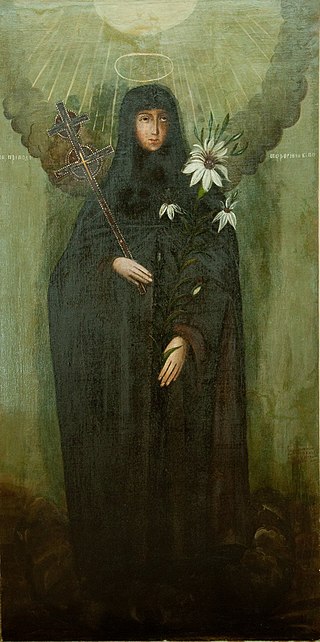
Euphrosyne of Polotsk was the granddaughter of Vseslav, the prince of Polotsk, and daughter of the prince Svyatoslav-Georgy Vseslavich. She has long been a popular saint among Orthodox devotees, particularly those in Belarus, Ukraine, and Russia with a traditional feast day of May 23. In addition, since 1984, she has been one of the 15 patron saints of Belarus, whose lives are celebrated in the Belarusian Orthodox Church, on the first Sunday after Pentecost.
Sviatopolk II Iziaslavich was Grand Prince of Kiev from 1093 to 1113. He was not a popular prince, and his reign was marked by incessant rivalry with his cousin Vladimir Monomakh.

Rurik Rostislavich, also spelt Riurik, was Prince of Novgorod (1170–1171), Belgorod (1173–1194), Grand Prince of Kiev, and Prince of Chernigov (1210–1214).
Sviatoslav III Vsevolodovich was Prince of Turov, Volhynia (1141–1146), Pinsk (1154), Novgorod-Seversk (1157–1164), Chernigov (1164–1177), Grand Prince of Kiev. He was the son of Vsevolod II Olgovich.
Rostislav Rurikovich, Prince of Torchesk (1195–1205), Grand Prince of Kiev, Prince of Vyshhorod (1205–1210), Prince of Halych (1207). Son of Rurik Rostislavich and Anna of Turov.

Roman Mstislavich, also known as Roman the Great, was Prince of Novgorod (1168–1170), Volhynia, and Galicia. He founded the Romanovichi branch of Rurikids, which would rule Galicia–Volhynia until 1340.
The family of Vladimir I, popularly known as Vladimir the Great, prince of Kievan Rus', is subject to scholarly studies. The primary sources about his life, such as the Primary Chronicle and the Chronicon Thietmari of Thietmar of Merseburg, are legendary, and require critical scrutiny to separate fact from fiction.
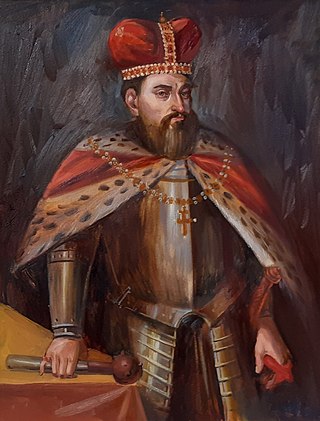
Leo I of Galicia was King of Ruthenia, Prince of Belz (1245–1264), Peremyshl, Galicia (1264–1269), and Kiev (1271–1301).
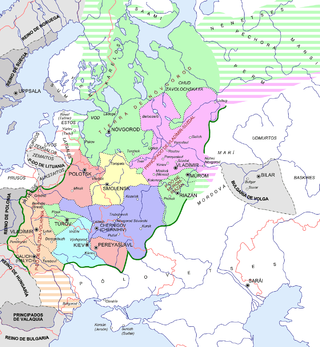
The inner Principality of Kiev was a medieval principality centered on the city of Kiev.

The Rurik dynasty, also known as the Rurikid or Riurikid dynasty, as well as simply Rurikids or Riurikids, was a noble lineage allegedly founded by the Varangian prince Rurik, who, according to tradition, established himself at Novgorod in the year 862. The Rurikids were the ruling dynasty of Kievan Rus' and its principalities following its disintegration.
Oleg III Svyatoslavich was a Kievan Rus' prince. His baptismal name was Feodosy. He was prince of Vshchizh, of Novgorod-Seversk (1200–1201), and of Chernigov (1201/1202–1204).
Eudoxia Iziaslavna of Kiev, was a Kievan Rus' princess member of the Izyaslavichi of Volhynia and by marriage Duchess of Greater Poland and since 1173 High Duchess of Poland.
Maria of Galicia was a princess of Galicia-Volhynia and a member of the Rurik Dynasty. She was sister to Leo II of Halych and Andrew of Halych, daughter of Yuri I of Galicia and his second wife, Euphemia of Kuyavia. She assisted her son king Boleslaus George II of Halych in ruling Galicia.

Vasilko Rostislavich was a prince of Kievan Rus' and member of the Rurik dynasty. He was the first Prince of Terebovl' from 1092. His Byzantine-style blinding was very unusual among the Rurik dynasty.
Anna-Euphrosyne Angelina or Anna-Helena Angelina (?–1253), was a Princess of Galicia and Volhynia by marriage to Roman the Great, in 1199–1205. She was regent of the Principality during the minority of her son Daniel of Galicia from 1205 to 1214.
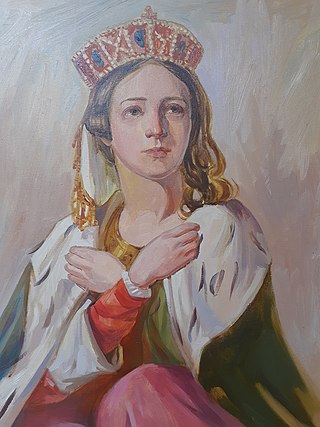
Constance of Hungary, was a Queen consort of Galicia and a Grand Princess of Kiev by marriage to Leo I of Galicia, Grand Prince of Kiev.
