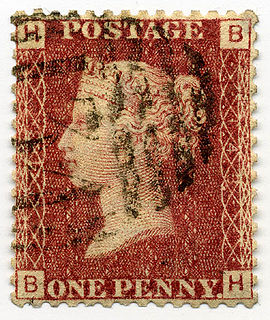
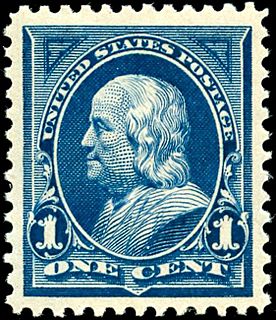
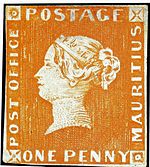
Stamp collecting is the collecting of postage stamps and related objects. It is related to philately, which is the study of stamps. It has been one of the world's most popular hobbies since the late nineteenth century with the rapid growth of the postal service, as a never-ending stream of new stamps was produced by countries that sought to advertise their distinctiveness through their stamps.

A cancellation is a postal marking applied on a postage stamp or postal stationery to deface the stamp and prevent its re-use. Cancellations come in a huge variety of designs, shapes, sizes and colors. Modern cancellations commonly include the date and post office location where the stamps were mailed, in addition to lines or bars designed to cover the stamp itself. The term "postal marking" sometimes is used to refer specifically to the part that contains the date and posting location, although the term often is used interchangeably with "cancellation." The portion of a cancellation that is designed to deface the stamp and does not contain writing is also called the "obliteration" or killer. Some stamps are issued pre-cancelled with a printed or stamped cancellation and do not need to have a cancellation added. Cancellations can affect the value of stamps to collectors, positively or negatively. The cancellations of some countries have been extensively studied by philatelists and many stamp collectors and postal history collectors collect cancellations in addition to the stamps themselves.

Philatelic literature is written material relating to philately, primarily information about postage stamps and postal history.

For postage stamps and postal history of India, see Postage stamps and postal history of India
This is a survey of the postage stamps and postal history of Afghanistan.

Postage stamps and postal history of Great Britain surveys postal history from the United Kingdom and the postage stamps issued by that country and its various historical territories until the present day.
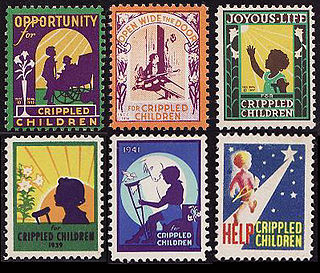
In philately, a cinderella stamp is "virtually anything resembling a postage stamp, but not issued for postal purposes by a government postal administration". The term excludes imprinted stamps on postal stationery.

This is a survey of the postage stamps and postal history of the Northern Nigeria Protectorate.

A revenue stamp, tax stamp, duty stamp or fiscal stamp is a (usually) adhesive label used to collect taxes or fees on documents, tobacco, alcoholic drinks, drugs and medicines, playing cards, hunting licenses, firearm registration, and many other things. Typically businesses purchase the stamps from the government, and attach them to taxed items as part of putting the items on sale, or in the case of documents, as part of filling out the form.

Postage stamp design is the activity of graphic design as applied to postage stamps. Many thousands of designs have been created since a profile bust of Queen Victoria was adopted for the Penny Black in 1840; some designs have been considered very successful, others less so.
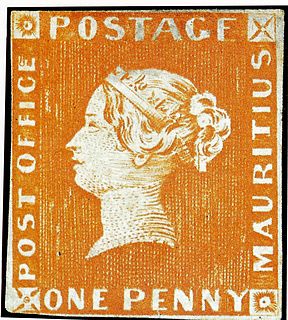
The Mauritius "Post Office" stamps were issued by the British Colony Mauritius in September 1847, in two denominations: an orange-red one penny (1d) and a deep blue two pence (2d). Their name comes from the wording on the stamps reading "Post Office", which was soon changed in the next issue to "Post Paid". They are among the rarest postage stamps in the world.

The postage stamps of Ireland are issued by the postal operator of the independent Irish state. Ireland was part of the United Kingdom of Great Britain and Ireland when the world's first postage stamps were issued in 1840. These stamps, and all subsequent British issues, were used in Ireland until the new Irish Government assumed power in 1922. Beginning on 17 February 1922, existing British stamps were overprinted with Irish text to provide some definitives until separate Irish issues became available. Following the overprints, a regular series of definitive stamps was produced by the new Department of Posts and Telegraphs, using domestic designs. These definitives were issued on 6 December 1922; the first was a 2d stamp, depicting a map of Ireland. Since then new images, and additional values as needed, have produced of nine definitive series of different designs.

The Hawaiian Missionaries are the first postage stamps of the Kingdom of Hawaii, issued in 1851. They came to be known as the "Missionaries" because they were primarily found on the correspondence of missionaries working in the Hawaiian Islands. Only a handful of these stamps have survived to the present day, and so they are amongst the great rarities of philately.

Plating refers to the reconstruction of a pane or "sheet" of postage stamps printed from a single plate by using individual stamps and overlapping strips and blocks of stamps. Likewise, if a sheet 10 or 20 postal cards is typeset, the variations of the letters or design elements may allow reconstruction or plating of the sheets based on these differences.

The Mosely Collection of British Africa stamps dating to 1935 was formed by Dr Edward Mosely of Johannesburg, South Africa. The collection was donated to the British Museum by his daughter, Kathleen Cunningham, in 1946 and is now held as part of the British Library Philatelic Collections. After the Tapling Collection, this is considered the Library's most important philatelic acquisition due to the number of countries represented and the number of unique items included.
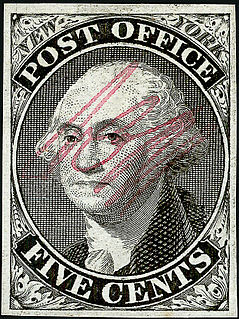
The New York Postmaster's Provisional is, as its designation implies, a postage stamp provided by the New York Post Office to facilitate the prepayment of mail at a time when the United States had not yet issued postage stamps for national use. Placed on sale on July 14, 1845, this was the nation's first provisional stamp to be issued by a local post office in response to the congressional postal reform act that had taken effect two weeks earlier. That law, passed on March 3, 1845, standardized nationwide mail rates, with the result that the use of stamps became a practical and reliable method of postal prepayment. Before standardization, the many different postal rates in different jurisdictions had made fees too unpredictable to prepay all letters with stamps as a matter of course, with the result that recipients of letters—rather than senders—generally paid the postage on them. Baltimore announced the issue of a provisional stamp one day after New York, on July 15, and New Haven soon followed. The New York issue has been cited as "the most elegantly executed and widely used of the group of provisionals issued by eleven different [U. S. post] offices between 1845 and 1847."