
Jalisco is a state in Western Mexico that is divided into 125 municipalities. According to the 2020 Mexican census, it is the third most populated state with 8,348,151 inhabitants and the seventh largest by land area spanning 78,595.9 square kilometres (30,346.0 sq mi). The largest municipality by population is Zapopan, with 1,476,491 residents, while the smallest is Santa María del Oro with 1,815 residents. The largest municipality by land area is Mezquitic which spans 3,363.60 km2 (1,298.69 sq mi), and the smallest is Techaluta with 79.20 km2 (30.58 sq mi). The newest is San Ignacio Cerro Gordo, established in 2007 out of Arandas.

Tlaquepaque, officially San Pedro Tlaquepaque, is a city and the surrounding municipality in the Mexican state of Jalisco.

Tonalá is a city and municipality within the Guadalajara Metropolitan Area in the state of Jalisco in Mexico. With a population of 442,440, it is the fourth largest city in the state, the other three being the other major population centres in the metro area: Guadalajara, Zapopan, and Tlaquepaque. It is best known as a major handcrafts center for Jalisco, especially pottery, as well as its very large Thursday and Sunday street market, dedicated to handcrafts.

The Sistema de Tren Eléctrico Urbano or SITEUR is an urban rail transit system serving the Guadalajara metropolitan area, in the municipalities of Guadalajara, Zapopan and Tlaquepaque, in the state of Jalisco, Mexico. It is owned and operated by the state of Jalisco.

The Guadalajara metropolitan area is the most populous metropolitan area of the Mexican state of Jalisco and the third largest in the country after Greater Mexico City and Monterrey. It includes the core municipality of Guadalajara and the surrounding municipalities of Zapopan, Tlaquepaque, Tonalá, Tlajomulco de Zúñiga, El Salto, Ixtlahuacán de los Membrillos and Juanacatlán.

The Guadalajara Mi Macro is a bus rapid transit (BRT) system in Guadalajara, Jalisco, Mexico. The initiation of work on the system was announced by Jalisco Governor Emilio González Márquez on February 29, 2008. The system was launched on March 11, 2009 by him and Mexican President Felipe Calderón Hinojosa.

The Museo Regional de la Cerámica in Tlaquepaque, Jalisco, Mexico is located on Independencia Street in the center of the city. The museum is one of two main ceramics museums in the city, with the other being the Pantaleon Panduro Museum. It was established in 1954 to preserve and promote indigenous handcrafts of Jalisco, especially the state’s ceramic tradition. The emphasis is still on ceramics but the museum also has a room dedicated to Huichol art and holds events related to various types of indigenous crafts and culture.

Ceramics of Jalisco, Mexico has a history that extends far back in the pre Hispanic period, but modern production is the result of techniques introduced by the Spanish during the colonial period and the introduction of high-fire production in the 1950s and 1960s by Jorge Wilmot and Ken Edwards. Today various types of traditional ceramics such as bruñido, canelo and petatillo are still made, along with high fire types like stoneware, with traditional and nontraditional decorative motifs. The two main ceramics centers are Tlaquepaque and Tonalá, with a wide variety of products such as cookware, plates, bowls, piggy banks and many types of figures.

Carmen Lucía Pérez Camarena is a Mexican politician affiliated with the PAN. As of 2013 she served as Deputy of the LXII Legislature of the Mexican Congress representing Jalisco.
Jalisco handcrafts and folk art are noted among Mexican handcraft traditions. The state is one of the main producers of handcrafts, which are noted for quality. The main handcraft tradition is ceramics, which has produced a number of known ceramicists, including Jorge Wilmot, who introduced high fire work into the state. In addition to ceramics, the state also makes blown glass, textiles, wood furniture including the equipal chair, baskets, metal items, piteado and Huichol art.
The Nueva Plaza Cartel is a Mexican criminal organization from the state of Jalisco. The group began as a split from the Jalisco New Generation Cartel, having an important presence in the Guadalajara metropolitan area, having been previously commanded by Carlos Enrique Sánchez Martínez, "El Cholo," Emilio Alejandro Pulido Saldaña, "El Tiburón," and Érick Valencia Salazar "El 85". El Cholo would be killed in 2021, with "El Tiburón" surrendering himself to Mexican authorities soon afterwards. El 85 would be arrested in 2022.

Jardín Hidalgo is a plaza in Tlaquepaque, in the Mexican state of Jalisco.

Parroquia de San Pedro Apóstol is a church in Tlaquepaque, in the Mexican state of Jalisco.

The Santuario de Nuestra Señora de la Soledad is a church in Tlaquepaque, in the Mexican state of Jalisco.

El grito continua is a 2010 sculpture by Camilo Ramírez, installed in Tlaquepaque, in the Mexican state of Jalisco.
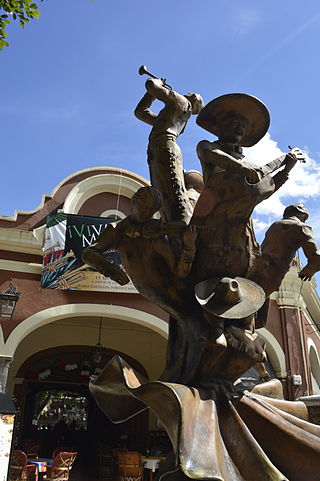
Creo en mis raíces is a sculpture by Camilo Ramírez, installed in Tlaquepaque, in the Mexican state of Jalisco.

El Señor de los Monitos, or simply El Señor Monitos, is a sculpture in Tlaquepaque, in the Mexican state of Jalisco. Camilo Ramírez made this piece in 2020. The statue is six meters tall and weighs 1.5 tons.

The Tlaquepaque Centro railway station is part of the Sistema de Tren Eléctrico Urbano in the Mexican state of Jalisco.
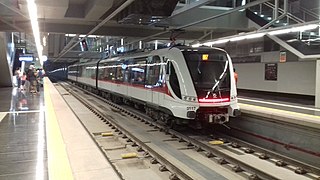
Line 3 of the Guadalajara Urban Electric Train System is the third public transport railway line in the Guadalajara metropolitan area (México) and currently its longest. The line connects the Historical Centres of Zapopan, Guadalajara and Tlaquepaque, through the Diagonal Metropolitan Vial Corridor; consisting of Juan Gil Preciado, Juan Pablo II, Manuel Ávila Camacho, Alcalde / 16 de Septiembre and Revolución / Francisco Silva Romero avenues, from the Arcos de Zapopan neighbourhood until the Central Camionera Oriente of Guadalajara. It has 18 stations from south-east to north-west, of which 13 are elevated and 5 are underground. It stretches along 21.5 km. It is estimated that the line moves 233,000 daily passengers.


