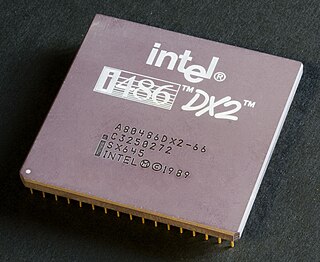
A central processing unit (CPU), also called a central processor, main processor or just processor, is the electronic circuitry within a computer that executes instructions that make up a computer program. The CPU performs basic arithmetic, logic, controlling, and input/output (I/O) operations specified by the instructions in the program. The computer industry used the term "central processing unit" as early as 1955. Traditionally, the term "CPU" refers to a processor, more specifically to its processing unit and control unit (CU), distinguishing these core elements of a computer from external components such as main memory and I/O circuitry.
In cryptography, encryption is the process of encoding information. This process converts the original representation of the information, known as plaintext, into an alternative form known as ciphertext. Only authorized parties can decipher a ciphertext back to plaintext and access the original information. Encryption does not itself prevent interference but denies the intelligible content to a would-be interceptor. For technical reasons, an encryption scheme usually uses a pseudo-random encryption key generated by an algorithm. It is possible to decrypt the message without possessing the key, but, for a well-designed encryption scheme, considerable computational resources and skills are required. An authorized recipient can easily decrypt the message with the key provided by the originator to recipients but not to unauthorized users. Historically, various forms of encryption have been used to aid in cryptography. Early encryption techniques were often utilized in military messaging. Since then, new techniques have emerged and become commonplace in all areas of modern computing. Modern encryption schemes utilize the concepts of public-key and symmetric-key. Modern encryption techniques ensure security because modern computers are inefficient at cracking the encryption.

Optical character recognition or optical character reader (OCR) is the electronic or mechanical conversion of images of typed, handwritten or printed text into machine-encoded text, whether from a scanned document, a photo of a document, a scene-photo or from subtitle text superimposed on an image.

In computing, the clock rate typically refers to the frequency at which the clock generator of a processor can generate pulses, which are used to synchronize the operations of its components, and is used as an indicator of the processor's speed. It is measured in clock cycles per second or its equivalent, the SI unit hertz (Hz).
Edge detection includes a variety of mathematical methods that aim at identifying points in a digital image at which the image brightness changes sharply or, more formally, has discontinuities. The points at which image brightness changes sharply are typically organized into a set of curved line segments termed edges. The same problem of finding discontinuities in one-dimensional signals is known as step detection and the problem of finding signal discontinuities over time is known as change detection. Edge detection is a fundamental tool in image processing, machine vision and computer vision, particularly in the areas of feature detection and feature extraction.

In computer science, multiple buffering is the use of more than one buffer to hold a block of data, so that a "reader" will see a complete version of the data, rather than a partially updated version of the data being created by a "writer". It is also used to avoid the need to use dual-ported RAM (DPRAM) when the readers and writers are different devices.
Quad Data Rate (QDR) SRAM is a type of static RAM computer memory that can transfer up to four words of data in each clock cycle. Like Double Data-Rate (DDR) SDRAM, QDR SRAM transfers data on both rising and falling edges of the clock signal. The main purpose of this capability is to enable reads and writes to occur at high clock frequencies without the loss of bandwidth due to bus-turnaround cycles incurred in DDR SRAM. QDR SRAM uses two clocks, one for read data and one for write data and has separate read and write data buses, whereas DDR SRAM uses a single clock and has a single common data bus used for both reads and writes. This helps to eliminate problems caused by the propagation delay of the clock wiring, and allows the illusion of concurrent reads and writes.

In computing, a computer bus operating with double data rate (DDR) transfers data on both the rising and falling edges of the clock signal. This is also known as double pumped, dual-pumped, and double transition. The term toggle mode is used in the context of NAND flash memory.
In the fields of digital electronics and computer hardware, multi-channel memory architecture is a technology that increases the data transfer rate between the DRAM memory and the memory controller by adding more channels of communication between them. Theoretically this multiplies the data rate by exactly the number of channels present. Dual-channel memory employs two channels. The technique goes back as far as the 1960s having been used in IBM System/360 Model 91 and in CDC 6600.
In computer science, a data buffer is a region of a physical memory storage used to temporarily store data while it is being moved from one place to another. Typically, the data is stored in a buffer as it is retrieved from an input device or just before it is sent to an output device. However, a buffer may be used when moving data between processes within a computer. This is comparable to buffers in telecommunication. Buffers can be implemented in a fixed memory location in hardware—or by using a virtual data buffer in software, pointing at a location in the physical memory. In all cases, the data stored in a data buffer are stored on a physical storage medium. A majority of buffers are implemented in software, which typically use the faster RAM to store temporary data, due to the much faster access time compared with hard disk drives. Buffers are typically used when there is a difference between the rate at which data is received and the rate at which it can be processed, or in the case that these rates are variable, for example in a printer spooler or in online video streaming. In the distributed computing environment, data buffer is often implemented in the form of burst buffer that provides distributed buffering service.

A multi-core processor is a computer processor integrated circuit with two or more separate processing units, called cores, each of which reads and executes program instructions, as if the computer had several processors. The instructions are ordinary CPU instructions but the single processor can run instructions on separate cores at the same time, increasing overall speed for programs that support multithreading or other parallel computing techniques. Manufacturers typically integrate the cores onto a single integrated circuit die or onto multiple dies in a single chip package. The microprocessors currently used in almost all personal computers are multi-core.
Pumping, when referring to computer systems, is an informal term for transmitting a data signal more than one time per clock signal.
In computing, computer performance is the amount of useful work accomplished by a computer system. Outside of specific contexts, computer performance is estimated in terms of accuracy, efficiency and speed of executing computer program instructions. When it comes to high computer performance, one or more of the following factors might be involved:
Quad data rate is a communication signaling technique wherein data are transmitted at four points in the clock cycle: on the rising and falling edges, and at two intermediate points between them. The intermediate points are defined by a second clock that is 90° out of phase from the first. The effect is to deliver four bits of data per signal line per clock cycle.

In estimation theory, estimation of signal parameters via rotational invariant techniques (ESPRIT) is a technique to determine parameters of a mixture of sinusoids in a background noise. This technique is first proposed for frequency estimation, however, with the introduction of phased-array systems in daily use technology, it is also used for Angle of arrival estimations as well.
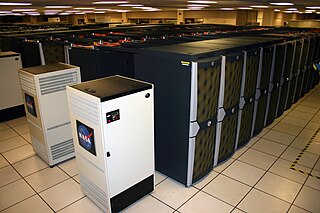
Pleiades is a petascale supercomputer housed at the NASA Advanced Supercomputing (NAS) facility at NASA's Ames Research Center located at Moffett Field near Mountain View, California. It is maintained by NASA and partners Hewlett Packard Enterprise and Intel.
In computing, quadruple precision is a binary floating point–based computer number format that occupies 16 bytes with precision more than twice the 53-bit double precision.

Voreen is an open-source volume visualization library and development platform. Through the use of GPU-based volume rendering techniques it allows high frame rates on standard graphics hardware to support interactive volume exploration.
SHAZAM is a comprehensive econometrics and statistics package for estimating, testing, simulating and forecasting many types of econometrics and statistical models. SHAZAM was originally created in 1977 by Kenneth White.
Software construction is a software engineering discipline. It is the detailed creation of working meaningful software through a combination of coding, verification, unit testing, integration testing, and debugging. It is linked to all the other software engineering disciplines, most strongly to software design and software testing.
