
Qarshi is a city in southern Uzbekistan. It is the capital of Qashqadaryo Region. Administratively, Qarshi is a district-level city, that includes the urban-type settlement Qashqadaryo. It has a population of 278,300. It is about 520 km south-southwest of Tashkent, and about 335 km north of Uzbekistan's border with Afghanistan. It is located at latitude 38° 51' 48N; longitude 65° 47' 52E at an altitude of 374 meters. The city is important in natural gas production, but Qarshi is also famous for its production of woven flat carpets.

Navoiy, also spelled Navoi, is a city and the capital of Navoiy Region in the southwestern part of Uzbekistan. Administratively, it is a district-level city, that includes the urban-type settlement Tinchlik. It is located at latitude 40° 5' 4N; longitude 65° 22' 45E, at an altitude of 382 meters. The city is named after Ali-Shir Nava'i. As of 2020, its population was 144,158 inhabitants.

Qashqadaryo Region is one of the regions of Uzbekistan, located in the south-eastern part of the country in the basin of the river Qashqadaryo and on the western slopes of the Pamir-Alay mountains. It borders with Tajikistan, Turkmenistan, Samarqand Region, Bukhara Region and Surxondaryo Region. It covers an area of 28,570 km2. The population is estimated 3,408,345 (2022), with 57% living in rural areas. The regional capital is Qarshi.

Konye-Urgench, also known as Old Urgench or Urganj, is a city of about 30,000 inhabitants in north Turkmenistan, just south from its border with Uzbekistan. It is the site of the ancient town of Gurgānj, which contains the ruins of the capital of Khwarazm. Its inhabitants deserted the town in the early eighteenth century in order to develop a new settlement, and Konye-Urgench has remained undisturbed ever since. In 2005, the ruins of Old Urgench were inscribed on the UNESCO List of World Heritage Sites.

The memorial complex of Chor-Bakr was built over the burial place of Abu-Bakr-Said, who died in the year 360 of the Muslim Calendar, and who was one of the four of Abu-Bakrs (Chor-Bakr) – descendants of Muhammad. The complex includes the necropolis of family tombs, and courtyards enclosed with walls. It is located in modern-day Kalaya, Uzbekistan.

Dor-i-Tilavat - in the center of Shahrisabz, in the west of the Darussiodat complex, there is a complex consisting of ancient structures belonging to the Timurid dynasty - the tomb of Shamsuddin Kulol, Gumbazi Sayyidon, and the Blue Dome Mosque, built on the site of the old madrasa here.
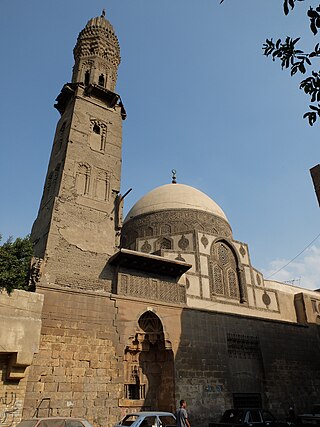
The Madrasa of Amir Sunqur Sa'di, also commonly known as the Mausoleum of (Sheikh) Hasan Sadaqa, is a medieval Mamluk-era madrasa structure and mausoleum in Cairo, Egypt. It was originally built between 1315 and 1321 CE by amir Sunqur Sa'di. Sunqur was forced to leave Egypt in his lifetime and was never buried there, but a sheikh known as Hasan Sadaqa was later buried in it and therefore the building is often known by his name. From the 17th century onward the complex was converted into Mevlevi Sufi lodge and is open today as the Mawlawiyya Museum or Museo Mevlevi.

Odina Mosque is the oldest preserved architectural monument located in the city of Qarshi, Qashqadaryo region. The mosque is situated in the center of the Qarshi fortress. Timur, during his expedition from Samarkand to Qarshi in 1385-1386, ordered the construction of this mosque.
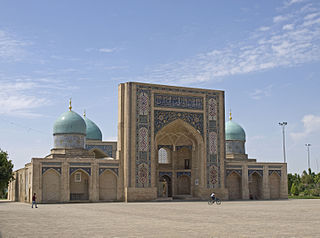
The Hazrati Imam complex is an architectural monument dating from the 16th to 20th centuries, located in the Olmazor district of Tashkent city, Uzbekistan. The complex consists of the Moʻyi Muborak madrasa, the Qaffol Shoshi mausoleum, the Baroqxon Madrasa, the Hazrati Imam mosque, the Tillashayx mosque, and the Imam al-Bukhari Islamic Institute. The ensemble was built near the grave of Hazrati Imam, the first imam-khatib of Tashkent, a scholar, one of the first Islamic preachers in Tashkent, a poet and an artist.
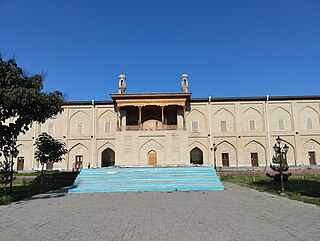
Andijan Jame Mosque Complex architectural monument. It consists of a mosque, a madrasa, and a minaret. In the mid-19th century, the city status was granted to settlements with a mosque in Uzbekistan. Complex Jami took place from 1883 to 1890. The total area of the complex is 1.5 hectares. Within the complex, the Andijon Region Literary and Art Museum is located.

Ulugbek Madrasah is a memorial to Abdul Khaliq Ghijduwani, located in the city of Gijduvon in the Bukhara region of Uzbekistan. It is one of the ancient and renowned madrasas of Bukhara, also known as the "Fayziya Madrasah." Presently, it is also referred to as the Mirzo Ulugbek Madrasa. This prestigious educational institution was built in the Hijri year 836 beside the grave of Shaykh Abdul Khaliq Ghijduwani, with a two-story structure made of baked bricks. The Ulugbek Madrasah, established by Ulugh Beg, is the third and last madrasa he founded, relatively smaller and simpler compared to the Ulugbek Madrasah in Bukhara and Samarkand.
Shergazikhan Madrasah - an architectural monument in Khiva (1719-1726); It is one of the many buildings in the Itchan Kala. According to the sources, it was built in 1719–1726 with the funds and decree of the Uzbek ruler Shergazikhan. It is located in the center of Itchan Kala, at the entrance to the Pahlavon Mahmud complex. The construction of the structure began during Shergozikhan's campaign to Khurasan. Khan's body was buried in a small room built in the west of the madrasah.

Abdurasulboy Madrasah is a former madrasa in Khiva, Uzbekistan. It was built according to the order of Mirzabashi Abdurasulboy in 1906. In 1990, it was included in the list of UNESCO World Heritage Sites as a part of Itchan Kala. Currently, it is used as a sozana embroidery workshop and exhibition space.
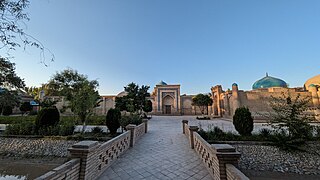
Said Mahruyjan Complex is an architectural monument in the Khiva city, Khorazm Region of the Republic of Uzbekistan. The complex consists of a madrasa, a monastery, etc. built in 1884 around the tomb of Said Muhammad Mahruyjan. Today it is located at 84, Amir Temur Street, "Mevaston" neighborhood.

Kazi Kalyan madrasah - an architectural monument in Khiva (1905); The madrasah is part of the Itchan Kala. The Kazi Kalyan Madrasah is part of the monuments of the Itchan Kala Museum-Reserve. The structure is located between Juma Mosque (Khiva) and Matniyoz Devonbegi Madrasah. It was built in 1905 by the chief judge of Khorezm, Mohammad Salih Okhund.
Abdulazizkhoja Madrasa is a memorial monument according to the Decree of the President of the Republic of Uzbekistan "On Measures to Radically Improve the Activities in the Field of Preservation of Material Cultural Heritage Objects" dated December 19, 2018, PQ-4068, it was included in the National Register of Immovable Property Objects of the Material and Cultural Heritage of Uzbekistan - taken under state protection.
The Bekmurodboy Madrasa is a historical and cultural monument located in the Darvozatutak district of Qarshi city, Qashqadaryo region, Uzbekistan. Bekmurodboy Madrasa is included in the National Register of Immovable Property of Uzbekistan's Material and Cultural Heritage by the Decree of the President of the Republic of Uzbekistan “On measures to radically improve the activities in the field of preservation of material and cultural heritage objects” dated December 19, 2018 No. PQ-4068.

Khoja Kurban Madrasah is an architectural monument located in Darvozatutak neighborhood, Qarshi city, Qashqadaryo Region. The architectural monument was included in the national list of real estate objects of the material and cultural heritage of Uzbekistan in accordance with the decision of the President of the Republic of Uzbekistan dated December 19, 2018.
The Sharifboy Madrasa is one of the historical and cultural monuments located in Chaqar district of Qarshi city, Qashqadaryo Region. Sharifboy madrasa was included in the National Register of Immovable Property Objects of the Material and Cultural Heritage of Uzbekistan according to the Decree of the President of the Republic of Uzbekistan "On measures to radically improve the activities in the field of preservation of material and cultural heritage objects" dated December 19, 2018 No. PQ-4068 — taken under state protection.
The Mozori Sharif Madrasa is an architectural monument in Khiva city of Khorezm region of the Republic of Uzbekistan. Currently, the madrasa is located in the Pahlavon Mahmud street, house 20. It was built in 1882 by the order of Muhammad Rahim Khan II (Feruz) and the funds of his son Toshhovuz ruler - Iso to’ra by the master Qalandar Kochim.
