
Rajaram Sharma (born 9 June 1963) is an Indian artist of Pichhwai and Indian miniature paintings. [1]
Rajaram Sharma (born 9 June 1963) is an Indian artist of Pichhwai and Indian miniature paintings. [1]
He was born on 9 June 1963 in Bijolia in Bhilwara district of Rajasthan. He completed his early education in Bijolia. At the age of 13, he came to Nathdwara to train under Tulsidasji Chitrakar who was the head of Shrinathji temple. After spending 13 years learning with Tulsidasji, Sharma had made a name for himself. In 1989, B. G. Sharma, an eminent Pichhwai artist, took Rajaram under his wings to teach him the nuances of Pichhwai and miniature painting. The artist worked under him for ten years and became adept in both Pichwai and miniature paintings. [2]
At the age of 22, the artist married Chhaya Sharma. Chhaya is the granddaughter of Bhuralal Sharma, a well-known Pichhwai artist from Nathdwara. Rajaram has two daughters, Swati Sharma and Jyoti Sharma, and a son, Rajat Sharma. Rajat is practicing miniature and contemporary art with his father.[ citation needed ]
Currently, the Rajaram works at his own studio, namely "Chitrashala", in Udaipur, where he also guides and trains upcoming artists. [2]
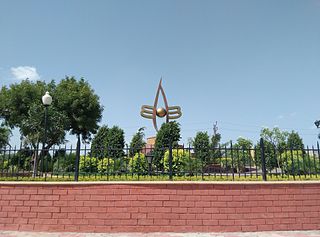
Nathdwara is a city in the Rajsamand district of the state of Rajasthan, India. It is located in the Aravalli hills, on the banks of the Banas River and is 48 kilometres north-east of Udaipur. Shrinathji, is a swarup of lord Krishna which resembles his 7-year-old "infant" incarnation of Krishna. The deity was originally worshiped at Jatpura, Mathura and was shifted in the year 1672 from Govardhan hill, near Mathura along holy river Yamuna after being retained at Agra for almost six months. Literally, Nathdwara means 'Gateway to Shrinathji (God)'.

Pichhwai, literally meaning 'that which hangs from the back' from the Sanskrit words "Pichh" means back and "wais" means hanging, are large devotional Hindu painted pictures, normally on cloth, which portray Krishna. They are mainly made to hang in Hindu temples of the Pushtimarg devotional tradition, especially the Shrinathji Temple in Nathdwara, Rajasthan, built around 1672. They are hung behind the idol of Shrinathji, a local form of Krishna and the centre of Pushtimarg worship, to depict his leelas. Aurangabad was another area associated with them. The purpose of pichhwais, other than artistic appeal, is to narrate tales of Krishna to the illiterate. Temples have sets with different images, which are changed according to the calendar of festivals celebrating the deity.

Mughal painting is a South Asian style of painting on paper made in to miniatures either as book illustrations or as single works to be kept in albums (muraqqa), originating from the territory of the Mughal Empire in the Indian subcontinent. It emerged from Persian miniature painting and developed in the court of the Mughal Empire of the 16th to 18th centuries. Battles, legendary stories, hunting scenes, wildlife, royal life, mythology, as well as other subjects have all been frequently depicted in paintings.

Rajput painting, painting of the regional Hindu courts during the Mughal era, roughly from the end of the 16th century to the middle of the 19th century. Traditionally, Rajput painting is further divided into Rajasthan and Pahari painting which flourished in two different areas "far apart from each other in terms of distance but all under the rule of Rajput chiefs, and bound together by a common culture".

Indian painting has a very long tradition and history in Indian art. The earliest Indian paintings were the rock paintings of prehistoric times, such as the petroglyphs found in places like the Bhimbetka rock shelters. Some of the Stone Age rock paintings found among the Bhimbetka rock shelters are approximately 10,000 years old. Because of the climatic conditions in the Indian subcontinent, very few early examples survive today.

Shrinathji is a form of Krishna, manifested as a seven-year-old child. The principal shrine of Shrinathji is the Shrinathji Temple in the temple city of Nathdwara, 48 kilometres north-east of Udaipur city in Rajasthan, India. Shrinathji is the central presiding deity of the Vaishnava sect known as Pushtimarg or the Vallabha Sampradaya, established by Vallabhacharya. Shrinathji is worshipped mainly by the followers of Bhakti Yoga and the Vaishnavas in Gujarat and Rajasthan, and Bhatias amongst others.
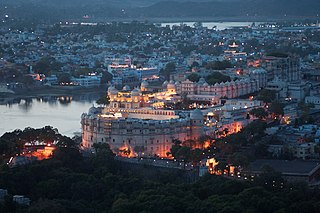
Udaipur is a city in the north-western Indian state of Rajasthan, about 415 km (258 mi) south of the state capital Jaipur. It serves as the administrative headquarters of Udaipur district. It is the historic capital of the kingdom of Mewar in the former Rajputana Agency. It was founded in 1559 by Udai Singh II of the Sisodia clan of Rajputs, when he shifted his capital from the city of Chittorgarh to Udaipur after Chittorgarh was besieged by Akbar. It remained as the capital city till 1818 when Mewar became a British princely state, and thereafter the Mewar province became a part of Rajasthan when India gained independence in 1947. It is also known as the City of Lakes, as it is surrounded by five major artificial lakes.

Shree Lal Joshi was an Indian Chippa caste artist of phad painting, a form of popular folk painting of Rajasthan.

Sachida Nagdev was an Indian painter based in central Indian town of Bhopal.
Bhanwar lal Girdhari lal Sharma, better known as B. G. Sharma, was a painter from Rajasthan, India. He is famous for his miniature devotional paintings and his rejuvenation and popularization of classic Rajasthan art, including the Mughal, Kishangarh, and Kangra styles. He is also well known for experimenting and mixing modern with traditional styles and producing some exemplary pieces of art.
Purushottam Das was the pioneer of the Nathdwara school of Pakhawaj playing.

C. P. Joshi is an Indian politician and a five-time MLA from Nathdwara, Rajasthan. He was born in a Brahmin family in Nathdwara, Rajasthan and he is a member of the Indian National Congress. He has previously served as Speaker of the Rajasthan Legislative Assembly. Previously, he was the Member of Parliament of India from Bhilwara in the 15th Lok Sabha. He was one of the first 19 members of India's new cabinet sworn in on 22 May 2009, despite being a first-time member of the Lok Sabha. As a union minister, Joshi held key portfolios like Road Transport and Highways, and Rural Development and Panchayati Raj in the Second Manmohan Singh ministry. Moreover, he was also a Cabinet Minister of the Government of Rajasthan from 1998 to 2003.

Narottam Narayan Sharma was an Indian artist from Nathdwara. He is especially famous for his images of Krishna, which were popular throughout North India and were even more influential than the works of Raja Ravi Varma.
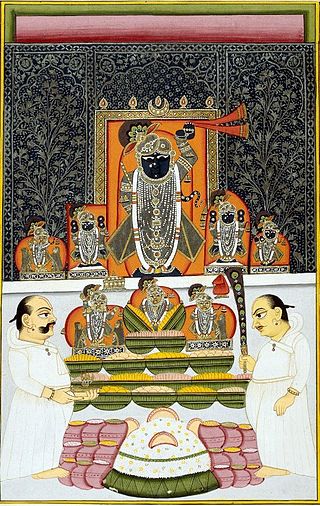
Nathdwara Painting refers to a painting tradition and school of art that emerged in Nathdwara, a city in Rajsamand district in the Western state of Rajasthan in India. Inspired by the Thanjavur Painting, Nathdwara paintings are of different sub-styles of which Pichhwai paintings are the most popular. The word Pichwai derives from the Sanskrit words pich meaning back and wais meaning hanging. These paintings are cloth paintings hung behind the image of the Hindu god Shrinathji.

The Shrinathji Temple is a Hindu temple dedicated to Shrinathji located in Nathdwara. It is considered an important pilgrimage centre by Vaishnavas.

Vijay Sharma is an Indian painter and art historian, known for his expertise in the Pahari school of miniature painting. He was honored by the Government of India, in 2012, with the fourth highest Indian civilian award of Padma Shri.

Gopal Prasad Sharma is an internationally recognised Indian artist associated with the traditional miniature art of Rajasthan.
Anil Relia is an Indian art collector, known for his portrait collection. He has over 3000 portraits and his personal collection includes many miniature paintings, early photographs along with works of artists like Raja Ravi Varma, M. F. Husain, Hemen Majumdar, Bhupen Khakhar, Jyoti Bhatt, Haku Shah, K. G. Subramanyan, S.H. Raza, Thota Vaikuntam, Manu Parekh and many more.
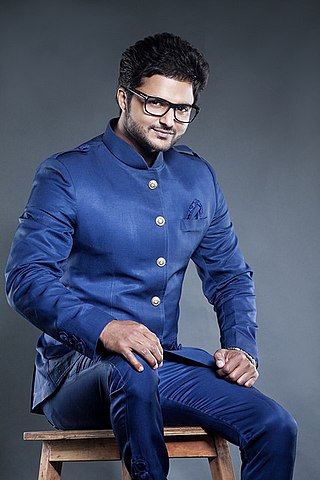
Suvigya Sharma is an Indian artist, painter, fashion designer, who does portrait miniatures and other miniature art, Tanjore painting, fresco work and portraits. He has worked in restoring frescoes at the City Palace, Jaipur, the Jama Masjid and the Singapore Art Museum.

Jagannath Murlidhar Ahivasi was an Indian painter and art educator. He is well known for his paintings in the Indian style inspired by the techniques and style of the Indian miniature paintings. J. M. Ahivasi was at the forefront of the revival of Indian Art in Western India from early to mid 20th century.