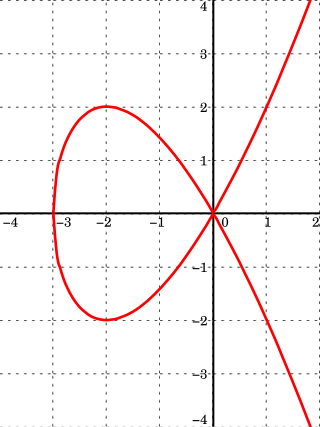
In mathematics, an affine algebraic plane curve is the zero set of a polynomial in two variables. A projective algebraic plane curve is the zero set in a projective plane of a homogeneous polynomial in three variables. An affine algebraic plane curve can be completed in a projective algebraic plane curve by homogenizing its defining polynomial. Conversely, a projective algebraic plane curve of homogeneous equation h(x, y, t) = 0 can be restricted to the affine algebraic plane curve of equation h(x, y, 1) = 0. These two operations are each inverse to the other; therefore, the phrase algebraic plane curve is often used without specifying explicitly whether it is the affine or the projective case that is considered.

In mathematics, birational geometry is a field of algebraic geometry in which the goal is to determine when two algebraic varieties are isomorphic outside lower-dimensional subsets. This amounts to studying mappings that are given by rational functions rather than polynomials; the map may fail to be defined where the rational functions have poles.
In mathematics, a Cohen–Macaulay ring is a commutative ring with some of the algebro-geometric properties of a smooth variety, such as local equidimensionality. Under mild assumptions, a local ring is Cohen–Macaulay exactly when it is a finitely generated free module over a regular local subring. Cohen–Macaulay rings play a central role in commutative algebra: they form a very broad class, and yet they are well understood in many ways.

In mathematics, a cubic surface is a surface in 3-dimensional space defined by one polynomial equation of degree 3. Cubic surfaces are fundamental examples in algebraic geometry. The theory is simplified by working in projective space rather than affine space, and so cubic surfaces are generally considered in projective 3-space . The theory also becomes more uniform by focusing on surfaces over the complex numbers rather than the real numbers; note that a complex surface has real dimension 4. A simple example is the Fermat cubic surface
In mathematics, an algebraic surface is an algebraic variety of dimension two. In the case of geometry over the field of complex numbers, an algebraic surface has complex dimension two and so of dimension four as a smooth manifold.
In mathematics, coherent duality is any of a number of generalisations of Serre duality, applying to coherent sheaves, in algebraic geometry and complex manifold theory, as well as some aspects of commutative algebra that are part of the 'local' theory.
In algebraic geometry, an algebraic variety or scheme X is normal if it is normal at every point, meaning that the local ring at the point is an integrally closed domain. An affine variety X is normal if and only if the ring O(X) of regular functions on X is an integrally closed domain. A variety X over a field is normal if and only if every finite birational morphism from any variety Y to X is an isomorphism.
In algebraic geometry, a Fano variety, introduced by Gino Fano in, is a complete variety X whose anticanonical bundle KX* is ample. In this definition, one could assume that X is smooth over a field, but the minimal model program has also led to the study of Fano varieties with various types of singularities, such as terminal or klt singularities. Recently techniques in differential geometry have been applied to the study of Fano varieties over the complex numbers, and success has been found in constructing moduli spaces of Fano varieties and proving the existence of Kähler–Einstein metrics on them through the study of K-stability of Fano varieties.

In algebraic geometry, the problem of resolution of singularities asks whether every algebraic variety V has a resolution, a non-singular variety W with a proper birational map W→V. For varieties over fields of characteristic 0 this was proved in Hironaka (1964), while for varieties over fields of characteristic p it is an open problem in dimensions at least 4.
In algebraic geometry, flips and flops are codimension-2 surgery operations arising in the minimal model program, given by blowing up along a relative canonical ring. In dimension 3 flips are used to construct minimal models, and any two birationally equivalent minimal models are connected by a sequence of flops. It is conjectured that the same is true in higher dimensions.
In mathematics, the cone of curves of an algebraic variety is a combinatorial invariant of importance to the birational geometry of .
In algebraic geometry, the minimal model program is part of the birational classification of algebraic varieties. Its goal is to construct a birational model of any complex projective variety which is as simple as possible. The subject has its origins in the classical birational geometry of surfaces studied by the Italian school, and is currently an active research area within algebraic geometry.
János Kollár is a Hungarian mathematician, specializing in algebraic geometry.
In mathematics, canonical singularities appear as singularities of the canonical model of a projective variety, and terminal singularities are special cases that appear as singularities of minimal models. They were introduced by Reid (1980). Terminal singularities are important in the minimal model program because smooth minimal models do not always exist, and thus one must allow certain singularities, namely the terminal singularities.
This is a glossary of algebraic geometry.
In algebraic geometry, the dualizing sheaf on a proper scheme X of dimension n over a field k is a coherent sheaf together with a linear functional
In algebraic geometry, a Gorenstein scheme is a locally Noetherian scheme whose local rings are all Gorenstein. The canonical line bundle is defined for any Gorenstein scheme over a field, and its properties are much the same as in the special case of smooth schemes.
In algebraic geometry, a contraction morphism is a surjective projective morphism between normal projective varieties such that or, equivalently, the geometric fibers are all connected. It is also commonly called an algebraic fiber space, as it is an analog of a fiber space in algebraic topology.
In mathematics, and in particular algebraic geometry, K-stability is an algebro-geometric stability condition for projective algebraic varieties and complex manifolds. K-stability is of particular importance for the case of Fano varieties, where it is the correct stability condition to allow the formation of moduli spaces, and where it precisely characterises the existence of Kähler–Einstein metrics.




