
Brigadier General Francis Marion, also known as the "Swamp Fox", was an American military officer, planter, and politician who served during the French and Indian War and the Revolutionary War. During the American Revolution, Marion supported the Patriot cause and enlisted in the Continental Army, fighting against British forces in the Southern theater of the American Revolutionary War from 1780 to 1781.

James Hugh Calum Laurie is an English actor, comedian, writer, and musician. He first gained recognition for his work as one half of the comedy double act Fry and Laurie with Stephen Fry. The two acted together in a number of projects during the 1980s and 1990s, including the BBC sketch comedy series A Bit of Fry & Laurie and the P. G. Wodehouse adaptation Jeeves and Wooster. From 1986 to 1989 he appeared in three series of the period comedy Blackadder, first as a guest star in the last two episodes of Blackadder II, before joining the main cast in Blackadder the Third, and going on to appear in Blackadder Goes Forth and many specials.

General John Burgoyne was a British general, dramatist and politician who sat in the House of Commons from 1761 to 1792. He first saw action during the Seven Years' War when he participated in several battles, most notably during the Portugal campaign of 1762.
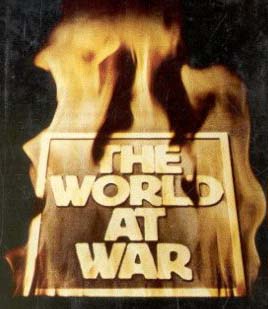
The World at War is a 26-episode British documentary television series that chronicles the events of the Second World War. It was produced in 1973, at a cost of £900,000, the most expensive factual series ever produced. It was produced by Jeremy Isaacs, narrated by Laurence Olivier and included music composed by Carl Davis. The book, The World at War, published the same year, was written by Mark Arnold-Forster to accompany the TV series.

Sir John Desmond Patrick Keegan was an English military historian, lecturer, author and journalist. He wrote many published works on the nature of combat between prehistory and the 21st century, covering land, air, maritime, intelligence warfare and the psychology of battle.

Edward Richard Holmes, CBE, TD, JP, VR, known as Richard Holmes, was a British military historian. He was co-director of Cranfield University's Security and Resilience Group from 1989 to 2009 and became Professor of Military and Security Studies at Cranfield in 1995.

Stanley Tucci Jr. is an American actor. Known as a character actor, he has played a wide variety of roles ranging from menacing to sophisticated. Tucci has earned numerous accolades, including six Emmy Awards, two Golden Globe Awards as well as nominations for an Academy Award, a BAFTA Award, and a Tony Award.

Sir Simon Michael Schama is an English historian and television presenter. He specialises in art history, Dutch history, Jewish history, and French history. He is a Professor of History and Art History at Columbia University.

Revolution is a 1985 British historical drama film directed by Hugh Hudson, written by Robert Dillon, and starring Al Pacino, Donald Sutherland, and Nastassja Kinski. The film stars Pacino as a fur trapper in the Province of New York who involuntarily gets enrolled in the Revolutionary forces during the American Revolutionary War.
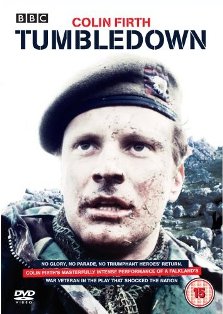
Tumbledown is a 1988 BBC Television drama film set during the Falklands War. Directed by Richard Eyre, it stars Colin Firth, Paul Rhys, and David Calder.
Roger Arthur Graef OBE was an American-born British documentary filmmaker and theatre director. Born in New York City, he moved to Britain in 1962, where he began a career producing documentary films investigating previously closed institutions, including Government ministries and court buildings.
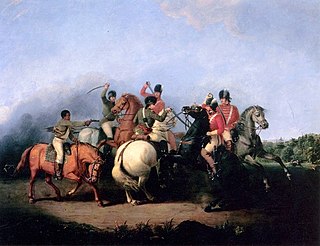
The southern theater of the American Revolutionary War was the central theater of military operations in the second half of the American Revolutionary War, 1778–1781. It encompassed engagements primarily in Virginia, Georgia, North Carolina, and South Carolina. Tactics consisted of both strategic battles and guerrilla warfare.
Hugh Bicheno is a political risk analyst and an historian of conflict. He is best known for his interpretations of the Falklands War in Razor's Edge: The Unofficial History of the Falklands War and of the American Revolution in Rebels and Redcoats: The American Revolutionary War.

Vice Admiral Sir George Collier was an officer of the Royal Navy who saw service during the Seven Years' War, the American War of Independence and the French Revolutionary Wars. As commander of the fourth-rate ship HMS Rainbow, he was one of the most successful British naval commanders during the opening stages of war with America. He achieved considerable success as one of the senior officers on the North American coast, conducting and organizing several highly effective raids and counter-strikes. He was superseded however, and returned to Britain to play a role in the closing events of the war in European waters, before moving ashore to start a political career. He enjoyed a brief return to service with the resumption of war with France, and achieved flag rank, but died shortly afterwards.

The Young Rebels is an American adventure TV series that was broadcast by ABC as part of its 1970 fall lineup on Sunday night at 7:00 p.m Eastern time.

The Office Christmas specials are the two-part series finale episodes of the British mockumentary comedy television series The Office. The specials were commissioned after the series' creators, Ricky Gervais and Stephen Merchant, announced that they would not write a full third series of the show. The first 45-minute part was broadcast on BBC One on 26 December 2003, and the second 50-minute part was shown the following evening. The episodes are presented in the style of "revisited" documentaries common on British television, in which series such as Airport are brought back for one-off specials several years after the series concluded. David Brent (Gervais), forcibly made redundant at the end of the second series, is now a travelling salesman of cleaning supplies. Tim Canterbury and Gareth Keenan are still working at the offices of Wernham Hogg, and former Wernham Hogg receptionist Dawn Tinsley, now living in Florida, is flown back to Britain by the documentary crew to reunite with her old colleagues.
Jacques-Melchior Saint-Laurent, Comte de Barras was a French Navy officer of the eighteenth century. He notably served in Yorktown Campaign of the War of American Independence.

Family Tree is a documentary-style television comedy created by Christopher Guest and Jim Piddock. The series premiered on 12 May 2013, on the American pay television network HBO, and appeared on the British channel BBC Two in July 2013. Guest, Piddock, Karen Murphy, Deborah Oppenheimer, and Mario Stylianides serve as the show's executive producers.
Vietnam: A Television History (1983) is a 13-part documentary mini-series about the Vietnam War (1955–1975) from the perspective of the United States. It was produced for public television by WGBH-TV in Boston, Central Independent Television of the UK and Antenne-2 of France. It was originally broadcast on PBS between October 4 and December 20, 1983.
Spies of Warsaw is a British television miniseries in which a Deuxième Bureau intelligence agent (spy) poses as a military attaché at the French embassy in Warsaw, and finds himself drawn into the outbreak of World War II.

