
Cooking, also known as cookery or professionally as the culinary arts, is the art, science and craft of using heat to make food more palatable, digestible, nutritious, or safe. Cooking techniques and ingredients vary widely, from grilling food over an open fire, to using electric stoves, to baking in various types of ovens, reflecting local conditions. Cooking is an aspect of all human societies and a cultural universal.

French fries, and chips, finger chips, french-fried potatoes, or simply fries are batonnet or allumette-cut deep-fried potatoes of disputed origin from Belgium or France. They are prepared by cutting potatoes into even strips, drying them, and frying them, usually in a deep fryer. Pre-cut, blanched, and frozen russet potatoes are widely used, and sometimes baked in a regular or convection oven; air fryers are small convection ovens marketed for frying potatoes.

Baking is a method of preparing food that uses dry heat, typically in an oven, but can also be done in hot ashes, or on hot stones. The most common baked item is bread, but many other types of foods can be baked. Heat is gradually transferred "from the surface of cakes, cookies, and pieces of bread to their center, typically conducted at elevated temperatures surpassing 300°F. Dry heat cooking imparts a distinctive richness to foods through the processes of caramelization and surface browning. As heat travels through, it transforms batters and doughs into baked goods and more with a firm dry crust and a softer center. Baking can be combined with grilling to produce a hybrid barbecue variant by using both methods simultaneously, or one after the other. Baking is related to barbecuing because the concept of the masonry oven is similar to that of a smoke pit.

Deep frying is a cooking method in which food is submerged in hot fat, traditionally lard but today most commonly oil, as opposed to the shallow frying used in conventional frying done in a frying pan. Normally, a deep fryer or chip pan is used for this; industrially, a pressure fryer or vacuum fryer may be used. Deep frying may also be performed using oil that is heated in a pot. Deep frying is classified as a hot-fat cooking method. Typically, deep frying foods cook quickly since oil has a high rate of heat conduction and all sides of the food are cooked simultaneously.

Pan frying or pan-frying is a form of frying food characterized by the use of minimal cooking oil or fat, typically using just enough to lubricate the pan. In the case of a greasy food such as bacon, no oil or fats may need to be added. As a form of frying, the technique relies on oil or fat as the heat transfer medium, and on correct temperature and time to not overcook or burn the food. Pan frying can serve to retain the moisture in foods such as meat and seafood. The food is typically flipped at least once to ensure that both sides are cooked properly.

Grilling is a form of cooking that involves heat applied to the surface of food, commonly from above, below or from the side. Grilling usually involves a significant amount of direct, radiant heat, and tends to be used for cooking meat and vegetables quickly. Food to be grilled is cooked on a grill, using a cast iron/frying pan, or a grill pan.
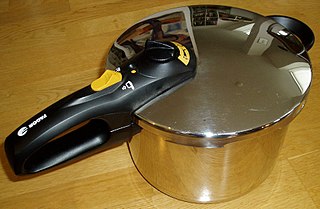
Pressure cooking is the process of cooking food with the use of high pressure steam and water or a water-based liquid, inside a sealed vessel called a pressure cooker; the high pressure limits boiling and creates higher temperatures not possible at lower pressures which allow food to be cooked much faster than at normal pressure.

Stir frying is a cooking technique in which ingredients are fried in a small amount of very hot oil while being stirred or tossed in a wok. The technique originated in China and in recent centuries has spread into other parts of Asia and the West. It is similar to sautéing in Western cooking technique.

A microwave oven or simply microwave is an electric oven that heats and cooks food by exposing it to electromagnetic radiation in the microwave frequency range. This induces polar molecules in the food to rotate and produce thermal energy in a process known as dielectric heating. Microwave ovens heat foods quickly and efficiently because excitation is fairly uniform in the outer 25–38 mm(1–1.5 inches) of a homogeneous, high-water-content food item.

Blanching is a cooking process in which a food, usually a vegetable or fruit, is scalded in boiling water, removed after a brief timed interval, and finally plunged into iced water or placed under cold running water to halt the cooking process. Blanching foods helps reduce quality loss over time. Blanching is often used as a treatment prior to freezing, dehydrating, or canning vegetables or fruits to deactivate enzymes, modify texture, remove the peel and wilt tissue. The inactivation of enzymes preserves colour, flavour, and nutritional value. The process has three stages: preheating, blanching, and cooling. The most common blanching methods for vegetables/fruits are hot water and steam, while cooling is either done using cold water or cool air. Other benefits of blanching include removing pesticide residues and decreasing microbial load. Drawbacks to the blanching process can include leaching of water-soluble and heat-sensitive nutrients and the production of effluent.

A convection oven is an oven that has fans to circulate air around food to create an evenly heated environment. The increased air circulation causes a fan-assisted oven to cook food faster than a conventional non-fan oven, which relies only on natural convection to circulate the hot air. Fan-assisted convection ovens are commonly used for baking as well as non-food, industrial applications. Small countertop convection ovens for household use are often marketed as air fryers.

A deep fryer is a kitchen appliance used for deep frying. Deep frying is a method of cooking by submerging food into oil at high heat, typically between temperatures of 350 to 375 °F.

A turkey fryer is an apparatus for deep-frying a turkey. Fried turkey has been a popular item in the Southern United States, and has become popular in other parts of the country because of the reduced time needed to cook a turkey in a deep fryer, versus other conventional methods such as an oven or a rotisserie grill.
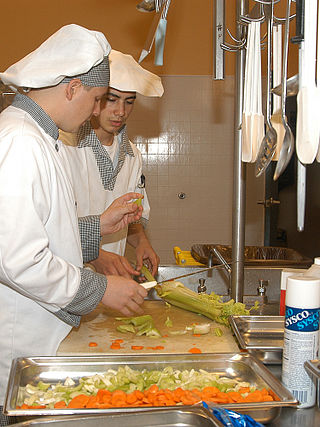
The following outline is provided as an overview of and topical guide to the preparation of food:

Heavy-duty cookware made of cast iron is valued for its heat retention, durability, ability to maintain high temperatures for longer time duration, and non-stick cooking when properly seasoned. Seasoning is also used to protect bare cast iron from rust. Types of cast-iron cookware include frying pans, dutch ovens, griddles, waffle irons, flattop grills, panini presses, crepe makers, deep fryers, tetsubin, woks, potjies, and karahi.
A vacuum fryer is a deep-frying device housed inside a vacuum chamber. With vacuum frying it is easier to maintain natural colors and flavours of the finished product. Due to the lower temperatures applied, the formation of suspected carcinogen acrylamide is significantly lower than in standard atmospheric fryers, where the frying temperature is approximately 170 °C (338 °F). The fat absorption of the products is also reported to be lower than in atmospheric fryers. In Southeast Asia batch type vacuum fryers are mainly used for the production of fruit chips. However, these machines are only appropriate for relatively small production companies.

Fried chicken, also known as Southern fried chicken, is a dish consisting of chicken pieces that have been coated with seasoned flour or batter and pan-fried, deep fried, pressure fried, or air fried. The breading adds a crisp coating or crust to the exterior of the chicken while retaining juices in the meat. Broiler chickens are most commonly used.

Shallow frying is a hot oil-based cooking technique. It is typically used to prepare portion-sized cuts of meat, fish, potatoes and patties such as fritters. Shallow frying can also be used to cook vegetables.

Cooking oil is a plant or animal liquid fat used in frying, baking, and other types of cooking. Oil allows higher cooking temperatures than water, making cooking faster and more flavorful, while likewise distributing heat, reducing burning and uneven cooking. It sometimes imparts its own flavor. Cooking oil is also used in food preparation and flavoring not involving heat, such as salad dressings and bread dips.


