
The Recreation Ground is a public park in Swanage, Dorset. It was acquired prior to WWI, but only properly established in the 1920s.
The Recreation Ground is a public park in Swanage, Dorset. It was acquired prior to WWI, but only properly established in the 1920s.
The land which is now the recreation ground was previously occupied by Eastbrook Farm. Although acquired before WWI, it was only after the War that it was turned into the recreation ground, with the war memorial being unveiled in 1920 and the bandstand installed in 1923. [1] As originally laid out, the recreation ground also included tennis courts and a bowling green. [2]

The bandstand was installed in 1923, in a sunken location to assist with acoustics in the open air. It was made by Scottish cast iron manufacturers, Walter Macfarlane & Co, to a design known as a MacFarlane 224. [3] It is one of only four surviving MacFarlane 224s, the other three being in the Royal Pump Room Gardens in Leamington Spa, Fassnidge Park in Uxbridge and the Vine Cricket Ground in Sevenoaks. [4] Following storm damage in 2012, the roof was removed. [5] It was restored in 2019 by Lost Art Limited, and the original finial was reinstated. [6] [7]
The Swanage Town Band perform concerts at the bandstand. [8] There is a Friends of Swanage Bandstand group. [9]

The war memorial was erected in 1920, and relocated within the recreation ground in 2014 in order to reduce the risk of it collapsing in a landslip. [10] [11] It is constructed from Purbeck stone and is Grade II listed. [12] It is in the form of a tapering cairn. [13] In addition to listing the war dead, the war memorial also lists civilians killed by enemy bombs in the town in WWII. [14]
Trevor Chadwick was a schoolteacher in Swanage who, working with Sir Nicholas Winton, was responsible for rescuing 669 children from Prague on the kindertransport . [15] As part of the objective of the Trevor Chadwick Memorial Trust to perpetuate the memory of Chadwick's work, the children's playground in the recreation ground has been renamed the Chadwick children's playground. [16] A bronze sculpture of Chadwick with two children by local sculptor Moira Purver has been designed and will shortly (2021) be cast and then installed in the recreation ground. [17] [18]

Corfe Castle is a village and civil parish in the English county of Dorset. It is the site of a ruined castle of the same name. The village and castle stand over a gap in the Purbeck Hills on the route between Wareham and Swanage. The village lies in the gap below the castle and is around four miles (6.4 km) south-east of Wareham, and four miles (6.4 km) north-northwest of Swanage. Both the main A351 road from Lytchett Minster to Swanage and the Swanage Railway thread their way through the gap and the village.
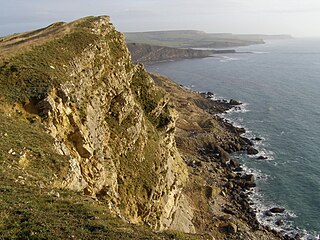
The Jurassic Coast is a World Heritage Site on the English Channel coast of southern England. It stretches from Exmouth in East Devon to Studland Bay in Dorset, a distance of about 96 miles (154 km), and was inscribed on the World Heritage List in mid-December 2001.

Swanage is a coastal town and civil parish in the south east of Dorset, England. It is at the eastern end of the Isle of Purbeck and one of its two towns, approximately 6+1⁄4 miles (10 km) south of Poole and 25 miles (40 km) east of Dorchester. In the 2011 census the civil parish had a population of 9,601. Nearby are Ballard Down and Old Harry Rocks, with Studland Bay and Poole Harbour to the north. Within the parish are Durlston Bay and Durlston Country Park to the south of the town. The parish also includes the areas of Herston, just to the west of the town, and Durlston, just to the south.
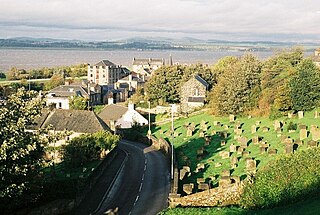
Borrowstounness is a town and former burgh and seaport on the south bank of the Firth of Forth in the Central Lowlands of Scotland. Historically part of the county of West Lothian, it is a place within the Falkirk council area, 17 miles northwest of Edinburgh and 6+3⁄4 miles east of Falkirk. At the 2011 United Kingdom census, the population of the Bo'ness locality was 15,100.
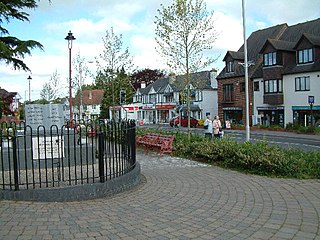
Verwood is a town and civil parish in eastern Dorset, England. The town lies 10 miles (16 km) north of Bournemouth and 13 miles (21 km) north east of Poole as the crow flies. The civil parish comprises the town of Verwood together with the extended village of Three Legged Cross, and in 2014 had a population of 15,170. Verwood is the largest town in Dorset without an upper school.

The Quarry is the main recreational park in Shrewsbury, the county town of Shropshire, England. The park was created in 1719 and encompasses 29 acres. It is listed Grade II in Historic England's Register of Parks and Gardens. With a location within easy walking distance of Shrewsbury town centre, Shrewsbury Sixth Form College and Shrewsbury School, it is the most heavily used public park within the county.

Princes Street Gardens are two adjacent public parks in the centre of Edinburgh, Scotland, lying in the shadow of Edinburgh Castle. The Gardens were created in the 1820s following the long draining of the Nor Loch and building of the New Town, beginning in the 1760s.
The London Borough of Bexley owns and maintains over 100 parks and open spaces within its boundaries, with a total of 638 hectares. They include small gardens, river and woodland areas, and large parks with many sporting and other facilities.

Fields in Trust is a British charity set up in 1925 as the National Playing Fields Association (NPFA), by Brigadier-General Reginald Kentish and the Duke of York, later King George VI, who was the first president, which protects parks and green spaces and promotes the cause of accessible spaces for play, sports and recreation in British cities and towns.
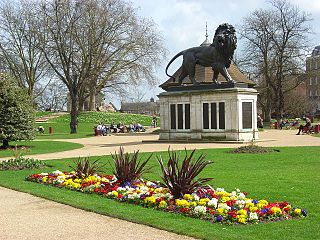
Forbury Gardens is a public park in the town of Reading in the English county of Berkshire. The park is on the site of the outer court of Reading Abbey, which was in front of the Abbey Church. The site was formerly known as the Forbury, and one of the roads flanking the current gardens is still known as The Forbury. Fairs were held on the site three times a year until the 19th century.
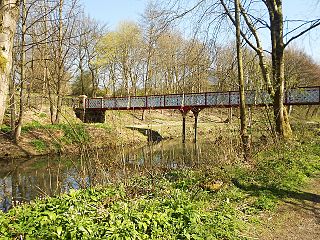
Queen's Park is a roughly circular 22 acres (8.9 ha) Victorian park lying on sloping ground to the north-west of Bolton town centre, in Greater Manchester, England. Opened as Bolton Park on 24 May 1866 by Lord Bradford it was renamed in 1897 in honour of Queen Victoria's Diamond Jubilee.

St Alban's Head is a headland located 5 kilometres (3.1 mi) southwest of Swanage, on the coast of Dorset, England. It is the most southerly part of the Purbeck peninsula, and comprises an outcrop of Portland Stone from the overlying Lower Purbeck Stone. It is part of the Jurassic Coast, a World Heritage Site. It is designated a Special Area of Conservation under the European Union's Habitats Directive.

Westerley Ware is a small garden and recreation ground in Kew in the London Borough of Richmond upon Thames. It is at the foot of Kew Bridge, between Waterloo Place and the Thames riverbank. Historically common land, it has a memorial garden – bordered by hedges – to the fallen in the First World War, a grass area, three hard tennis courts and a children's playground. Since 1939 it has been managed by the local authority, which is now Richmond upon Thames Council.

Durdle Pier is a disused 17th-century stone shipping quay, located on the Isle of Portland, Dorset, England; part of the Jurassic Coast. It is found close by Yeolands Quarry, on the east side of the island within the area of East Weares and Penn's Weare.
Gerda Kamilla Mayer was an English poet. Born to a Jewish family in Karlovy Vary, Czechoslovakia, she escaped to England from Prague in 1939, aged eleven, on a Kindertransport flight organised by Trevor Chadwick. Having composed her first poem, in German, at the age of four, she continued her education in Dorset and Surrey and began writing poetry in English. She has published several volumes of verse and her poems have appeared in many anthologies. She has been described by Carol Ann Duffy as a fine poet "who should be better known."

Trevor Chadwick was a British humanitarian who was involved in the Kindertransport to rescue Jews and other refugee children in Czechoslovakia in 1938–1939 before World War II. After the Munich Agreement Nazi Germany annexed Sudetenland from Czechoslovakia in 1938 and occupied the whole Czech part of Czechoslovakia in 1939. The children were mostly resettled with families in the United Kingdom.
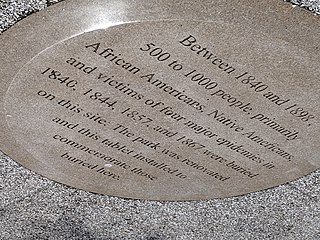
Old Town of Flushing Burial Ground is a historic cemetery located in Flushing, Queens, New York City. It was established in 1840 and known as The Olde Towne of Flushing Burial Ground. It was the result of Cholera and Smallpox epidemics in 1840 and 1844, added by town elders north of Flushing Cemetery due to fears of contamination of church burial grounds. Once known as "Pauper Burial Ground", "Colored Cemetery of Flushing" and "Martins Field", it was purchased by the New York City Department of Parks and Recreation on December 2, 1914, and renamed in 2009 to "The Olde Towne of Flushing Burial Ground".

Prince Albert Gardens is a park in Swanage, Dorset, England. It was established in 1996.
The Prince Albert Memorial is a memorial in Swanage, Dorset in the form of a stone obelisk to Prince Albert, the consort of Queen Victoria, who died in 1861. The memorial was erected in 1862, and is notable for having been the earliest civic memorial to the Prince. It was dismantled in 1971, and only rebuilt 50 years later, in 2021.

The Priest's Way is the historical route taken by clergy from St Nicholas's, Worth Matravers to St Mary's Church, Swanage in the Isle of Purbeck in Dorset. The track arose as a result of St Mary's being a chapel of ease to St Nicholas's, and followed the route priests took to say mass in Swanage. A modern footpath and bridleway follows much of the route.