
Plant pathology is the scientific study of diseases in plants caused by pathogens and environmental conditions. Organisms that cause infectious disease include fungi, oomycetes, bacteria, viruses, viroids, virus-like organisms, phytoplasmas, protozoa, nematodes and parasitic plants. Not included are ectoparasites like insects, mites, vertebrate, or other pests that affect plant health by eating plant tissues. Plant pathology also involves the study of pathogen identification, disease etiology, disease cycles, economic impact, plant disease epidemiology, plant disease resistance, how plant diseases affect humans and animals, pathosystem genetics, and management of plant diseases.
There are a number of lines of defence against pests and diseases in the orchard, principal among these being the practice of good husbandry, creating healthy soil and ensuring high standards of garden hygiene. But no matter how diverse and healthy the garden eco-system may be, there will always be a degree of disease and pest presence. In many ways, some level of pathogen population in the garden can be not only acceptable but desirable as they are indicative of a generally healthful and diverse environment, and add to the overall robustness of the system as an immunity to such detrimental influences will build up, particularly in a balanced polycultural regime. Indeed, most of the plants we grow will tend to be selected because they are trouble free, and those that are more susceptible to attack will have fallen by the wayside over time. However, most farmers find it unacceptable that the food crops they grow are damaged by pests.
Fungicides are biocidal chemical compounds or biological organisms used to kill parasitic fungi or their spores. A fungistatic inhibits their growth. Fungi can cause serious damage in agriculture, resulting in critical losses of yield, quality, and profit. Fungicides are used both in agriculture and to fight fungal infections in animals. Chemicals used to control oomycetes, which are not fungi, are also referred to as fungicides, as oomycetes use the same mechanisms as fungi to infect plants. Fungicides can either be contact, translaminar or systemic. Contact fungicides are not taken up into the plant tissue and protect only the plant where the spray is deposited. Translaminar fungicides redistribute the fungicide from the upper, sprayed leaf surface to the lower, unsprayed surface. Systemic fungicides are taken up and redistributed through the xylem vessels. Few fungicides move to all parts of a plant. Some are locally systemic, and some move upwardly.
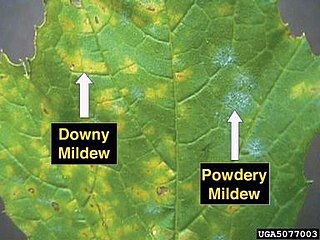
Powdery mildew is a fungal disease that affects a wide range of plants. Powdery mildew diseases are caused by many different species of fungi in the order Erysiphales. Powdery mildew is one of the easier plant diseases to identify, as its symptoms are quite distinctive. Infected plants display white powdery spots on the leaves and stems. The lower leaves are the most affected, but the mildew can appear on any above-ground part of the plant. As the disease progresses, the spots get larger and denser as large numbers of asexual spores are formed, and the mildew may spread up and down the length of the plant.

Stem rust, also known as cereal rust, black rust, red rust or red dust, is caused by the fungus Puccinia graminis, which causes significant disease in cereal crops. Crop species that are affected by the disease include bread wheat, durum wheat, barley and triticale. These diseases have affected cereal farming throughout history. The annual recurrence of stem rust of wheat in North Indian plains was discovered by Prof. K.C. Mehta. Since the 1950s, wheat strains bred to be resistant to stem rust have become available. Fungicides effective against stem rust are available as well.
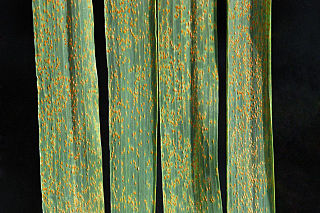
Wheat leaf rust is a fungal disease that affects wheat, barley, rye stems, leaves and grains. In temperate zones it is destructive on winter wheat because the pathogen overwinters. Infections can lead up to 20% yield loss, which is exacerbated by dying leaves, which fertilize the fungus. The pathogen is a Puccinia rust fungus. It is the most prevalent of all the wheat rust diseases, occurring in most wheat-growing regions. It causes serious epidemics in North America, Mexico and South America and is a devastating seasonal disease in India. P. triticina is heteroecious, requiring two distinct hosts.
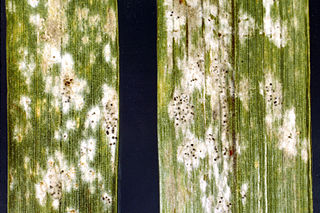
Blumeria graminis is a fungus that causes powdery mildew on grasses, including cereals. It is the only species in the genus Blumeria. It has also been called Erysiphe graminis and Oidium monilioides or Oidium tritici.

Lactuca serriola, also called prickly lettuce, milk thistle, compass plant, and scarole, is an annual or biennial plant in the dandelion tribe within the daisy family. It has a slightly fetid odor and is commonly considered a weed of orchards, roadsides and field crops. It is the closest wild relative of cultivated lettuce.
The gene-for-gene relationship was discovered by Harold Henry Flor who was working with rust of flax. Flor showed that the inheritance of both resistance in the host and parasite ability to cause disease is controlled by pairs of matching genes. One is a plant gene called the resistance (R) gene. The other is a parasite gene called the avirulence (Avr) gene. Plants producing a specific R gene product are resistant towards a pathogen that produces the corresponding Avr gene product. Gene-for-gene relationships are a widespread and very important aspect of plant disease resistance. Another example can be seen with Lactuca serriola versus Bremia lactucae.
Leptosphaeria maculans is a fungal pathogen of the phylum Ascomycota that is the causal agent of blackleg disease on Brassica crops. Its genome has been sequenced, and L. maculans is a well-studied model phytopathogenic fungus. Symptoms of blackleg generally include basal stem cankers, small grey lesions on leaves, and root rot. The major yield loss is due to stem canker. The fungus is dispersed by the wind as ascospores or rain splash in the case of the conidia. L. maculans grows best in wet conditions and a temperature range of 5–20 degrees Celsius. Rotation of crops, removal of stubble, application of fungicide, and crop resistance are all used to manage blackleg. The fungus is an important pathogen of Brassica napus (canola) crops.
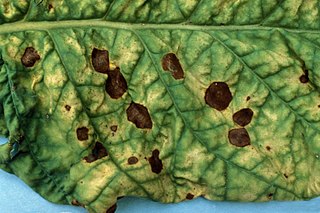
Alternaria alternata is a fungus which has been recorded causing leaf spot and other diseases on over 380 host species of plant. It is an opportunistic pathogen on numerous hosts causing leaf spots, rots and blights on many plant parts.

Theliaviopsis basicola is the plant-pathogen fungus responsible for black root rot disease. This particular disease has a large host range, affecting woody ornamentals, herbaceous ornamentals, agronomic crops, and even vegetable crops. Examples of susceptible hosts include petunia, pansy, poinsettia, tobacco, cotton, carrot, lettuce, tomato, and others. Symptoms of this disease resemble nutrient deficiency but are truly a result of the decaying root systems of plants. Common symptoms include chlorotic lower foliage, yellowing of plant, stunting or wilting, and black lesions along the roots. The lesions along the roots may appear red at first, getting darker and turning black as the disease progresses. Black root lesions that begin in the middle of a root can also spread further along the roots in either direction. Due to the nature of the pathogen, the disease can easily be identified by the black lesions along the roots, especially when compared to healthy roots. The black lesions that appear along the roots are a result of the formation of chlamydospores, resting spores of the fungus that contribute to its pathogenicity. The chlamydospores are a dark brown-black color and cause the "discoloration" of the roots when they are produced in large amounts.
Marker assisted selection or marker aided selection (MAS) is an indirect selection process where a trait of interest is selected based on a marker linked to a trait of interest, rather than on the trait itself. This process has been extensively researched and proposed for plant and animal breeding.

Phakopsora pachyrhizi is a plant pathogen. It causes Asian soybean rust.

Genetically modified plants have been engineered for scientific research, to create new colours in plants, deliver vaccines, and to create enhanced crops. Plant genomes can be engineered by physical methods or by use of Agrobacterium for the delivery of sequences hosted in T-DNA binary vectors. Many plant cells are pluripotent, meaning that a single cell from a mature plant can be harvested and then under the right conditions form a new plant. This ability can be taken advantage of by genetic engineers; by selecting for cells that have been successfully transformed in an adult plant a new plant can then be grown that contains the transgene in every cell through a process known as tissue culture.
Resistance genes (R-Genes) are genes in plant genomes that convey plant disease resistance against pathogens by producing R proteins. The main class of R-genes consist of a nucleotide binding domain (NB) and a leucine rich repeat (LRR) domain(s) and are often referred to as (NB-LRR) R-genes or NLRs. Generally, the NB domain binds either ATP/ADP or GTP/GDP. The LRR domain is often involved in protein-protein interactions as well as ligand binding. NB-LRR R-genes can be further subdivided into toll interleukin 1 receptor (TIR-NB-LRR) and coiled-coil (CC-NB-LRR).
Biotic stress is stress that occurs as a result of damage done to an organism by other living organisms, such as bacteria, viruses, fungi, parasites, beneficial and harmful insects, weeds, and cultivated or native plants. It is different from abiotic stress, which is the negative impact of non-living factors on the organisms such as temperature, sunlight, wind, salinity, flooding and drought. The types of biotic stresses imposed on an organism depend the climate where it lives as well as the species' ability to resist particular stresses. Biotic stress remains a broadly defined term and those who study it face many challenges, such as the greater difficulty in controlling biotic stresses in an experimental context compared to abiotic stress.

Plant disease resistance protects plants from pathogens in two ways: by pre-formed structures and chemicals, and by infection-induced responses of the immune system. Relative to a susceptible plant, disease resistance is the reduction of pathogen growth on or in the plant, while the term disease tolerance describes plants that exhibit little disease damage despite substantial pathogen levels. Disease outcome is determined by the three-way interaction of the pathogen, the plant and the environmental conditions.

β-Aminobutyric acid (BABA) is an isomer of the amino acid aminobutyric acid with the chemical formula C4H9NO2. It has two isomers, α-aminobutyric acid and γ-aminobutyric acid (GABA), a neurotransmitter in animals that is also found in plants, where it may play a role in signalling. All three are non-proteinogenic amino acids, not being found in proteins. BABA is known for its ability to induce plant disease resistance, as well as increased resistance to abiotic stresses, when applied to plants.

Northern corn leaf blight (NCLB) or Turcicum leaf blight (TLB) is a foliar disease of corn (maize) caused by Exserohilum turcicum, the anamorph of the ascomycete Setosphaeria turcica. With its characteristic cigar-shaped lesions, this disease can cause significant yield loss in susceptible corn hybrids.
