
Antonio Amador José de Nariño y Álvarez del Casal, was a Colombian ideological precursor of the independence movement in New Granada as well as one of its early political and military leaders. In 1793 he published the first French to Spanish translation of the Declaration of the Rights of Man and of the Citizen in Spain's american colonies.

José Camilo Clemente de Torres Tenorio was a Neogranadine independence leader and lawyer who also served as president of the United Provinces of New Granada. He is credited as being an early founder of the nation due to his role in early struggles for independence from Spain.

Manuel Atanasio Girardot Díaz was a Neogranadine military officer and one of the heroes of the Colombian and Venezuelan wars of Independence. He is famous for having died during the Battle of Bárbula, trying to plant the republican flag on Bárbula Hill.

The First Republic of New Granada, known despectively as the Foolish Fatherland, is the period in the history of Colombia immediately following the declaration of independence from Spain in 1810 and until the Spanish reconquest in 1816. The period between 1810 and 1816 in the Viceroyalty of New Granada was marked by such intense conflicts over the nature of the new government or governments that it became known as la Patria Boba. Constant fighting between federalists and centralists gave rise to a prolonged period of instability that eventually favored Spanish reconquest. Similar developments can be seen at the same time in the United Provinces of the Río de la Plata. Each province, and even some cities, set up its own autonomous junta, which declared themselves sovereign from each other.

Manuel de Bernardo Álvarez del Casal was an influential Criollo figure in New Granada at the time of the independence movement. He occupied several important positions in the rebel government. He was also the uncle of Antonio Nariño, forerunner of independence. He served as president of the rebel State of Cundinamarca in 1814.

Francisco José de Caldas was a Neogranadine lawyer, military engineer, self-taught naturalist, mathematician, geographer and inventor, who was executed by orders of General Pablo Morillo during the Spanish American Reconquista for being a forerunner of the fight for the independence of New Granada. Arguably the first Colombian scientist, he is often nicknamed "El Sabio".

Antonio Clemente José María Bernabé Ricaurte Lozano was a patriot of the Independence of Colombia and Venezuela and captain of Bolívar's army. He is remembered as the martyr of the Battle of San Mateo, where, in a heroic action, he blasted an enemy stronghold by immolating himself.
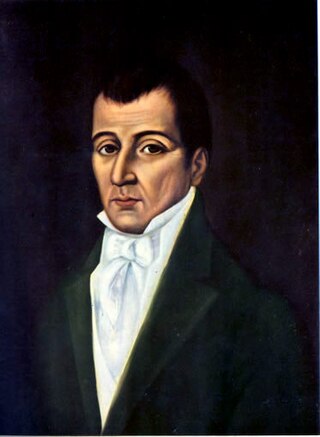
José Joaquín Justo Camacho y Rodriguez de Lago was a Neogranadine statesman, lawyer, journalist and professor, who worked for the Independence of the New Granada, what is now Colombia, and participated in the Open Cabildo which declared the Act of Independence, of which he was also a signer. He was executed during the Reign of Terror of Pablo Morillo after the Spanish invasion of New Granada.

Jorge Tadeo Lozano de Peralta, Viscount of Pastrana was a Neogranadine scientist, journalist, and politician who presided over the Constituent College of Cundinamarca and was elected President of Cundinamarca in 1811.
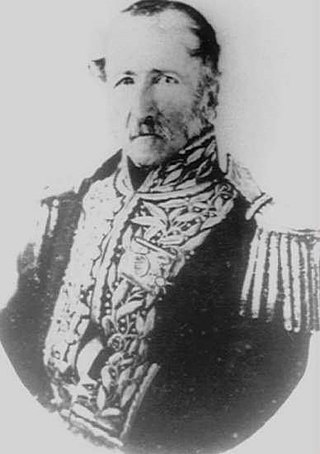
Joaquín París y Ricaurte was a Colombian military officer and politician who fought in the Colombian War of Independence and various civil wars that took place in Colombia during the 19th century. París was later also commander-in-chief of the army and Secretary of War on various occasions.

The Free and Independent State of Cundinamarca was a rebel state in colonial Colombia. It included parts of the former New Kingdom of Granada. The state originated as a result of the Foolish Fatherland period at the beginning of the Spanish American wars of independence. Its capital was Bogotá, the former capital of the Viceroyalty of New Granada.
The Lozano de Peralta family was one of the most aristocratic families of Colombia during the colonial age, well known for being the richest family of the new kingdom of Granada. ln 1771, they acquired the title of Marquises, the only noble title of Colombia. The marquisate of Saint George of Bogotá was a noble title given to Jorge Miguel Lozano de Peralta by the King Carlos III.
José de Ayala y Vergara was a Neogranadine martyr of the independence of Colombia, lawyer, lieutenant colonel and commander of different patriot insurgent battalions who fought against the Spanish rule in the Viceroyalty of New Granada.

José Ignacio París Ricaurte was a hero of independence and businessman from New Granada, the first contractor for the Coscuez mines after the country's independence.

The first family of Colombia is the family of the president of Colombia, who is both head of state and head of government of Colombia. It is an unofficial title for the family of a republic's head of state. Members of the first family consist of the president, the First Lady of Colombia, and any of their children. However, other close relatives of the president and first spouse, such as parents, grandchildren, stepchildren, and in-laws, may be classified as members of the first family for context purposes. The first family of Colombia live in the presidential residence Casa de Nariño in Bogotá, Colombia.

José Maria Vergara y Lozano de Peralta (1792–1857) was a Colombian major general and hero of Independence of New Granada and Gran Colombia, Deputy for Casanare in the Congress of Angostura and diplomat of Colombia in London representing the South American country in the Congress of Troppau.
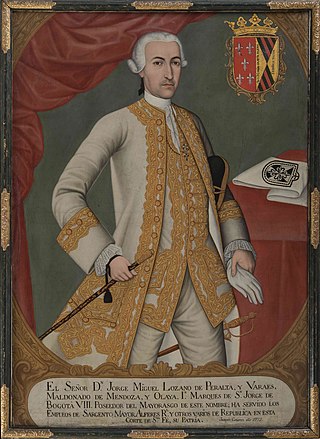
Jorge Miguel Lozano de Peralta y Varaes Maldonado de Mendoza y Olaya, was a Colombian aristocrat, First Marquis of San Jorge de Bogotá, and eighth owner of the "mayorazgo" of the same name, a businessman and politician. descendant of Spanish and Creole elite. Served as mayor of Bogotá and is well known for being the richest man of Colombia during the 18th-century.

The New Granada Civil War was a civil war between 1812 and 1814 in New Granada between Federalists and Centralists. The war ended with a victory for the Federalists.

María Manuela Sanz de Santamaría y Prieto de Salazar or Manuela Santamaría was a learned, polyglot, and intellectual woman from New Granada.
