
Rudolf Emil Kálmán was a Hungarian-American electrical engineer, mathematician, and inventor. He is most noted for his co-invention and development of the Kalman filter, a mathematical algorithm that is widely used in signal processing, control systems, and guidance, navigation and control. For this work, U.S. President Barack Obama awarded Kálmán the National Medal of Science on October 7, 2009.

The Fu Foundation School of Engineering and Applied Science is the engineering and applied science school of Columbia University, a private research university in New York City. It was founded as the School of Mines in 1863 and then the School of Mines, Engineering and Chemistry before becoming the School of Engineering and Applied Science. On October 1, 1997, the school was renamed in honor of Chinese businessman Z.Y. Fu, who had donated $26 million to the school.
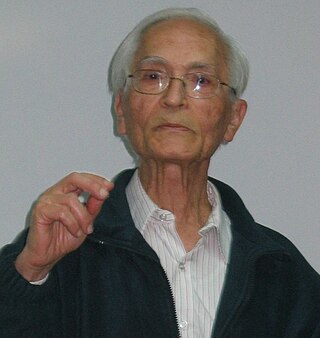
Jacob Ziv was an Israeli electrical engineer and information theorist who developed the LZ family of lossless data compression algorithms alongside Abraham Lempel.

Arden Lee Bement Jr. is an American engineer and scientist and has served in executive positions in government, industry and academia.
Alfred Yi Cho is a Chinese-American electrical engineer, inventor, and optical engineer. He is the Adjunct Vice President of Semiconductor Research at Alcatel-Lucent's Bell Labs. He is known as the "father of molecular beam epitaxy"; a technique he developed at that facility in the late 1960s. He is also the co-inventor, with Federico Capasso of quantum cascade lasers at Bell Labs in 1994.

Yale Nance Patt is an American professor of electrical and computer engineering at The University of Texas at Austin. He holds the Ernest Cockrell, Jr. Centennial Chair in Engineering. In 1965, Patt introduced the WOS module, the first complex logic gate implemented on a single piece of silicon. He is a fellow of both the Institute of Electrical and Electronics Engineers and the Association for Computing Machinery, and in 2014 he was elected to the National Academy of Engineering.

Chandra Kumar Naranbhai Patel (born 2 July 1938) is an electrical engineer. He developed the carbon dioxide laser in 1963; it is now widely used in industry for cutting and engraving a wide range of materials like plastic and wood. Because the atmosphere is quite transparent to infrared light, CO2 lasers are also used for military rangefinding using LIDAR techniques.
Roger Ware Brockett was an American control theorist and the An Wang Professor of Computer Science and Electrical Engineering at Harvard University, who founded the Harvard Robotics Laboratory in 1983.
John Burnette MacChesney II was an American scientist. A Bell Labs pioneer in optical communication, he was best known for his 1974 invention of the modified chemical vapor deposition (MCVD) process with colleague P.B. O'Connor, and for co-inventing high-purity "sol-gel" overcladding for optical fiber in the early 1980s. These inventions were key to the commercial manufacture of optical fiber.
Zenon Jan Pudlowski (Pudłowski) is an engineer and educator. He is currently director of the World Institute for Engineering and Technology Education based in Melbourne, Australia. He is also a visiting professor at Slovak University of Technology in Bratislava, Bratislava, Slovakia.
Behzad Razavi is an Iranian-American professor and researcher of electrical and electronic engineering. Noted for his research in communications circuitry, Razavi is the director of the Communication Circuits Laboratory at the University of California Los Angeles. He is a Fellow and a distinguished lecturer for the Institute of Electrical and Electronics Engineers. Among his awards, Razavi is a two-time recipient of the Beatrice Winner Award for Editorial Excellence at the 1994 and 2001 International Solid-State Circuits Conferences. In 2017, he was elected as a member into the National Academy of Engineering for contributions to low-power broadband communication circuits.

Yu Hsiu Ku or Gu Yuxiu was a Chinese-American electrical engineer, musician, novelist, poet, and politician. A polymathic academic, he was one of the first Chinese people to earn a doctorate from the Massachusetts Institute of Technology, in 1928, and became a leader in higher education in China until the fall of the Republic of China in 1949. Afterwards, he worked for many years as a professor of electrical engineering at the University of Pennsylvania.
Ingo R. Titze is a voice scientist and executive director of the National Center for Voice and Speech and Adjunct Professor in the Department of Otolaryngology/Head and Neck Surgery at the University of Utah in Salt Lake City. He also teaches at the Summer Vocology Institute, also housed at the University of Utah. He is a Distinguished Professor at the Department of Communication Sciences and Disorders at the University of Iowa and has written several books relating to the human voice.
David A. B. Miller is the W. M. Keck Foundation Professor of Electrical Engineering at Stanford University, where he is also a professor of Applied Physics by courtesy. His research interests include the use of optics in switching, interconnection, communications, computing, and sensing systems, physics and applications of quantum well optics and optoelectronics, and fundamental features and limits for optics and nanophotonics in communications and information processing.
Laxmangudi Krishnamurthy Doraiswamy (1927–2012) was an Indian-American chemical engineer, author and academic, known for his contributions in developing Organic synthesis engineering as a modern science discipline. Chemical Engineering journal of McGraw Hill listed him among the 10 most distinguished chemical engineers in the world in 1988. He was the author of nine texts in chemical engineering, including Organic Synthesis Engineering, a 2001 publication which is known to have introduced the topic as a definitive scientific stream and Heterogeneous reactions: Analysis, Examples, and Reactor Design, reportedly the first comprehensive text in chemical engineering.
Thomas H. Lee was a Chinese-American electrical engineer and writer. He worked for General Electric for 30 years, where he developed the first practical vacuum interrupter and the silicon rectifier in the 1960s. In the 1980s he served as the Philip Sporn Professor of Energy Processing at the Massachusetts Institute of Technology and co-chaired the MIT Sloan School's Management of Technology program. He was elected a member of the National Academy of Engineering in 1975 and a foreign member of the Chinese Academy of Engineering in 2000. He was an IEEE Fellow and received the IEEE Haraden Pratt Award in 1983.

Adam Robertson is an American politician, businessman, and engineer who served as a member of the Utah House of Representatives for the 63rd district, which includes Provo, Utah.
Dave Williams is an American politician, retired engineer, and businessman who served as a member of the Iowa House of Representatives from the 60th district. Elected in 2018, he assumed office on January 14, 2019.

Andrew B. Williams is an American academic in the field of engineering. He is currently the Dean of Engineering and the Louis S. LeTellier Chair for The Citadel School of Engineering in Charleston. It comes with a rank of Colonel in the SCM. He was the Associate Dean for Diversity, Equity, and Inclusion at the University of Kansas, and the Charles E. and Mary Jane Spahr Professor in Electrical Engineering and Computer Science.
Ulrich Lothar Albert Rohde is a German and American electrical engineer, entrepreneur, and university professor.
