
Eyam is an English village and civil parish in the Derbyshire Dales that lies within the Peak District National Park. There is evidence of early occupation by Ancient Britons on the surrounding moors and lead was mined in the area by the Romans. A settlement was founded on the present site by Anglo-Saxons, when mining was continued and other industries later developed. However, Eyam’s main claim to fame is the story of how the village chose to go into isolation so as to prevent infection spreading after bubonic plague was discovered there in 1665.

During the Great Plague of 1665 the area of Derby, England, fell victim to the bubonic plague epidemic, with many deaths. Some areas of Derby still carry names that record the 1665 visitation such as Blagreaves Lane which was Black Graves Lane, while Dead Man's Lane speaks for itself. It has been claimed by some historians that bodies were buried standing upright at St. Peter's Church, Derby, but this legend has been refuted by experts.

The history of Derbyshire can be traced back to human settlement since the last Ice Age, over 10,000 years ago. The county of Derbyshire in England dates back to the 11th century.

Toxteth Park Cemetery is a graveyard on Smithdown Road, Liverpool, United Kingdom. It was opened on Monday 9 June 1856. It was the responsibility of the Toxteth Park Burial Board, which had been established by at least 1855.

Ashford-in-the-Water is a village and civil parish in the Derbyshire Peak District, England. The village is on the River Wye, 2 miles (3 km) north-west of Bakewell. It is known for the quarrying of Ashford Black Marble, and for the maidens' garlands made to mark the deaths of virgins in the village until 1801. Some of these are preserved in the parish church. The civil parish population taken at the 2011 Census was 559.

Erwarton or Arwarton is a small village and civil parish in the Babergh district of Suffolk, England. The parish includes the hamlet of Shop Corner. Located on the Shotley peninsula around 9 miles (14 km) south of Ipswich, in 2005 it had a population of 110, increasing to 126 at the 2011 Census.

York Cemetery is a cemetery located in the city of York, England. Founded in 1837, it now encompasses 24 acres and is owned and administered by The York Cemetery Trust with support of the Friends of York Cemetery. It is situated on Cemetery Road in the Fishergate area of York. It has approximately 28,000 graves and over 17,000 monuments, six of which are Grade II-listed. The chapel is a Grade II* listed building, while the gatehouse, gate and railings are Grade II. The architect of these buildings and the grounds was James Pigott Pritchett.

Warstone Lane Cemetery,, also called Brookfields Cemetery, Church of England Cemetery, or Mint Cemetery, is a cemetery dating from 1847 in Birmingham, England. It is one of two cemeteries in the city's Jewellery Quarter, in Hockley. It is no longer open to new burials.

William Mompesson was a Church of England priest whose decisive action when his Derbyshire parish, Eyam, became infected with the plague in the 17th century averted more widespread catastrophe.

St John the Baptist church is a C of E church in Bamford in the Hope Valley, Derbyshire, England.

Eyam Hall is a country house within the civil parish of Eyam, Derbyshire, located to the west of St Lawrence's Church, Eyam. It is recorded in the National Heritage List for England as a Grade II* listed building.

Eyam Museum or as it is locally known Eyam Plague museum is a local museum in the village of Eyam, located in the Peak District, Derbyshire, England.

The English coastal city of Brighton and Hove, made up of the formerly separate Boroughs of Brighton and Hove in East Sussex, has a wide range of cemeteries throughout its urban area. Many were established in the mid-19th century, a time in which the Victorian "cult of death" encouraged extravagant, expensive memorials set in carefully cultivated landscapes which were even recommended as tourist attractions. Some of the largest, such as the Extra Mural Cemetery and the Brighton and Preston Cemetery, were set in particularly impressive natural landscapes. Brighton and Hove City Council, the local authority responsible for public services in the city, manages seven cemeteries, one of which also has the city's main crematorium. An eighth cemetery and a second crematorium are owned by a private company. Many cemeteries are full and no longer accept new burials. The council maintains administrative offices and a mortuary at the Woodvale Cemetery, and employs a coroner and support staff.
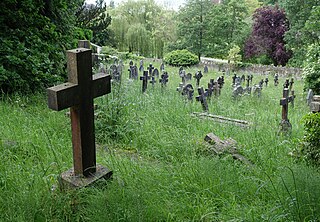
Smallcombe Cemetery is on the edge of Bath, Somerset, England, in a valley between Widcombe Hill and Bathwick Hill. It has two distinct parts, the Anglican section known as St Mary's Churchyard and the nonconformist section known as Smallcombe Vale cemetery; they are sometimes known together as Smallcombe Garden cemetery. The two cemeteries have been closed to new burials since 1988 and are maintained by Bath and North East Somerset Council. The Bath Corporation had assumed responsibility for both cemeteries in 1947.

Vineyard Passage Burial Ground is a cemetery on Vineyard Passage in Richmond in the London Borough of Richmond upon Thames. Established in 1790 and consecrated in 1791, it was enlarged in 1823. The last burials were in 1874. Managed by Richmond upon Thames Council and maintained by volunteers from the Environment Trust for Richmond upon Thames, it is now a garden of rest.
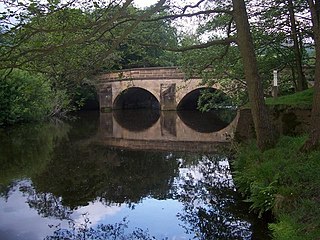
Highlow is a civil parish within the Derbyshire Dales district, in the county of Derbyshire, England. Largely rural, Highlow's population is reported with the population of neighbouring parishes for a total of 585 residents in 2011. It is 140 miles (230 km) north-west of London, 28 miles (45 km) north-west of the county city of Derby, and 7+1⁄2 miles (12.1 km) north of the nearest market town of Bakewell. Highlow is wholly within the Peak District national park, and shares a border with the parishes of Abney and Abney Grange, Eyam, Foolow, Grindleford, Hathersage as well as Offerton. There are nine listed buildings in Highlow.
Eyam is a civil parish in the Derbyshire Dales district of Derbyshire, England. The parish contains 55 listed buildings that are recorded in the National Heritage List for England. Of these, one is listed at Grade I, the highest of the three grades, two are at Grade II*, the middle grade, and the others are at Grade II, the lowest grade. The parish contains the village of Eyam and the surrounding countryside. The history of the village is notable because when the plague broke out in 1666, the village went into voluntary quarantine to prevent the disease from spreading outside. Some of the listed buildings are associated with this event, including cottages occupied by the victims of the disease, and their gravestones. Most of the other listed buildings are houses, cottages and farmhouses and associated structures. The other listed buildings include a church, a cross and tombs in the churchyard, the rectory, a well head, water troughs, a set of stocks, and the former engine house to a lead mine,

Mompesson's Well is a 17th-century grade II listed water well in Eyam, Derbyshire.

Jumber Brook is a stream in Eyam in the Derbyshire Peak District. The stream originates to the north of the village at Highcliffe. The brook flows south through the middle of the village before meeting the Dale Brook in Middleton Dale near Stoney Middleton.


