
Riverside is a city in, and the county seat of, Riverside County, California, United States, located in the Inland Empire metropolitan area. It is named for its location beside the Santa Ana River. It is the most populous city in the Inland Empire and in Riverside County, and is located about 55 miles (89 km) east of downtown Los Angeles. It is also part of the Greater Los Angeles area. Riverside is the 58th most populous city in the United States and 12th most populous city in California. As of the 2010 Census, Riverside had a population of 303,871.

California Citrus State Historic Park is an open-air museum in the state park system of California, USA, interpreting the historic cultural landscape of the citrus industry. The park’s museum exhibits and interpretive features share the story of the citrus industry's role in the history and development of Southern California, and is told through the experiences of the diverse migrant and immigrant groups who made it all possible. The California Citrus State Historic Park is in the city of Riverside in Riverside County, California, United States. The 248-acre (100 ha) park was established in 1993.

The Minnesota Historical Society (MNHS) is a nonprofit educational and cultural institution dedicated to preserving the history of the U.S. state of Minnesota. It was founded by the territorial legislature in 1849, almost a decade before statehood. The Society is named in the Minnesota Constitution. It is headquartered in the Minnesota History Center in downtown Saint Paul.
The Mission Inn, now known as The Mission Inn Hotel & Spa, is a historic landmark hotel in downtown Riverside, California. Although a composite of many architectural styles, it is generally considered the largest Mission Revival Style building in the United States. Mission Inn Hotel & Spa is a member of Historic Hotels of America, the official program of the National Trust for Historic Preservation.

The Bowers Museum is an art museum located in Orange County, California. The museum's permanent collection includes more than 100,000 objects, and features notable strengths in the areas of pre-Columbian Mesoamerica, Native American art, the art of Asia, Africa, and Oceania, and California plein-air painting. The Bowers organizes and hosts special exhibitions from institutions throughout the world, and travels exhibitions nationally and internationally. The museum has a second campus two blocks south of the main site, Kidseum, a children's museum with a focus on art and archaeology. The Bowers Museum and Kidseum are located in Santa Ana 6.4 km south of Disneyland.
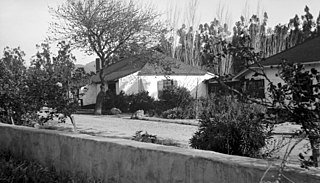
Rancho Camulos, now known as Rancho Camulos Museum, is a ranch located in the Santa Clara River Valley 2.2 miles (3.5 km) east of Piru, California and just north of the Santa Clara River, in Ventura County, California. It was the home of Ygnacio del Valle, a Californio alcalde of the Pueblo de Los Angeles in the 19th century and later elected member of the California State Assembly. The ranch was known as the Home of Ramona because it was widely believed to have been the setting of the popular 1884 novel Ramona by Helen Hunt Jackson. The novel helped to raise awareness about the Californio lifestyle and romanticized "the mission and rancho era of California history."

The Louisiana State Museum (LSM), founded in New Orleans in 1906, is a statewide system of National Historic Landmarks and modern structures across Louisiana, housing thousands of artifacts and works of art reflecting Louisiana's legacy of historic events and cultural diversity.
James Preston Delgado, Ph.D. is a maritime archaeologist, historian, maritime preservation expert, author, television host, and explorer.

The Indiana State Museum is a museum located within White River State Park in Indianapolis, Indiana, United States. The museum houses exhibits on the science, art, culture, and history of Indiana from prehistoric times up to the present day. The museum is also the site of the state's largest IMAX screen.

The Museum of Indian Arts and Culture/Laboratory of Anthropology is a museum of Native American art and culture located in Santa Fe, New Mexico. It is one of eight museums in the state operated by the New Mexico Department of Cultural Affairs and is accredited by the American Alliance of Museums as part of the Museum of New Mexico system. The museum and its programs are financially supported by the Museum of New Mexico Foundation.
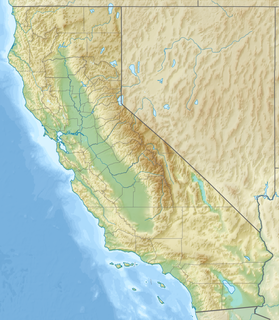
Mount Rubidoux is a mountain just west of downtown in the city of Riverside, California, United States, that has been designated a city park and landmark. The mountain was once a popular Southern California tourist destination and is still the site of the oldest outdoor non-denominational Easter Sunrise service in the United States. Many historic markers and memorials have been placed on the mountain, the most prominent being the cross at the summit dedicated to Father Junípero Serra. A majority of Mt. Rubidoux is owned by the City of Riverside, while 0.43 acres at the peak is owned by Rivers & Lands Conservancy after the cross attracted a potential lawsuit and the city decided to sell it at auction it to a private organization.
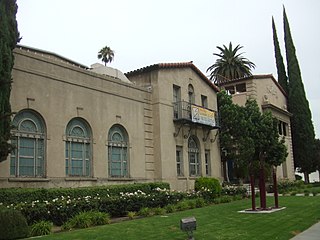
Riverside Art Museum is an art museum in the historic Mission Inn District of Riverside, California. The museum is a non-profit organization.

The Harada House is a historic house located on 3356 Lemon Street in Riverside, California. The house, created in 1884 and built upon by the Harada family, was the focus of a critical application of the California Alien Land Law of 1913, which prevented foreigners who were ineligible for citizenship from owning property. The state of California attempted to seize the property from the family in California v. Harada, but the Haradas ultimately won the case and retained ownership of the house. The house was declared a National Historic Landmark in 1990 and is currently overseen by the Riverside Metropolitan Museum.

The New Jersey State Museum is located at 205 West State Street in Trenton, New Jersey, overlooking the Delaware River, and serves a broad region between New York and Philadelphia. The museum's collections include natural history specimens, archaeological and ethnographic artifacts, and cultural history and fine art objects, and exhibitions, educational programs and research provide context for the collections. The museum, a division of the New Jersey Department of State, includes a 140-seat planetarium and a 384-seat auditorium.

The Orcutt Ranch Horticulture Center, formally known as Rancho Sombra del Roble, is a Los Angeles Historic-Cultural Monument located in the West Hills section of Los Angeles, California, USA.

Riverside, California, was founded in 1870, and named for its location beside the Santa Ana River. It became the county seat when Riverside County, California, was established in 1893.

Cabot's Pueblo Museum is a historic house museum located in Desert Hot Springs, California, United States. A large, Hopi-style pueblo, built in the Pueblo Revival Style, it contains artworks, artifacts of American Indian and Alaska Native cultures, and memorabilia of early desert homesteader life.
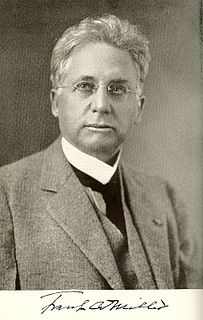
Frank Augustus Miller was the owner and chief developer of the Mission Inn in Riverside, California, United States, where Frank Augustus Miller Middle School was named after him. He was also a civic leader and one of Riverside's strongest promoters.

The Colorado Springs Pioneers Museum is located at 215 S. Tejon Street in Colorado Springs, Colorado. The granite building with a domed clock tower was the El Paso County Courthouse building from 1903 to 1973. The museum, which moved to this location in 1979, has fine arts, artifacts and archival collections that document the Pikes Peak region. The building is on the National Register of Historic Places, and was the 2nd property to be listed in El Paso County, after Pikes Peak.

The Corona Founders Monument is a monument built in 1936 to the founding fathers of the City of Corona in the Riverside County, California. The monument was designated a California Historic Landmark (No.738) on June 6, 1960. The monument is in the Corona City Park in the 100 block of 6th Street of Corona, California. The founding fathers at first called the city South Riverside after the company they started the South Riverside Land and Water Company.


