
Bryozoa are a phylum of simple, aquatic invertebrate animals, nearly all living in sedentary colonies. Typically about 0.5 millimetres long, they have a special feeding structure called a lophophore, a "crown" of tentacles used for filter feeding. Most marine bryozoans live in tropical waters, but a few are found in oceanic trenches and polar waters. The bryozoans are classified as the marine bryozoans (Stenolaemata), freshwater bryozoans (Phylactolaemata), and mostly-marine bryozoans (Gymnolaemata), a few members of which prefer brackish water. 5,869 living species are known. At least, four genera are solitary ; all the rest are colonial.

The lycophytes, when broadly circumscribed, are a vascular plant (tracheophyte) subgroup of the kingdom Plantae. They are sometimes placed in a division Lycopodiophyta or Lycophyta or in a subdivision Lycopodiophytina. They are one of the oldest lineages of extant (living) vascular plants; the group contains extinct plants that have been dated from the Silurian. Lycophytes were some of the dominating plant species of the Carboniferous period, and included tree-like species, although extant lycophytes are relatively small plants.
Stenolaemata are a class of exclusively marine bryozoans. Stenolaemates originated and diversified in the Ordovician, and more than 600 species are still alive today. All extant (living) species are in the order Cyclostomatida, the third-largest order of living bryozoans.
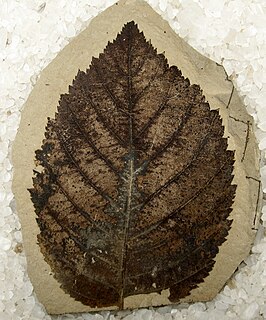
Paleobotany, which is also spelled as palaeobotany, is the branch of botany dealing with the recovery and identification of plant remains from geological contexts, and their use for the biological reconstruction of past environments (paleogeography), and the evolutionary history of plants, with a bearing upon the evolution of life in general. A synonym is paleophytology. It is a component of paleontology and paleobiology. The prefix palaeo- means "ancient, old", and is derived from the Greek adjective παλαιός, palaios. Paleobotany includes the study of terrestrial plant fossils, as well as the study of prehistoric marine photoautotrophs, such as photosynthetic algae, seaweeds or kelp. A closely related field is palynology, which is the study of fossilized and extant spores and pollen.

The cladoxylopsids are an extinct group of plants related to ferns and sphenopsids.

Herpestes is a genus within the mongoose family Herpestidae. Several species in the family are known as slender mongooses. It is the type genus of the family, and comprises 5-6 living species, each with several subspecies. Fossil remains of three prehistoric species were excavated in France, and described in 1853.

Polysporangiophytes, also called polysporangiates or formally Polysporangiophyta, are plants in which the spore-bearing generation (sporophyte) has branching stems (axes) that bear sporangia. The name literally means 'many sporangia plant'. The clade includes all land plants (embryophytes) except for the bryophytes whose sporophytes are normally unbranched, even if a few exceptional cases occur. While the definition is independent of the presence of vascular tissue, all living polysporangiophytes also have vascular tissue, i.e., are vascular plants or tracheophytes. Extinct polysporangiophytes are known that have no vascular tissue and so are not tracheophytes.

Oxetocyon is an extinct monospecific genus of the Borophaginae subfamily of canids native to North America. It lived during the Early Oligocene epoch, existing for approximately 2.5 million years. Fossils have been found in Nebraska and South Dakota.

Tomarctus is a canid genus of the extinct subfamily Borophaginae which inhabited most of North America during the late Early Miocene to the Early Barstovian age of the Middle Miocene. Tomarctus existed for approximately 6.83 million years.
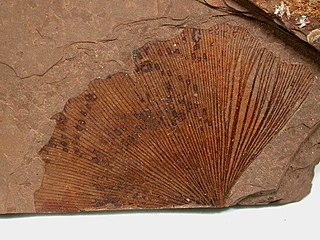
Ginkgo is a genus of non-flowering seed plants. The scientific name is also used as the English name. The order to which it belongs, Ginkgoales, first appeared in the Permian, 270 million years ago, and is now the only living genus within the order. The rate of evolution within the genus has been slow, and almost all its species had become extinct by the end of the Pliocene. The sole surviving species, Ginkgo biloba is only found in the wild in China, but is cultivated around the world. The relationships between ginkgos and other groups of plants are not fully resolved.

The evolution of fungi has been going on since fungi diverged from other life around 1.5 billion years ago, with the glomaleans branching from the "higher fungi" (dikaryans) at ~570 million years ago, according to DNA analysis. Fungi probably colonized the land during the Cambrian, over 500 million years ago,, and possibly 635 million years ago during the Ediacaran, but terrestrial fossils only become uncontroversial and common during the Devonian, 400 million years ago.

Rusophycus is a trace fossil ichnogenus allied to Cruziana. Rusophycus is the resting trace, recording the outline of the tracemaker; Cruziana is made when the organism moved. The sculpture of Rusophycus may reveal the approximate number of legs that the tracemaker had, although striations (scratchmarks) from a single leg may overlap or be repeated.
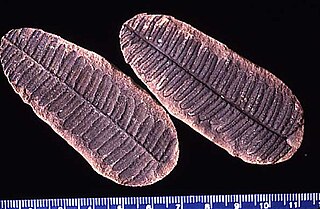
Pecopteris is a very common form genus of leaves. Most Pecopteris leaves and fronds are associated with the marattialean tree fern Psaronius. However, Pecopteris-type foliage also is borne on several filicalean ferns, and at least one seed fern. Pecopteris first appeared in the Devonian period, but flourished in the Carboniferous, especially the Pennsylvanian. Plants bearing these leaves became extinct in the Permian period, due to swamps disappearing and temperatures on Earth dropping.
Diadsomaspis is an extinct genus of placoderm fish, which lived during the Late Devonian period in Europe.
Leptorrhamphus is an extinct monospecific genus of gavialoid crocodilian that lived during the Middle to Late Miocene in what is now Argentina. Fossils have been found in the formation then named Entrerriana Formation, in modern literature referred to as the Ituzaingó Formation. The type species is L. entrerrianus, named after the formation in 1890. It is now thought to be a nomen dubium.

Cynarctoides is an extinct genus of the Borophaginae subfamily of canids native to North America. It lived from the Early Oligocene to the Middle Miocene, 33.3—13.6 Mya, existing for approximately 19.7 million years. Seven species are currently recognised, all of which are estimated to have weighed no more than 1 kilogram (2.2 lb). They had an unusual dentition that implies an omnivorous, or possibly even herbivorous, diet.
Serrulacaulis was a genus of early land plant with branching axes. Known fossils are of Late Devonian age.

Pagiophyllum is a form genus of fossil coniferous plant foliage. Plants of the genus have been variously assigned to several different conifer groups including Araucariaceae and Cheirolepidiaceae. They were found around the globe during the Carboniferous to the Cretaceous period.
The Calamopityales are an extinct order of plants belonging to Pteridospermatophyta, or seed ferns.
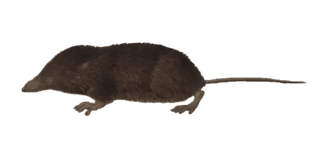
Soriculus is a genus of shrew native to Asia. The Himalayan shrew (Soriculus nigrescens) is the only extant member of the genus, though other species were once included here and there are also several fossil species included here.


