Related Research Articles
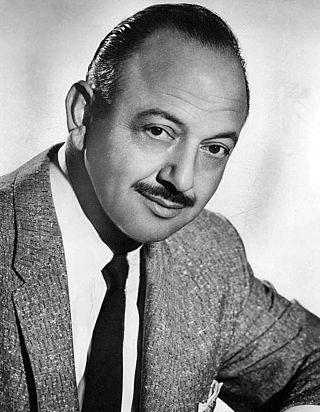
Melvin Jerome Blanc was an American voice actor and radio personality whose career spanned over 60 years. During the Golden Age of Radio, he provided character voices and vocal sound effects for comedy radio programs, including those of Jack Benny, Abbott and Costello, Burns and Allen, The Great Gildersleeve, Judy Canova, and his own short-lived sitcom.

Bugs Bunny is an animated cartoon character created in the late 1930s at Warner Bros. Cartoons and voiced originally by Mel Blanc. Bugs is best known for his featured roles in the Looney Tunes and Merrie Melodies series of animated short films, produced by Warner Bros. Earlier iterations of the character first appeared in Ben Hardaway's Porky's Hare Hunt (1938) and subsequent shorts before Bugs's definitive characterization debuted in Tex Avery's A Wild Hare (1940). Bob Givens, Chuck Jones and Robert McKimson are credited for defining Bugs's design.

Daffy Duck is an animated cartoon character created for Leon Schlesinger Productions by animators Tex Avery and Bob Clampett. Styled as an anthropomorphic black duck, he has appeared in cartoon series such as Looney Tunes and Merrie Melodies, in which he is usually depicted as a foil for either Bugs Bunny or Porky Pig. He was one of the first of the new "screwball" characters that emerged in the late 1930s to replace traditional everyman characters who were more popular earlier in the decade, such as Mickey Mouse, Porky Pig, and Popeye.

Porky Pig is an animated character in the Warner Bros. Looney Tunes and Merrie Melodies series of cartoons. He was the first character created by the studio to draw audiences based on his star power, and the animators created many critically acclaimed shorts featuring the character. Even after he was supplanted by later characters, Porky continued to be popular with moviegoers and, more importantly, the Warners directors, who recast him in numerous everyman and sidekick roles.

Yosemite Sam is a cartoon character in the Looney Tunes and Merrie Melodies series of short films produced by Warner Bros. His name is taken from Yosemite National Park. He is an adversary of Bugs Bunny. He is commonly depicted as a mean-spirited and extremely aggressive, gunslinging outlaw or cowboy with a hair-trigger temper and an intense hatred of rabbits, Bugs in particular. In cartoons with non-Western themes, he uses various aliases, including "Chilkoot Sam" and "Square-deal Sam" in 14 Carrot Rabbit, "Riff Raff Sam" in Sahara Hare, "Sam Schultz" in Big House Bunny, "Seagoin' Sam" in Buccaneer Bunny, "Shanghai Sam" in Mutiny on the Bunny, "Von Schamm the Hessian" in Bunker Hill Bunny, "Baron Sam von Schpamm" in Dumb Patrol, and many others. During the golden age of American animation, Yosemite Sam appeared as antagonist in 33 animated shorts made between 1945 and 1964.

Arthur Quirk Bryan was an American actor and radio personality. He is best remembered for his longtime recurring role as well-spoken, wisecracking Dr. Gamble on the radio comedy Fibber McGee and Molly and for creating the voice of the Warner Brothers cartoon character Elmer Fudd.
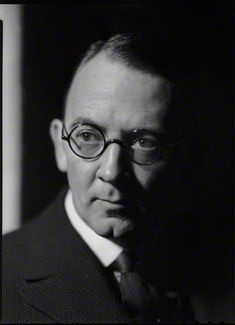
Noel Gay was born Reginald Moxon Armitage. He also used the name Stanley Hill professionally. He was a successful British composer of popular music of the 1930s and 1940s whose output comprised 45 songs as well as the music for 28 films and 26 London shows. Sheridan Morley has commented that he was "the closest Britain ever came to a local Irving Berlin". He is best known for the musical, Me and My Girl.

The Big Snooze is a 1946 Warner Bros. Looney Tunes cartoon planned by Bob Clampett and was written by him, but was ultimately completed by Arthur Davis, both being uncredited as directors. Its title was inspired by the 1939 book The Big Sleep, and its 1946 film adaptation, also a Warner release. The Big Snooze features Bugs Bunny and Elmer Fudd, voiced by Mel Blanc and Arthur Q. Bryan.
Flanagan and Allen were a British singing and comedy double act most active during the 1930s and 1940s. Its members were Bud Flanagan and Chesney Allen (1894–1982). They were first paired in a Florrie Forde revue, and were booked by Val Parnell to appear at the Holborn Empire in 1929.

Up Helly Aa is a type of fire festival held annually from January to March in various communities in Shetland, Scotland, to mark the end of the Yule season. Each festival involves a torchlit procession by squads of costumed participants that culminates in the burning of an imitation Viking galley. The largest festival held in Lerwick, Shetland's capital, involves a procession of up to a thousand guizers who march through the streets of Lerwick on the last Tuesday in January. The other rural festivals see lower numbers of participants in accordance with their lower populations.
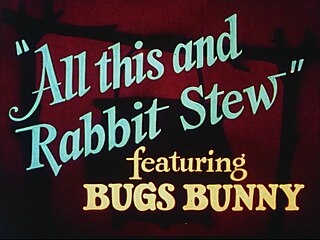
All This and Rabbit Stew is a 1941 Merrie Melodies cartoon directed by Tex Avery. The cartoon was released on September 13, 1941, and features Bugs Bunny.

Rabbit in the Moon is an American electronic music group that formed in 1991. Their style draws from psychedelic trance, house music and breakbeat, along with other diverse influences.
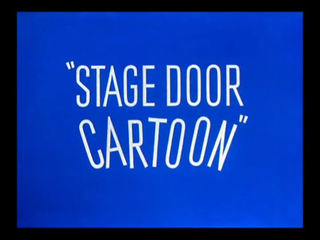
Stage Door Cartoon is a 1944 Merrie Melodies cartoon directed by Friz Freleng. The short was released on December 30, 1944, and features Bugs Bunny and Elmer Fudd.
Ralph Thomas Butler was a British songwriter, responsible for the lyrics of many popular songs of the 1930s and later, mostly with comic or novelty elements.

Elmer J. Fudd is an animated cartoon character in the Warner Bros. Looney Tunes/Merrie Melodies series and the archenemy of Bugs Bunny. He has one of the more disputed origins in the Warner Bros. cartoon pantheon. His aim is to hunt Bugs, but he usually ends up seriously injuring himself and other antagonizing characters. He speaks in an unusual way, replacing his Rs and Ls with Ws, so he often refers to Bugs Bunny as a "scwewy" or "wascawwy (rascally) wabbit". Elmer's signature catchphrase is, "Shhh. Be vewy vewy quiet, I'm hunting wabbits", as well as his trademark laughter.
The character that would evolve into Bugs Bunny appeared in four cartoon shorts before his first official appearance in Tex Avery's A Wild Hare. While this early version is commonly referred to as "Happy Rabbit", animation historian David Gerstein disputes this, saying that the only usage of the term was from Mel Blanc himself; the name "Bugs Bunny" was used as early as April 1938, from a model sheet made by Charles Thorson which was used for the short Hare-um Scare-um. Bugs was also mentioned by name from an August 1939 review of the short in the Motion Picture Herald.
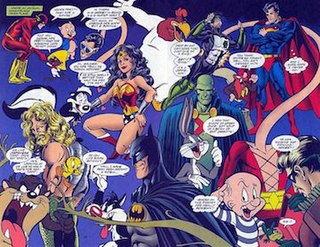
Superman & Bugs Bunny is a four-issue comics miniseries released in 2000 by DC Comics. It is the first official DC crossover between the DC Universe and the Looney Tunes characters.

The Looney Tunes Show is an American animated sitcom produced by Warner Bros. Animation that ran from May 3, 2011, through August 31, 2014, on Cartoon Network. The series consists of two seasons, each containing 26 episodes, and features characters from the Looney Tunes and Merrie Melodies theatrical cartoon shorts updated for the 21st century.

Looney Tunes: Rabbits Run is a 2015 American animated direct-to-video adventure comedy film based on the 2011 TV series The Looney Tunes Show, produced by Warner Bros. Animation. It is the first new Looney Tunes direct-to-video film in nine years since Bah, Humduck! A Looney Tunes Christmas. The film was directed by Jeff Siergey, a supervising animator on Space Jam and lead animator on Looney Tunes: Back in Action. He was also a director on The Looney Tunes Show. It was released on August 4, 2015 by Warner Home Video, but it was released early on July 7, 2015 on Vudu and Walmart.
References
- ↑ Bennett, Daniel (17 November 2019). "A bomb, a song, a rabbit - the first WW2 bombs to fall on British soil". BBC . Retrieved 4 January 2021.
The rabbit in the photo is curiously intact," observes Dr Tait. "The fact is a rabbit was killed in the attack, but was eaten. Some people claim this rabbit (in the photo) is a prop - that's an over-rectification of history. The rabbit in the photo isn't the one the bomb killed." Robbie Williamson, a photographer from Lerwick, had a keen eye for a shot. When he heard about the rabbit's death, he went to record the "historic bombing" for the purposes of a postcard. But his camera wasn't the only gear he brought. "He had a good eye for something that would sell. But before going north he went to a butcher's shop to buy a rabbit," explains Dr Tait.
- ↑ "The event made headline news across Britain and a photograph was taken of a man holding two dead rabbits at the site of the crater. The rabbits came from a butcher shop in Lerwick. The story popularised the song Run, Rabbit, Run, which was seen as a skit on the ineffectiveness of the German air force (Luftwaffe)." Photo Number NE02730, Bomb crater, 13th Nov 1939, at https://photos.shetlandmuseumandarchives.org.uk/. Accessed 4 Jan 2021
- ↑ "The idea that the popular song "Run, Rabbit, Run" commemorated it is nonsense." /comparing dates of song and bomb/ Photo Number 02963, Bomb Crater, November 1939, at Shetland Museum Archives, accessed 4 Jan 2021
- ↑ Ratter, JD. "Photo #R01263, 13th Nov 1939". Shetland Museum & Archives. Retrieved 4 January 2021.
A popular myth in Shetland is that the song "Run, Rabbit, Run" commemorated this event, as a skit on the ineffectiveness of the German air force, but this is wrong - the song was released before the event.
- ↑ Hickman, Tom: Churchill's Bodyguard: The Authorised Biography of Walter H Thompson. Headline Book Publishing, 2005, ISBN 0-7553-1448-4
- ↑ Bunny & Elmer Fudd Weetabix advert
- ↑ Edelstein, David (23 February 2017). "Jordan Peele's Get Out Is Terrifying, Socially Conscious Horror". Vulture. Retrieved 27 May 2017.
