
Valentin Vitalyevich Lebedev is a former Soviet cosmonaut who made two flights into space. His stay aboard the Space Station Salyut 7 with Anatoly Berezovoy in 1982, which lasted 211 days, was recorded in the Guinness Book of Records.
GOST refers to a set of international technical standards maintained by the Euro-Asian Council for Standardization, Metrology and Certification (EASC), a regional standards organization operating under the auspices of the Commonwealth of Independent States (CIS).

The Academy of Sciences of the Soviet Union was the highest scientific institution of the Soviet Union from 1925 to 1991. It united the country's leading scientists and was subordinated directly to the Council of Ministers of the Soviet Union.

The Society for the Assistance of Defense, Aircraft and Chemical Construction was a Soviet socio-political defense organization and mass voluntary society that existed from 1927–1948. It was the predecessor of DOSAAF.

Azerbaijan National Academy of Sciences (ANAS), located in Baku, is the main state research organization and the primary body that conducts research and coordinates activities in the fields of science and social sciences in Azerbaijan. It was established on 23 January 1945.

The Karelian Research Centre of RAS is a state public institute of the Russian Academy of Sciences based in Petrozavodsk. It was founded on January 31, 1946. At the beginning of 2010, the centre employed 751 personnel, including 3 Corresponding Academicians, 70 Doctors of Science (DSc) and 214 Candidates of Science (PhD).

Belarusian Trade-Economic University of Consumer Cooperation is a university in Gomel, Belarus.

The Government of the Soviet Union, formally the All-Union Government of the Union of Soviet Socialist Republics, commonly abbreviated to Soviet Government, was the executive and administrative organ of state in the former Soviet Union. It had four different names throughout its existence; Council of People's Commissars (1923–1946), Council of Ministers (1946–1991), Cabinet of Ministers and Committee on the Operational Management of the National Economy. It also was known as Workers-Peasants Government of the Soviet Union during the Stalin era.

The State Committee for City Building and Architecture is a governmental agency within the Cabinet of Azerbaijan in charge of regulating the urban construction and development and overseeing architectural activities in Azerbaijan. The Committee is headed by Anar Guliyev.
The National Archive Department of the Republic of Azerbaijan is a governmental agency within the Cabinet of Azerbaijan in charge of managing, maintaining, protecting and updating national archives of Azerbaijan. The agency is headed by Atakhan Pashayev.

State Public Scientific and Technological Library of the Siberian Branch of the Russian Academy of Sciences (SPSTL SB RAS) is the largest library in Russia east of the Urals, the State Universal Book repository of Siberia, an Informational Center of the federal level, head library of the centralized system. Here are located the Museum of Book, Siberian Regional Library Center of Continuous Education (SRLCCE), Siberian Regional Center of Document Conservation, Multi-functional Regional Center for Patent and Informational Services in the sphere of protection of intellectual property objects. The Library is the only research institute in the East of the country in the field of librarianship and bibliology with 26 specialists having candidate degree and 6 – Doctor degree.
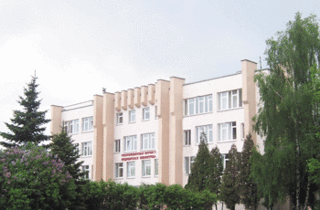
The Republican Scientific Medical Library (RSML) plays a role in providing scientists and specialists, research institutions and medical and preventive treatment facilities, educational establishments and other healthcare facilities of the Republic of Belarus with information and library services.

Arkady Ivanovich Melua is the general director and editor-in-chief of the scientific publishing house, Humanistica.

StateUniversity of Trade and Economics is a Ukrainian university in the capital, Kyiv.

Petrozavodsk State University (PetrSU) is a classical university in Petrozavodsk, Republic of Karelia, Russia. It was founded in 1940 as the Karelian-Finnish University and was renamed in 1956 to Petrozavodsk State University. The rector of Petrozavodsk State University is Prof. Anatoly V. Voronin.

Arkady Ilyich Ostashev, KN, was a Soviet and Russian scientist, engineer-mechanic, a designer of rocket and space systems, who participated in the first launch of a Sputnik and the first cosmonaut by the Soviet Union. He was a Candidate of Technical Sciences, docent, laureate of the Lenin and state prizes, one of the leading managers of work in the field of experimental development of rocket technology products OKB-1, as well as an companion of Sergey Korolev, head of the Soviet space program.

The St. Petersburg Institute for Informatics and Automation of the Russian Academy of Sciences (SPIIRAS) is a federal state budgetary institution of science located in St. Petersburg, Russia. It was founded on December 19, 1977 by a Decree of the Council of Ministers of the USSR. The official foundation date is January 19, 1978, according to a Decree of the Presidium of the USSR Academy of Sciences. The main research fields of the institute are computer science, intelligent automation systems and information technologies. The Institute is located in the building of the former gymnasium of K. May. The current director of the institute is Rafael Midhatovich Yusupov.

The All-Russian Scientific Research Institute of Experimental Physics (VNIIEF) is a research institute based in Sarov, Russia and established in 1947. During the Soviet era, it was known as KB-11 and All-Soviet (All-Union) Scientific Research Institute of Experimental Physics. It is currently part of the Rosatom group.
The Russian Academy of Rocket and Artillery Sciences (RARAN) is a non-profit scientific organization of the Russian Federation. RARAN coordinates the activities of scientists who carry out complex research and development (R & D) on the creation, operation and use of modern weapons, military technology and special equipment. The Academy was established on April 5, 1994 by a decree of the RF President "in order to revive the traditions of Russian military science, and to develop scientific research in the country's defense complex". RARAN is the only scientific and expert organization in the power structures that has state status. It unites leading scientists and specialists from organizations of the Russian Ministry of Defense, other federal executive authorities and the defense industry. This union enables the solutions of problematic issues such as the systemic development of weapons and special military technology (VVST). According to its legal form, RARAN is a federal state budgetary institution. By the Decree of the RF Government on July 17, 1995 No. 715, RARAN was equated with branch academies. The principles of activity and its numbers were determined: 100 full members and 200 corresponding members. In addition, the charter provides for the possibility of electing honorary and foreign members. Since 2016, according to the decision of the board of the RF Military-Industrial Commission, RARAN was designated the head scientific organization for the Council of Chief Designers of the weapons systems of the Army. The President of the Academy was also appointed the head of this council.

