
A smart card (SC), chip card, or integrated circuit card is a physical electronic authentication device, used to control access to a resource. It is typically a plastic credit card-sized card with an embedded integrated circuit (IC) chip. Many smart cards include a pattern of metal contacts to electrically connect to the internal chip. Others are contactless, and some are both. Smart cards can provide personal identification, authentication, data storage, and application processing. Applications include identification, financial, public transit, computer security, schools, and healthcare. Smart cards may provide strong security authentication for single sign-on (SSO) within organizations. Numerous nations have deployed smart cards throughout their populations.
Radio-frequency identification (RFID) uses electromagnetic fields to automatically identify and track tags attached to objects. An RFID system consists of a tiny radio transponder, a radio receiver and transmitter. When triggered by an electromagnetic interrogation pulse from a nearby RFID reader device, the tag transmits digital data, usually an identifying inventory number, back to the reader. This number can be used to track inventory goods.
MG, Mg, or mg and variants may refer to:

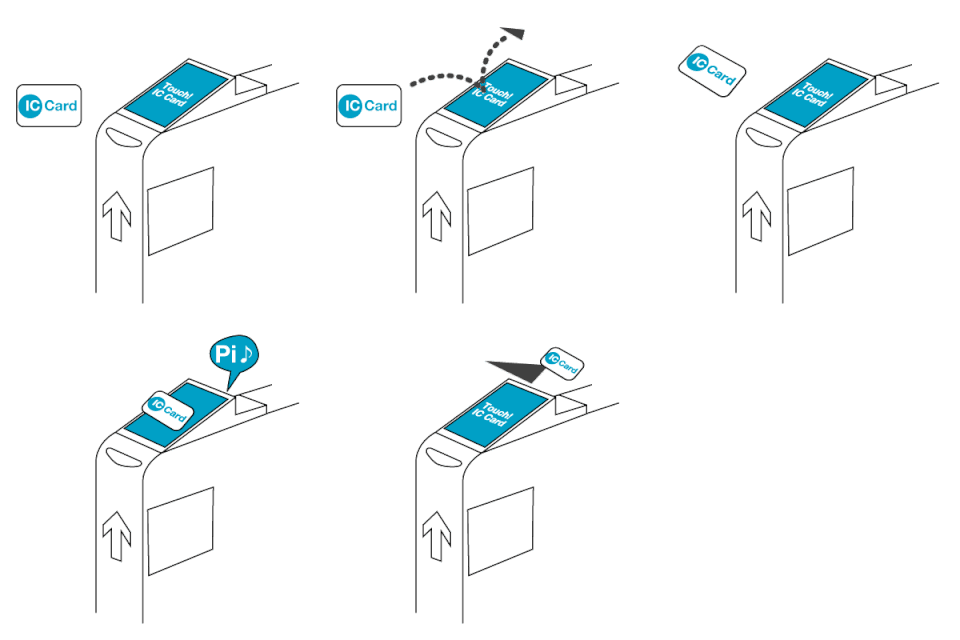
A proximity card or prox card also known as a key card or keycard is a contactless smart card which can be read without inserting it into a reader device, as required by earlier magnetic stripe cards such as credit cards and contact type smart cards. The proximity cards are part of the contactless card technologies. Held near an electronic reader for a moment they enable the identification of an encoded number. The reader usually produces a beep or other sound to indicate the card has been read.

Near-field communication (NFC) is a set of communication protocols that enables communication between two electronic devices over a distance of 4 cm (1.57 in) or less. NFC offers a low-speed connection through a simple setup that can be used to bootstrap more capable wireless connections. Like other "proximity card" technologies, NFC is based on inductive coupling between two antennas present on NFC-enabled devices—for example a smartphone and a printer—communicating in one or both directions, using a frequency of 13.56 MHz in the globally available unlicensed radio frequency ISM band using the ISO/IEC 18000-3 air interface standard at data rates ranging from 106 to 848 kbit/s.

A lock is a mechanical or electronic fastening device that is released by a physical object, by supplying secret information, by a combination thereof, or it may only be able to be opened from one side, such as a door chain.

A QR code is a type of two-dimensional matrix barcode, invented in 1994, by Japanese company Denso Wave for labelling automobile parts. A barcode is a machine-readable optical image that contains information specific to the labelled item. In practice, QR codes contain data for a locator, an identifier, and web tracking. To efficiently store data, QR codes use four standardized modes of encoding (i) numeric, (ii) alphanumeric, (iii) byte or binary, and (iv) kanji.
The EZ-Link card is a rechargeable contactless smart card and electronic money system that is primarily used as a payment method for public transport such as bus and rail lines in Singapore. A standard EZ-Link card is a credit-card-sized stored-value contact-less smart-card that comes in a variety of colours, as well as limited edition designs. It is sold by TransitLink Pte Ltd, a subsidiary of the Land Transport Authority (LTA), and can be used on travel modes across Singapore, including the Mass Rapid Transit (MRT), the Light Rail Transit (LRT), public buses which are operated by SBS Transit, SMRT Buses, Tower Transit Singapore and Go-Ahead Singapore, as well as the Sentosa Express.
FeliCa is a contactless RFID smart card system from Sony in Japan, primarily used in electronic money cards. The name stands for Felicity Card. First utilized in the Octopus card system in Hong Kong, the technology is used in a variety of cards also in countries such as Singapore, Japan, Indonesia, Macau, the Philippines and the United States.
LonTalk is a networking protocol. Originally developed by Echelon Corporation for networking devices over media such as twisted pair, powerlines, fiber optics, and RF. It is popular for the automation of various functions in industrial control, home automation, transportation, and buildings systems such as lighting and HVAC, the protocol has now been adopted as an open international control networking standard in the ISO/IEC 14908 family of standards. Published through ISO/IEC JTC 1/SC 6, this standard specifies a multi-purpose control network protocol stack optimized for smart grid, smart building, and smart city applications.
A contactless smart card is a contactless credential whose dimensions are credit card size. Its embedded integrated circuits can store data and communicate with a terminal via NFC. Commonplace uses include transit tickets, bank cards and passports.
Oracle Secure Global Desktop (SGD) software provides secure access to both published applications and published desktops running on Microsoft Windows, Unix, mainframe and IBM i systems via a variety of clients ranging from fat PCs to thin clients such as Sun Rays.

Speech-generating devices (SGDs), also known as voice output communication aids, are electronic augmentative and alternative communication (AAC) systems used to supplement or replace speech or writing for individuals with severe speech impairments, enabling them to verbally communicate. SGDs are important for people who have limited means of interacting verbally, as they allow individuals to become active participants in communication interactions. They are particularly helpful for patients with amyotrophic lateral sclerosis (ALS) but recently have been used for children with predicted speech deficiencies.
G.hn is a specification for home networking with data rates up to 2 Gbit/s and operation over four types of legacy wires: telephone wiring, coaxial cables, power lines and plastic optical fiber. A single G.hn semiconductor device is able to network over any of the supported home wire types. Some benefits of a multi-wire standard are lower equipment development costs and lower deployment costs for service providers.
The Open Smart Grid Protocol (OSGP) is a family of specifications published by the European Telecommunications Standards Institute (ETSI) used in conjunction with the ISO/IEC 14908 control networking standard for smart grid applications. OSGP is optimized to provide reliable and efficient delivery of command and control information for smart meters, direct load control modules, solar panels, gateways, and other smart grid devices. With over 5 million OSGP based smart meters and devices deployed worldwide it is one of the most widely used smart meter and smart grid device networking standards.
ISO/IEC JTC 1/SC 39 Sustainability for and by Information Technology is a standardization subcommittee of the Joint Technical Committee ISO/IEC JTC 1 of the International Organization for Standardization (ISO) and the International Electrotechnical Commission (IEC), that develops and facilitates standards within the field of sustainability and resource efficiency through Information Technology. The international secretariat of ISO/IEC JTC 1/SC 39 is the American National Standards Institute (ANSI), located in the United States.
ISO/IEC JTC 1/SC 25 Interconnection of information technology equipment is a standardization subcommittee of the Joint Technical Committee ISO/IEC JTC 1, of the International Organization for Standardization (ISO) and the International Electrotechnical Commission (IEC), which develops and facilitates standards within the field of interconnection of information technology equipment. The international secretariat of ISO/IEC JTC 1/SC 25 is the Deutsches Institut für Normung (DIN) located in Germany.
