

Sadie Kuttner Epstein (1883 - May 28, 1973) was an American concert singer.
Sadie Kuttner Epstein (1883 - May 28, 1973) was an American concert singer.
Sadie Kuttner was born in Cincinnati in 1883, the daughter of Simon H. Kuttner (1853-1940) and Pauline Grunauer (1850-1913). She moved to St. Louis in 1900, at which time she entered the Beethoven Conservatory, where she took a course of music under A. I. Epstein, who later became her husband. [1]
She early showed musical talent, taking up the study of the piano as a child. She was gifted by nature with a splendid voice, and could not remember a time when she did not sing. [1]
Sadie Kuttner Epstein had a crystal clear soprano voice with a fullness of tone, richness of color, and emotional expression that invariably captures her audiences. Hers might be an international reputation did she not choose a domestic life in preference to an acceptance of the many flattering offers made by Eastern managers. The warmth and grace of her temperament, added to the skilled cultivation of her musicianship, placed her in the foremost rank of singers. [1]
Since her appearance on the concert stage Epstein sang with the most prominent singing societies in St. Louis and elsewhere, engagements taking her as far north as Winnipeg, Canada, and east as far as Pittsburgh. With many of the societies she was called to take part in oratorios. Her repertoire included the soprano roles in George Frideric Handel's Hiawatha, Giuseppe Verdi's Requiem , Franz Liszt's Elizabeth of Hungary , Max Bruch's Die Schone Helene, Robert Schumann's Paradise and the Peri , and many others. [1]
Epstein had the linguistic ability to interpret her song in three languages. Incessant study, determination and ambition placed her in the high position which she occupied. [1]
There were few concert singers before the public in the 1910s who could render such long and varied lists of song as Epstein. From the point of view of vocalization alone her success was great, and as to interpretation her range of intelligence and feeling was inexhaustive. Epstein had very flattering offers from Eastern concert leaders, but she realized that she could not be the happy wife and mother that she was and lead a life such as would be required of a member of an opera troupe at the same time. [1]
Without any hesitation or regret she refused offer after offer. Her work with the St. Louis Symphony Society was a great triumph. For the first time in many years a singer from this city was chosen to appear as soloist at the regular concerts. [1]
During the Louisiana Purchase Exposition she was engaged by the Scranton Oratorio Society of Scranton, Pennsylvania, to sing the soprano role in Felix Mendelssohn's Oratorio, Elijah , at the concert given by them in Festival Hall in 1904. Epstein was the only St. Louis singer engaged for the concerts given during the fair, most of them coming from Chicago and New York. The soprano role in Elijah was a difficult one, which she rendered amazingly well. [1]
Many unique programmes were rendered by Epstein in connection with Mrs. C. B. Rohland's lecture recitals, and unquestionably some of the most difficult and interesting works of the old and modern composers were presented by these two artists. Compositions by Jean Sibelius, Johann Strauss I, Claude Debussy, Christian Wolff, Pyotr Ilyich Tchaikovsky, Mily Balakirev, Anton Rubinstein, Alexander Borodin, Mikhail Glinka, Bachmetieff, Modest Mussorgsky, Alexander Dargomyzhsky, were presented to the public, and beauties of these works brought out in masterly style. Epstein was the first singer in America to give an entire recital of the works of Sibelius, the great Finnish composer. The two women prepared a pretentious programme of modern Italian music given in various cities during the season of 1913–14. Rohland was a recognized authority on musical data and was closely identified with the development of music in St. Louis. Her lectures were excellently prepared, instructive, and her sympathetic artistic accompaniments on the piano a great help to the singer. She was the director of the new Choral Society which was organized in St. Louis for singers only, the object of the club being to do strictly choral work. Rohland was a resident of Alton, Illinois, but made weekly visits to St. Louis for the purpose of directing musical societies. The Alton public had brought before them many of the leading orchestras, soloists and best musical talent of all countries through the influence of Rohland. [1]

Sadie Kuttner Epstein was the wife of Abraham I. Epstein (1858-1929), of the Beethoven Conservatory, with whom, from 1879 to 1924, as organist and choirmaster of St. John's Methodist Church and the Temple Shaari Emeth, she sang many years. Epstein, in addition to conservatory work, directed these two church choirs for more than twenty years, both of which were known for their remarkable aggregation of good singers. [1]
Two of the representative musicians of St. Louis are Marcus I. Epstein (1855-1947) and Abraham I. Epstein, who gained a national reputation as players of duets on the piano. The Epsteins were an exceptionally talented family. Herman Epstein was equally distinguished as a pianist. They were all Native Americans — born in Mobile, Alabama, the sons of Rabbi Isaac Epstein. [1] [2]
Abraham Epstein studied with Eugène Prévost and other masters, devoting himself mainly to teaching piano, organ and composition lessons. He often did concerts to good advantage, and wrote a concerto for orchestra and piano, also composed considerable church music. By Mariana Brandt and other famous vocalists he was pronounced one of the most skillful of accompanists. [1]
The Epsteins lived at 4316 Lindell, and had two daughters, Marian Epstein Goldstein (1905-1985) and Janet Epstein Mendelson (1909-2005), who were also talented in music. [1]
She died on May 28, 1973, and is buried at New Mount Sinai Cemetery, Affton, Missouri.

Grace Melzia Bumbry was an American opera singer, considered one of the leading mezzo-sopranos of her generation, who also ventured to soprano roles. She belonged to a pioneering generation of African-American classical singers, led by Marian Anderson. She was recognized internationally when Wieland Wagner cast her for the 1961 Bayreuth Festival as Venus in Tannhäuser, the first black singer to appear at the festival.
Louise Juliette Talma was an American composer, academic, and pianist. After studies in New York and in France, piano with Isidor Philipp and composition with Nadia Boulanger, she focused on composition from 1935. She taught at the American Conservatory in Fontainebleau, and at Hunter College. Her opera The Alcestiad was the first full-scale opera by an American woman staged in Europe. She was the first woman in the National Institute of Arts and Letters and the first woman awarded the Sibelius Medal for Composition.
Gundula Janowitz is an Austrian lyric soprano singer of operas, oratorios, lieder, and concerts. She is one of the most renowned opera singers of the 20th century and was pre-eminent in the 1960s and 1970s.
Sheila Harms was a soprano in Germany and Austria. She specialized in the vocal interpretation of lieder, oratorio, and opera, which she combined with her musicianship at the piano.
Jennifer Brigit Vyvyan was a British classical soprano who had an active international career in operas, concerts, and recitals from 1948 up until her death in 1974. She possessed a beautifully clear, steady voice with considerable flexibility in florid music. She was praised for her subtle phrasing and her dramatic gifts enabled her to create vivid individual portrayals. Although she sang a broad repertoire, she is particularly remembered for her association with the works of Benjamin Britten; notably singing roles created for her in the world premieres of several of his operas with the English Opera Group.
Nancy Argenta is a Canadian soprano singer, best known for performing music from the pre-classical era. She has won international acclaim, and is considered one of the leading Handel sopranos of her time.

Betty Allen was an American operatic mezzo-soprano who had an active international singing career during the 1950s through the 1970s. In the latter part of her career her voice acquired a contralto-like darkening, which can be heard on her recording of Sergei Prokofiev’s Alexander Nevsky with conductor Eugene Ormandy and the Philadelphia Orchestra. She was known for her collaborations with American composers, such as Leonard Bernstein, Aaron Copland, David Diamond, Ned Rorem, and Virgil Thomson among others.

Otto Moritz David Goldschmidt was a composer, conductor, pianist and educator, whose works included a piano concerto and other piano pieces, and an oratorio, Ruth, on a biblical theme, written for the Three Choirs Festival. From a prosperous mercantile family in Hamburg, he studied under Felix Mendelssohn at the Leipzig Conservatoire and quickly established himself as a pianist. Among the singers whom he accompanied was "the Swedish Nightingale", the soprano Jenny Lind. They married in 1852, after which she insisted on being billed as "Madame Lind-Goldschmidt".

Ida Paulina Ekman was a Finnish soprano singer. She was also referred to as Ida Morduch-Ekman. Her career was mainly in oratorio and lieder, and she was a renowned interpreter of the songs of Jean Sibelius, many of which were dedicated to her and her husband Karl Ekman, with whose career her own was closely connected. Sibelius regarded her as his favourite singer.
Larysa Kuzmenko is a Juno Awards-nominated Canadian composer and pianist based in Toronto, Ontario. She currently teaches on the music faculties of The Royal Conservatory of Music and the University of Toronto.

Mathilde Aloisia Kralik von Meyrswalden was an Austrian composer.
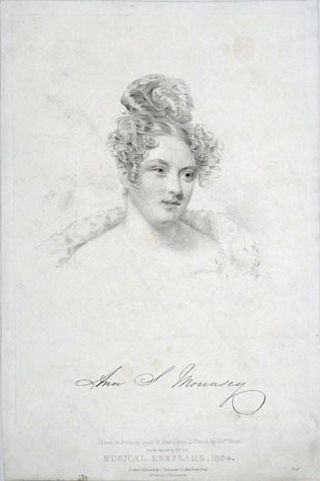
Ann Mounsey or Ann Sheppard Mounsey or Ann Mounsey Bartholomew was born on 17 April 1811 and died on 24 June 1891. She was well known in London as a teacher, conductor, and organist. As a composer, she published songs, hymns, partsongs, large-scale choral worka, and many pieces for the piano and the organ.

Gena Branscombe was a Canadian pianist, composer, music educator and choir conductor who lived and worked in the United States.

Georg Liebling was a German pianist and composer. Part of the Liebling family of musicians, he had an active international career as a concert pianist and accompanist from the 1880s into the 1920s. He also worked as a piano teacher for most of his life, beginning that occupation at the age of 16 and continuing up until his death more than 50 years later. He taught on the faculties of the Kullack Conservatory in Berlin (1881–1889), the Guildhall School of Music in London (1898–1906), and the Hollywood Conservatory of Music in the early 1930s in addition to teaching privately in Berlin, Munich, and New York City. As a composer, his salon compositions are noteworthy, especially the Air de Ballet and Romance; a gavotte, and the vocal Lieblingswalzer. Also notable is his 1908 opera Die heilige Katharina.

Bessie Jones was a Welsh singer featured on some of the earliest recordings of songs from London musicals. Jones began a professional opera career soon after training at the Royal College of Music. From 1913 to 1926, she was a contract singer for HMV studios, recording numerous popular songs, Welsh folksongs and musical theatre songs, and appearing on recordings of the Gilbert and Sullivan operas and several other works. She also had an oratorio and concert career and sang in BBC radio broadcasts.
Philip Trajetta (Filippo Traetta) (January 8, 1777 – January 9, 1854) was an Republic of Venice-born American composer and music teacher. The son of Italian composer Tommaso Traetta, in 1800 he moved as a political refugee to the United States, where he had a successful musical career as a composer and one of the founders of music conservatories in Boston (1801), New York (1812), and Philadelphia (1828).

Stella Weiner Kriegshaber was a noted American pianist.

Alexandra Ahnger was a Finnish opera singer (mezzo-soprano) and pedagogue, notable as a leading teacher of voice in her time in Finland.

Abraham Ojanperä was a Finnish singer, vocal pedagogist, and cantor. He usually sang bass and baritone roles in oratorios and Finnish operas at a time when the country still lacked a regularly performing opera.
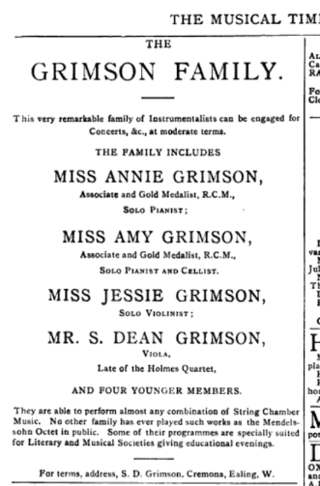
The Grimson family was a family of classical musicians active in London from the early 1870s.
 This article incorporates text from this source, which is in the public domain .