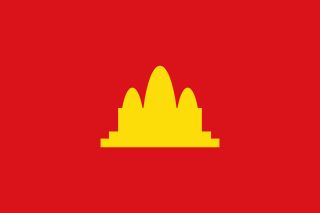
The Khmer Rouge was the name popularly given to the followers of the Communist Party of Kampuchea (CPK) and by extension to the regime through which the CPK ruled in Cambodia between 1975 and 1979. The name had originally been used in the 1950s by Norodom Sihanouk as a blanket term for the Cambodian left.
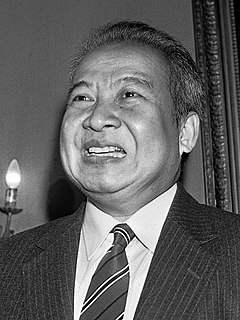
Norodom Sihanouk was head of state of Cambodia numerous times. In Cambodia, he is known as Samdech Euv. During his lifetime Cambodia was variously called the French Protectorate of Cambodia, the Kingdom of Cambodia (1953–70), the Khmer Republic (1970–75), Democratic Kampuchea (1975–79), the People's Republic of Kampuchea (1979–93), and again the Kingdom of Cambodia.

The Kingdom of Cambodia, also known as the First Kingdom of Cambodia and the Sangkum Reastr Niyum regime, referred to Norodom Sihanouk's first administration of Cambodia from 1953 to 1970, an especially significant time in the country's history. Sihanouk continues to be one of the most controversial figures in Southeast Asia's turbulent and often tragic postwar history.

Son Sen, alias Comrade Khieu (សមមិត្តខៀវ), was a Cambodian Communist politician and soldier. A member of the Central Committee of the Communist Party of Kampuchea/Party of Democratic Kampuchea, the Khmer Rouge, from 1974 to 1992, Sen oversaw the Party's security apparatus, including the Santebal secret police and the notorious security prison S-21 at Tuol Sleng.
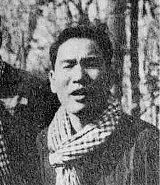
Hu Nim, alias "Phoas" (ភាស់), was a Cambodian Communist intellectual and politician who held a number of ministerial posts. His long political career included spells with the Sangkum regime of Prince Norodom Sihanouk, the Communist guerrilla resistance, the GRUNK coalition government-in-exile, and the administration of Democratic Kampuchea, when the country was controlled by the Communist Party of Kampuchea.
The Social Republican Party or Socio-Republican Party was a right-wing political party in Cambodia, founded by the then Head of State Lon Nol in June 1972 to contest the National Assembly Elections of the Khmer Republic held on September 3, 1972.

General elections were held in Cambodia on June 9, 1955. The elections were held following the peace established at the 1954 Geneva Conference and the independence of the country. The election were postponed to September 1955. The result was a landslide victory for the Sangkum party, which won all 91 seats. The election was marked by widespread voter fraud and intimidation.

The leader called Sisowath Thomico had instead of creating a political party chose to create on Friday 28 July 2006 what was called the "Sampoan Sangkum Cheat Niyum ." This was because when gathering some of the parties like the Khmer Unity Party and Angkor Empire Party etc. Thomico said ""We decided not to form the party yet since the alliance is not yet complete" which meant the Thomico was giving more time to other political parties to join the alliance and postpone the changing of the alliance into a new political party with a new name. However, later on it was finally changed into a political party called Sangkum Jatiniyum Front Party that is recognized in October by the Interior Ministry of Cambodia.
The Sangkum Reastr Niyum, literally the "community of the common people", was a political organisation set up in 1955 by Prince Norodom Sihanouk of Cambodia. Though it described itself as a 'movement' rather than a political party, the Sangkum retained control of the government of Cambodia throughout the first administration of Sihanouk, from 1955 to 1970.
Cheng Heng was a Cambodian politician, who acted as the country's Head of State from 1970–1971, and was a relatively prominent political figure during the Khmer Republic period (1970–1975).
The Krom Pracheachon, often referred to simply as Pracheachon, was a Cambodian political party that contested in parliamentary elections in 1955, 1958 and 1972.
General Sak Sutsakhan was a Cambodian politician and soldier who had a long career in the country's politics. He was the last Head of State of the Khmer Republic, the regime overthrown by the Khmer Rouge in 1975. Sak Sutsakhan formed a pro-US force known as the "Khmer Sâ".
The Democratic Party, commonly referred to as The Democrats, was a left-wing pro-independence political party formed in 1946 by Prince Sisowath Youtevong, who had previously been a member of the French Section of the Workers' International. It was the sole dominant party in Cambodia from 1946 until the creation of Sangkum in 1955.
Prince Norodom Phurissara was a prominent leftist Cambodian politician of the 1950s, 1960s and 1970s, who held a number of ministerial posts. A member of the Cambodian royal family, he disappeared during the political purges carried out by the Communist Party of Cambodia after it came to power.
Khmer Renovation, also translated as "Khmer Renewal", was an anti-communist, nationalist and royalist political party founded in Cambodia in September 1947. In 1955, it became one of the core elements of the Sangkum political movement of Prince Norodom Sihanouk.
General elections were held in Cambodia on 23 March 1958. The Sangkum party received all but 409 of the 1.6 million votes, winning all 61 seats in the National Assembly.

The Community of Royalist People's Party was a Cambodian political party that lasted from March 2014 until January 2015. It was founded and led by Norodom Ranariddh, who had been ousted from FUNCINPEC back in 2006. Ideologically a royalist party, the CRPP drew its inspiration from the political legacy of the former King of Cambodia, Norodom Sihanouk, and competed for its voter base with both FUNCINPEC and the Cambodia National Rescue Party (CNRP). In January 2015, the CRPP was dissolved when Ranariddh returned to FUNCINPEC.
In Cambodian politics, Sihanoukism refers to the political ideology of King Norodom Sihanouk. Sihanoukist political parties include the Sangkum Reastr Niyum, FUNCINPEC, and the most recent Community of Royalist People's Party. On 30 June 2006, in a letter to Sisowath Thomico, Sihanouk urged FUNCINPEC and other parties not to use in their writings or statements "Sihanoukism" and "Sihanoukist".