Related Research Articles

Traditional Sámi spiritual practices and beliefs are based on a type of animism, polytheism, and what anthropologists may consider shamanism. The religious traditions can vary considerably from region to region within Sápmi.

Shorea robusta, the sal tree, sāla, shala, sakhua, or sarai, is a species of tree in the family Dipterocarpaceae. The tree is native to India, Assam, Bangladesh, Nepal, Tibet, and the Himalayas.

Sacred groves or sacred woods are groves of trees and have special religious importance within a particular culture. Sacred groves feature in various cultures throughout the world. They were important features of the mythological landscape and cult practice of Celtic, Estonian, Baltic, Germanic, ancient Greek, Near Eastern, Roman, and Slavic polytheism; they also occur in locations such as India, Japan, West Africa and Ethiopia Examples of sacred groves include the Greco-Roman temenos, various Germanic words for sacred groves, and the Celtic nemeton, which was largely but not exclusively associated with Druidic practice. During the Northern Crusades of the Middle Ages, conquering Christians commonly built churches on the sites of sacred groves. The Lakota and various other North American tribes regard particular forests or other natural landmarks as sacred places. Singular trees which a community deems to hold religious significance are known as sacred trees.
Nature worship also called naturism or physiolatry is any of a variety of religious, spiritual and devotional practices that focus on the worship of the nature spirits considered to be behind the natural phenomena visible throughout nature. A nature deity can be in charge of nature, a place, a biotope, the biosphere, the cosmos, or the universe. Nature worship is often considered the primitive source of modern religious beliefs and can be found in pantheism, theism, panentheism, deism, polytheism, animism, totemism, shamanism, paganism, Saridharam and sarnaism. Common to most forms of nature worship is a spiritual focus on the individual's connection and influence on some aspects of the natural world and reverence towards it. Due to their admiration of nature, the works of Carl Linnaeus and Charles Wordsworth were viewed as nature worship.

The Kurukh or Oraon or Dhangar, also spelt Uraon or Oraon, are a Dravidian ethnic group inhabiting the Indian states of Jharkhand, West Bengal, Odisha and Chhattisgarh. They predominantly speak Kurukh as their native language, which belongs to the Dravidian language family. In Maharashtra, Oraon people are also known as Dhangad or Dhangar.
The tribes of Jharkhand consist of 32 scheduled tribes inhabiting the Jharkhand state in India. In 1872, only 18 tribes were counted among the schedule tribes from which Banjara, Bhatudi, Chik Baraik and Mahli were marked as semi-Hindu aboriginal and Kora as proletariat Hindu. In the 1931 census, including above four semi-Hindu aboriginal and Kora, a proletariat Hindu, the number was raised to 26 from 18 by adding four more in the annexure. They were Birajia, Godait, Karmali and Paharia, but Kisan was excluded from the list. In 1941 census, Baga, Bedia and Lohra included again taking Kisan in the annexure and number came to 30 which was prevailing till June 2003. Kanwar and Kol were added on 8 June 2003 in the annexure and the number of Schedule Tribes came to 32.

A sacred tree is a tree which is considered to be sacred, or worthy of spiritual respect or reverence. Such trees appear throughout world history in various cultures including the ancient Greek, Hindu mythology, Celtic and Germanic mythologies. They also continue to hold profound meaning in contemporary culture in places like Japan (shinboku), Korea, India, and the Philippines, among others. Tree worship is core part of religions which include aspects of animism as core elements of their belief, which is the eco-friendly belief that trees, forests, rivers, mountains, etc have a life force and need to be conserved and used in a sustainable manner.
Sacred groves of India are forest fragments of varying sizes, which are communally protected, and which usually have a significant religious connotation for the protecting community. Hunting and logging are usually strictly prohibited within these patches. Other forms of forest usage like honey collection and deadwood collection are sometimes allowed on a sustainable basis. NGOs work with local villagers to protect such groves. Traditionally, and in some cases even today, members of the community take turns to protect the grove. The introduction of the protected area category community reserves under the Wild Life (Protection) Amendment Act, 2002 has introduced legislation for providing government protection to community held lands, which could include sacred groves.
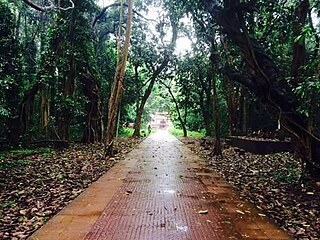
Kāvû is the traditional name given for sacred groves across the Malabar Coast in Kerala, South India. Kavus are notable for Theyyam, the centuries-old ritual dance.

Sacred mountains are central to certain religions, and are usually the subjects of many legends. For many, the most symbolic aspect of a mountain is the peak because it is believed that it is closest to heaven or other religious worlds. Many religions have traditions centred on sacred mountains, which either are or were considered holy or are related to famous events. In some cases, the sacred mountain is purely mythical, like the Hara Berezaiti in Zoroastrianism. Mount Kailash is believed to be the abode of the deities Shiva and Parvati, and is considered sacred in four religions: Hinduism, Bon, Buddhism, and Jainism. Volcanoes, such as Mount Etna in Italy, were also considered sacred, Mount Etna being believed to have been the home of Vulcan, the Roman god of fire and the forge.
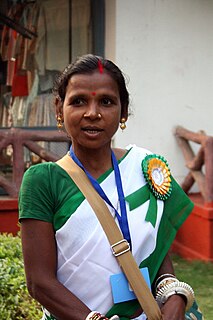
The Ho or Kolha people are an Austroasiatic Munda ethnic group of India. They call themselves the Ho, Hodoko and Horo, which mean 'human' in their own language. Officially, however, they are mentioned in different subgroups like Kolha, Mundari, Munda, Kol and Kolah in Odisha. They are mostly concentrated in the Kolhan region of Jharkhand and Odisha where they constitute around 10.7% and 7.3% of the total Scheduled Tribe population respectively, as of 2011. With a population of approximately 700,000 in the state in 2001, the Ho are the fourth most numerous Scheduled tribe in Jharkhand after the Santals, Kurukhs, and Mundas. Ho also inhabit adjacent areas in the neighboring states of Odisha, West Bengal and Bihar bringing the total to 806,921 as of 2001. They also live in Bangladesh and Nepal.

A yorishiro (依り代/依代/憑り代/憑代) in Shinto terminology is an object capable of attracting spirits called kami, thus giving them a physical space to occupy during religious ceremonies. Yorishiro are used during ceremonies to call the kami for worship. The word itself literally means "approach substitute". Once a yorishiro actually houses a kami, it is called a shintai. Ropes called shimenawa decorated with paper streamers called shide often surround yorishiro to make their sacredness manifest. Persons can play the same role as a yorishiro, and in that case are called yorimashi or kamigakari.

Bhumij is a Munda ethnic group of India. They primarily live in the Indian states of West Bengal, Odisha, and Jharkhand, mostly in the old Singhbhum district. Also in states like Bihar and Assam. There is also a sizeable population found in Bangladesh. Bhumijas speak the Bhumij language, an Austroasiatic language, and use Ol Onal script for writing.

The practice of Hindu animal sacrifice is mostly associated with Shaktism, and in currents of folk Hinduism strongly rooted in local popular or tribal traditions, however animal sacrifices were part of the ancient Vedic religion in India, and are mentioned in scriptures such as the Yajurveda. The practice declined during the formation of Hinduism as Hindu scriptures like the Puranas and the Bhagvad Gita forbid animal sacrifice.

The early Dravidian religion constituted a non-Vedic form of Hinduism in that they were either historically or are at present Āgamic. The Agamas are non-Vedic in origin, and have been dated either as post-Vedic texts, or as pre-Vedic compositions. The Agamas are a collection of Tamil and Sanskrit scriptures chiefly constituting the methods of temple construction and creation of murti, worship means of deities, philosophical doctrines, meditative practices, attainment of sixfold desires and four kinds of yoga. The worship of tutelary deity, sacred flora and fauna in Hinduism is also recognized as a survival of the pre-Vedic Dravidian religion. Dravidian linguistic influence on early Vedic religion is evident, many of these features are already present in the oldest known Indo-Aryan language, the language of the Rigveda, which also includes over a dozen words borrowed from Dravidian. The linguistic evidence for Dravidian impact grows increasingly strong as one moves from the Samhitas down through the later Vedic works and into the classical post-Vedic literature. This represents an early religious and cultural fusion or synthesis between ancient Dravidians and Indo-Aryans that went on to influence Indian civilisation.

Sarna are sacred groves in the Indian religious traditions of the Chota Nagpur Plateau region in the states of Jharkhand, Bihar, Assam, and Chhattisgarh. Followers of these rituals primarily belong to people of Chotoanagpur Munda, Bhumij, Kharia, Baiga, Ho, Kurukh, Santal and non-tribal Sadan. According to local belief, a Gram deoti or village deity resides in the sarna, where sacrifice is offered twice a year. Their belief system is called "Sarnaism", "Sarna Dharma", or "Religion of the Holy Woods".

Sarhul is a spring festival in the Indian state of Jharkhand. The festival is celebrated for three days, from the 3rd day of Chaitra month in Sukla Paksh to Chaitra Purnima. In the festival, the village priest Pahan offers sacrifice of flowers, fruit, vermilion, rooster and tapan (liquor) in Sarna to Sun, village deity and ancestor for good fortune of the village. Then the locals dance holding flowers of the sal tree. It is a symbol of commencement of the new year. According to the tradition, it also symbolises marriage between the Earth and the Sun. It is an important festival observed by the Kurukh and Sadan. Among Kurukh it is known as Khaddi in Kurukh.
Sarna is a place of worship in Chotanagpur region of Jharkhand, Chhattisgarh and Odisha. It is a sacred grove, where people of village gather to perform rituals in village festival.
References
- 1 2 3 Porteous, Alexander (2012-04-03). The Forest in Folklore and Mythology. Courier Corporation. ISBN 9780486120324.
- 1 2 3 4 5 6 Damodaran, Vinita (August 2002). "History, landscape, and indigeneity in Chotanagpur, 1850–1980". South Asia: Journal of South Asian Studies. 25 (2): 77–110. doi:10.1080/00856400208723476. ISSN 0085-6401. S2CID 145545087.
- 1 2 Raman, Sita Anantha (2009-06-08). Women in India: A Social and Cultural History [2 volumes]: A Social and Cultural History. ABC-CLIO. ISBN 9780313014406.
- 1 2 "Sacred Groves of India: An Annotated Bibliography" (PDF). Centre for Ecological Sciences, IISc, Bangalore.
- ↑ Frazer, James (2018-07-11). The Golden Bough: A Study in Comparative Religion (Vol. 1 of 2). Litres. ISBN 9785040868858.