Schwanenburg Castle

Last updated
Schwanenburg Castle
Kleef graafschap wapen.svg
Schwanenburg Castle Kleve, Kleef, Zwanenburcht, Shvanenburg (Kleve).jpg
Schwanenburg Castle, seen from the south
Schwanenburg Castle
Alternative namesSwan Castle
General information
Architectural styleBaroque
Town or city Kleve
Country North Rhine-Westphalia state, Germany
CompletedBefore 1092
Renovated1663-1666, 1948-1953
Height180 feet (55 m)
Design and construction
ArchitectPieter Post
Known for Anna of Cleves, Lohengrin (opera), Klevian gardens
Other information
ParkingYes
Website
https://www.kleve.de/de/sehenswuerdigkeiten/schwanenburg/

The Schwanenburg Castle (English: Swan Castle), in North Rhine-Westphalia, where the Dukes of Cleves resided, was founded on a steep hill. It is located at the northern terminus of the Kermisdahl where it joins with the Spoykanal, which was previously an important transportation link to the Rhine.

Contents

History

It is already conceivable that in Roman times there was a military base at this point, high above the Rhine, halfway between Xanten and Nijmegen.

The Swan Castle was first mentioned in 1020 in the monastery annals. The Swan Tower collapsed on 7 October 1439. "300 years before God's birth Caesar has built this". This can be read on an inscription above the entrance of the Swan Tower, which was installed by Adolph I, Duke of Cleves after the tower was rebuilt. [1]

The knight's hall, built around 1170, stood where today the car park surrounded by lime trees is located in the outer courtyard. Remains of the richly decorated hall have been excavated in the courtyard of the castle and can be seen today.

Gate 1664 Schwanenburg Castle Kleve, Kleef, Zwanenburcht, Shvanenburg (Kleve) Zwingertor gate, poort 1664.jpg
Gate 1664

In 1663, the Stadtholder of the Great Elector; John Maurice, Prince of Nassau-Siegen approved a renovation of the Schwanenburg in the Dutch Baroque style by architect Pieter Post and commissioned the construction of extensive gardens that greatly influenced European landscape design of the 17th century. Significant amounts of his original plan for Kleve were put into effect and have been maintained to the present, a particularly well-loved example of which is the Forstgarten. [2]

In the middle of the 18th century, the building was reduced by collapse and demolition to its present size. Since then, the judicial authorities are located at the castle, and today the castle is the seat of the district and district court of Kleve. In the Swan Tower, a small geological museum is located. [3]

On 7 October 1944, Kleve was subjected to a huge bombardment. These attacks resulted in huge damage to the town. The bombardment destroyed the historic centre of Kleve, including the Swan tower. The castle was rebuilt between 1948 and 1953. [4]

Swan tower

The old castle has a massive tower, the Schwanenturm (Swan tower) 180 feet (55 m) high, that is associated in legend with the Knight of the Swan, immortalized in Richard Wagner's Lohengrin.

Lohengrin first appears as "Loherangrin", the son of Parzival and Condwiramurs in Wolfram von Eschenbach's Parzival. Wolfram's story is a variation of the Knight of the Swan tale, previously attached to the Crusade cycle of medieval literature. Loherangrin and his twin brother Kardeiz join their parents in Munsalväsche when Parzival becomes the Grail King; Kardeiz later inherits their father's secular lands, and Loherangrin remains in Munsalväsche as a Grail Knight.

Swan tower Schwanenburg Castle Kleve, Kleef, Zwanenburcht, Shvanenburg (Kleve) tower turm toren.jpg
Swan tower

Members of this order are sent out in secret to provide lords to kingdoms that have lost their protectors and Loherangrin is eventually called to this duty in Brabant,[ citation needed ] where the duke has died without a male heir. His daughter Elsa fears the kingdom will be lost, but Loherangrin arrives in a boat pulled by a swan and offers to defend her, though he warns her that she must never ask his name. He weds the duchess and serves Brabant for years, but one day Elsa asks the forbidden question. He explains his origins and steps back onto his swan boat, never to return.

From Dutch legends of the Swan knight we read that Dietrich, Count of Cleves, Lohn in Westphalia and Teisterbant died in 713 and his daughter Beatrix had to succeed him. Pepin of Herstal, duke of Brabant, who could have helped her, also died (714). In 715 Beatrix was attacked from all sides. She fled to her castle in Nijmegen (Valkhofburcht). Then Elias Lohengrin appears, with a golden sword, silver shield with a double, golden cross, a hunting horn and a beautiful ring with a diamond. He defeats the besiegers, marries Beatrix, and becomes king of Francia. They have three sons: Diederik, Godfrey, and Konrad.

Afterwards Beatrix lives in a tower on the river close to Kleve. She died young and was later remembered as the ‘White Woman of the Swan Tower’. Diederik inherited the golden sword and silver shield and succeeded his father in the county of Cleves. Godfrey became count of Lohn and inherited the hunting horn. And the youngest, Konrad, became ancestor of the counts of Hessen and inherited the ring with the diamond. Lohengrin was told that he had fought the Moors with Charles Martel.

The legend in historical context

There is almost no reliable information about the local power relations in the area of "Kleve" in the early Middle Ages. The few statements by some historians are also controversial. According to one of these sources to 711, a daughter of a noble family named Beatrix married a Count Aelius (or Helios) Gralius, who was a follower of Charles Martell. This count had possessed areas in the area of Teisterbant as a fief. The son of this marriage had been known as Theodoric I from 742 both Count of Teisterbant and the first Earl of Cleves. Among his descendants, the counties Teisterbant and Cleves were divided. The last descendant of this noble family in Cleves was Count Nufried, after his death in 1008 this family line has died out.

A "Beatrix" from a noble house is also mentioned in a legend or fairy tale as the ancestor of the Counts of Cleves, who married a swan knight Elias. At least since the 15th century, the Counts and Dukes of Cleves derived their origin from this swan knight Elias (Aelius = Elias), who is related to the figure of Lohengrin.

About Beatrix of Cleves, Countess of Teisterband

Walter, Count of Teisterbant, in the Dukedom of Gelre, District of the Betuwe, died either 724 or 742 (Oudheusden). His daughter and heiress Beatrix, Countess of Teisterbant, married around 711 Theodoric, Stadtholder and Lord of Cleves. Their daughter and heiress Beatrix, Countess of Teisterbant, got married after the death of both her parents to Elias, Aelius, or Elius Grail, Gralius, Graielis, or Grajus, a great hero, Stadtholder of Nijmegen and (purely legendary) first Count of Cleves. She died 734. [5]

See also

Related Research Articles

<i>Lohengrin</i> (opera) Opera by Richard Wagner

Lohengrin, WWV 75, is a Romantic opera in three acts composed and written by Richard Wagner, first performed in 1850. The story of the eponymous character is taken from medieval German romance, notably the Parzival of Wolfram von Eschenbach, and its sequel Lohengrin, itself inspired by the epic of Garin le Loherain. It is part of the Knight of the Swan legend.

Gelderland Province of the Netherlands

Gelderland, also known as Guelders in English, is a province of the Netherlands, occupying the centre-east of the country. With a total area of 5,136 km2 (1,983 sq mi) of which 173 km2 (67 sq mi) is water, it is the largest province of the Netherlands. Gelderland shares borders with six other provinces and the German state of North Rhine-Westphalia.

Kleve Place in North Rhine-Westphalia, Germany

Kleve is a town in the Lower Rhine region of northwestern Germany near the Dutch border and the River Rhine. From the 11th century onwards, Cleves was capital of a county and later a duchy. Today, Cleves is the capital of the district of Cleves in the German state of North Rhine-Westphalia. The city is home to one of the campuses of the Rhine-Waal University of Applied Sciences.

County of Mark

The County of Mark was a county and state of the Holy Roman Empire in the Lower Rhenish–Westphalian Circle. It lay on both sides of the Ruhr river along the Volme and Lenne rivers.
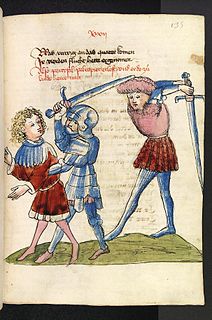
<i>Parzival</i> 13th-century Arthurian romance by Wolfram von Eschenbach

Parzival is a medieval romance by the knight-poet Wolfram von Eschenbach in Middle High German. The poem, commonly dated to the first quarter of the 13th century, centers on the Arthurian hero Parzival and his long quest for the Holy Grail following his initial failure to achieve it.
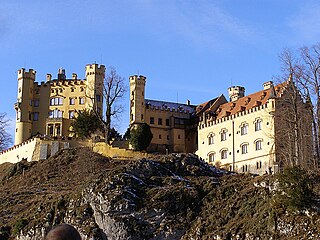
Hohenschwangau Castle Palace in southern Germany

Hohenschwangau Castle is a 19th-century palace in southern Germany. It was the childhood residence of King Ludwig II of Bavaria and was built by his father, King Maximilian II of Bavaria. It is located in the German village of Hohenschwangau near the town of Füssen, part of the county of Ostallgäu in southwestern Bavaria, Germany, very close to the border with Austria.

Duchy of Cleves State of the Holy Roman Empire

The Duchy of Cleves was a State of the Holy Roman Empire which emerged from the medieval Hettergau. It was situated in the northern Rhineland on both sides of the Lower Rhine, around its capital Cleves and the towns of Wesel, Kalkar, Xanten, Emmerich, Rees and Duisburg bordering the lands of the Prince-Bishopric of Münster in the east and the Duchy of Brabant in the west. Its history is closely related to that of its southern neighbours: the Duchies of Jülich and Berg, as well as Guelders and the Westphalian county of Mark. The Duchy was archaically known as Cleveland in English.
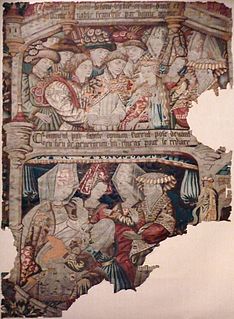
Knight of the Swan

The story of the Knight of the Swan, or Swan Knight, is a medieval tale about a mysterious rescuer who comes in a swan-drawn boat to defend a damsel, his only condition being that he must never be asked his name.
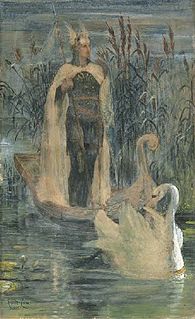
Lohengrin

Lohengrin is a character in German Arthurian literature. The son of Parzival (Percival), he is a knight of the Holy Grail sent in a boat pulled by swans to rescue a maiden who can never ask his identity. His story, which first appears in Wolfram von Eschenbach's Parzival, is a version of the Knight of the Swan legend known from a variety of medieval sources. Wolfram's story was expanded in two later romances. Richard Wagner's opera Lohengrin of 1848 is based upon the legend.

Feirefiz Character in poem Parzival

Feirefiz is a character in Wolfram von Eschenbach's Arthurian poem Parzival. He is the half-brother of Parzival, the story's hero. He is the child of their father Gahmuret's first marriage to the Moorish queen Belacane, and equals his brother in knightly ability. Because his father was white and his mother black, Feirefiz's skin consists of black and white patches. His appearance is compared to that of a magpie or a parchment with writing on it, though he is considered very handsome.
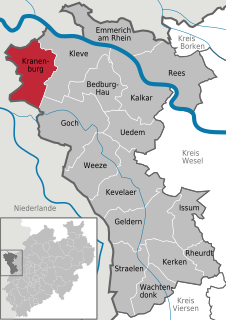
Kranenburg, North Rhine-Westphalia Municipality in North Rhine-Westphalia, Germany

Kranenburg is a town and municipality in the district of Cleves in the state of North Rhine-Westphalia, Germany. It is located near the border with the Netherlands, 12 kilometres (7 mi) south-east of Nijmegen and 11 kilometres (7 mi) west of Cleves.
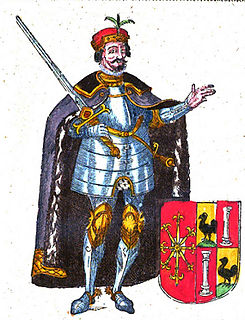
Dietrich I, Count of Cleves Count of Cleves

Dietrich I was the first Count of Cleves. He reigned from 1092 through 1119. The County of Cleves was a comital polity of the Holy Roman Empire in present Germany and the Netherlands. Its rulers, called counts, had a special and privileged standing in the Empire. The County of Cleves was first mentioned in the 11th century. In 1417, the county became a duchy, and its rulers were raised to the status of Dukes.

Arnold I, Count of Cleves

Arnold I was Count of Cleves from 1119 through 1147. Son of Dietrich I, Count of Cleves.

Dietrich IV was Count of Cleves from 1188 through 1198.

Dietrich VII, Count of Cleves (1256–1305)

Dietrich VII (1256–1305) was Count of Cleves from 1275 through 1305. He was the son of Dietrich VI, Count of Cleves and his wife Aleidis von Heinsberg.

Jakobea of Baden

Princess Jakobea of Baden was daughter of the Margrave Philibert of Baden-Baden and Mechthild of Bavaria.

Philip of Cleves, Lord of Ravenstein Lord of Ravenstein

Philip of Cleves, Lord of Ravenstein, Wijnendale and Enghien, was a nobleman from the Low Countries and army commander, first for Maximilian of Austria, then for Flemish rebels and the kingdom of France.

Diederik III count of Limburg Hohenlimburg and Broich

Diederik III of Limburg Hohenlimburg, born around 1328, was the eldest son of Everhard II van Limburg Hohenlimburg and Juta of Sayn. His father Everhard died on 11 November 1344. Twenty years later he followed the 9th of August 1364 his grandfather Diederik II count of Limburg Hohenlimburg. In 1366 Diederik III became the Amtmann of Angermünde, the district between Duisburg and Düsseldorf. As the successor to lord Diederik III of Broich, who five years later would become his father-in-law. He also was Voght of the Rellinghausen Abbey. On 3 July 1371. Diederik married Ludgardis (Lukarda) daughter of Diederik of Broich and Katharina of Steinfurt. Lukarda was heiress of the Lordship Broich. At his wedding, he receives a dowry of 1,600 old gold shields.

Elsa von Brabant

Elsa von Brabant is a figure from the Middle High German Swan knight legend from the late 13th century. She is a marginal figure in Wolfram von Eschenbach's epic Parzival. She gained new fame as the main female protagonist in Richard Wagner's opera Lohengrin.
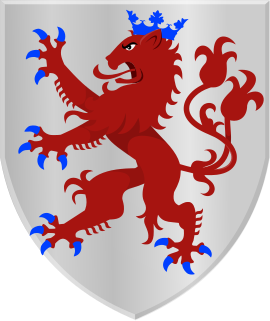
Willem II and Hendrik I counts of Limburg Hohenlimburg Broich

The brothers counts Willem II and Hendrik I, sons of Diederick IV count of Limburg Hohenlimburg Broich and Lukardis of Broich succeed each other as Count of Limburg Hohenlimburg Broich. In 1446, two years after the death of their father Diederick. The Archbishop of Cologne, after the conquest of Broich castle handed over his share of Broich to Willem II of Limburg. The Duke of Gullick-Berg also returned his share of Broich. Willem had to reconfirm provisions that his father Diederik IV had agreed upon in 1430. Brother Hendrik of Limburg continued to fight for the Cleves party. It was not until April 7, 1454, that he agreed to waiver of his Lordship rights to Broich.

References

  1. "Blättern im Zedler-Lexikon Bd. 6, Seite 220". Zedler-lexikon.de. Retrieved 2019-10-27.
  2. "Zwanenburcht te Kleef Duitsland". Absolutefacts.nl. Retrieved 2019-10-27.
  3. "Sehenswürdigkeiten: Schwanenburg | Stadt Kleve". Kleve.de. Retrieved 2019-10-27.
  4. [ dead link ]
  5. "Beatrix van Kleef van Teisterband (c.695 - c.734) - Genealogy". Geni.com. 2019-01-22. Retrieved 2019-10-27.