 | The topic of this article may not meet Wikipedia's notability guideline for books .(November 2023) |
Sex Secrets of Ancient Atlantis is a novel by John Grant published in 1986.
| The topic of this article may not meet Wikipedia's notability guideline for books .(November 2023) |
Sex Secrets of Ancient Atlantis is a novel by John Grant published in 1986.
Sex Secrets of Ancient Atlantis is a narrative featuring sexual revelations about ancient Atlantis. [1]
Dave Langford reviewed Sex Secrets of Ancient Atlantis for White Dwarf #75 and wrote, "The illustrations are sadly all quite printable; the text pokes fun at UFOlogy, the Atlantis myth, magic pendulums, The Tao of Sex, and worse." [1]
Jenny Randles wrote in her book Looking for the Aliens that "Sex Secrets of Ancient Atlantis, which masquerades as a pseudo-Erich von Dänekin report on certain mystical 'discoveries' that, in this instance, ought not to alter anyone's concept of the universe for longer than it takes to read the book itself." [2]
The Locus Index to Science Fiction: 2004 describes the novel as a "Humorous 'epistolary fringe-SF novel,' a mock academic discussion of archaeological discoveries about Atlantis." [3]
The Encyclopedia of Science Fiction noted that "The solo A Directory of Discarded Ideas (1981), largely on Pseudoscience, led directly to his book-length "nonfiction" Sex Secrets of Ancient Atlantis (1985; rev 2004), a broad Parody of pseudoscience in general and Atlantis studies in particular." [4]
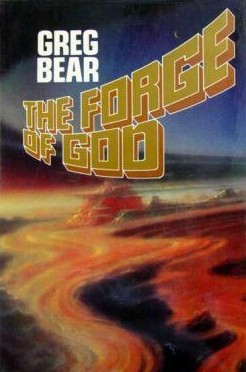
The Forge of God is a 1987 science fiction novel by American writer Greg Bear. Earth faces destruction when an inscrutable and overwhelming alien form of life attacks.

James White was a Northern Irish author of science fiction novellas, short stories and novels. He was born in Belfast and returned there after spending some early years in Canada. After a few years working in the clothing industry, he worked at Short Brothers Ltd., an aircraft company based in Belfast, from 1965 until taking early retirement in 1984 as a result of diabetes. White married Margaret Sarah Martin, another science fiction fan, in 1955 and the couple had three children. He died of a stroke.
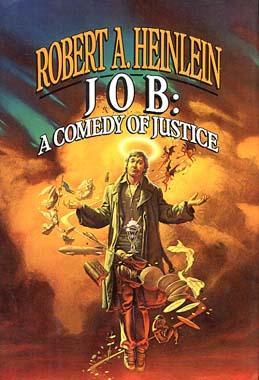
Job: A Comedy of Justice is a science fiction novel by American writer Robert A. Heinlein published in 1984. The title is a reference to the biblical Book of Job and James Branch Cabell's book Jurgen, A Comedy of Justice. It won the Locus Award for Best Fantasy Novel in 1985 and was nominated for the Nebula Award for Best Novel in 1984, and the Hugo Award for Best Novel in 1985.

Friday is a 1982 science fiction novel by American writer Robert A. Heinlein. It is the story of a female "artificial person", the eponymous Friday, genetically engineered to be stronger, faster, smarter, and generally better than normal humans. Artificial humans are widely resented, and much of the story deals with Friday's struggle both against prejudice and to conceal her enhanced attributes from other humans. The story is set in a Balkanized 21st century, in which the nations of the North American continent have been split up into a number of smaller states.

Gordon Rupert Dickson was an American science fiction writer. He was inducted into the Science Fiction and Fantasy Hall of Fame in 2000.

David Rowland Langford is a British author, editor, and critic, largely active within the science fiction field. He publishes the science-fiction fanzine and newsletter Ansible and holds the all-time record for most Hugo Awards, with a total of 29 wins.

Pluto has appeared in fiction as a setting since shortly after its 1930 discovery, albeit infrequently. It was initially comparatively popular as it was newly discovered and thought to be the outermost object of the Solar System and made more fictional appearances than either Uranus or Neptune, though still far fewer than other planets. Alien life, sometimes intelligent life and occasionally an entire ecosphere, is a common motif in fictional depictions of Pluto. Human settlement appears only sporadically, but it is often either the starting or finishing point for a tour of the Solar System. It has variously been depicted as an originally extrasolar planet, the remnants of a destroyed planet, or entirely artificial. Its moon Charon has also appeared in a handful of works.

Heechee Rendezvous is a science fiction novel by the American writer Frederik Pohl, published in 1984 by the Del Rey imprint of Ballantine Books. It is a sequel to Gateway (1977) and Beyond the Blue Event Horizon (1981) and is set about three decades after Gateway. It has been cataloged as the third book in a six-book series called Heechee or The Heechee Saga but Kirkus reviewed it as completing a trilogy and a German-language edition of the three books was published as the Gateway trilogy after all six were out.
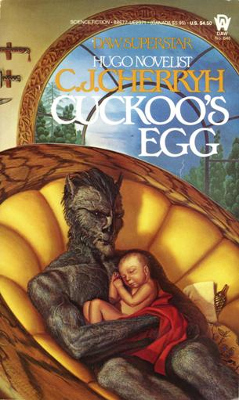
Cuckoo's Egg is a science fiction novel by American writer C. J. Cherryh, which introduces a fictional race raising a human boy. It was published by DAW Books in 1985, and there was also a limited hardcover printing by Phantasia Press in the same year. The book was nominated for the Hugo Award and longlisted for the Locus Award for Best Novel. It was later reprinted along with Cherryh's novel Serpent's Reach in the 2005 omnibus volume The Deep Beyond.

His Master's Voice is a 1960s science fiction novel written by Polish writer Stanisław Lem. It was first published in 1968 and translated into English by Michael Kandel in 1983. The book incorporates a "message from space" theme. It is a densely philosophical first contact story about an effort by scientists to decode, translate, and understand an extraterrestrial transmission. The novel critically approaches humanity's intelligence and intentions in deciphering and truly comprehending a message from outer space. It is considered to be one of the three best-known books by Lem, the other two being Solaris and The Cyberiad.

Planets outside of the Solar System have appeared in fiction since at least the 1850s, long before the first real ones were discovered in the 1990s. Most of these fictional planets do not differ significantly from the Earth, and serve only as settings for the narrative. The majority host native lifeforms, sometimes with humans integrated into the ecosystems. Fictional planets that are not Earth-like vary in many different ways. They may have significantly stronger or weaker gravity on their surfaces, or have a particularly hot or cold climate. Both desert planets and ocean planets appear, as do planets with unusual chemical conditions. Various peculiar planetary shapes have been depicted, including flattened, cubic, and toroidal. Some fictional planets exist in multiple-star systems where the orbital mechanics can lead to exotic day–night or seasonal cycles, while others do not orbit any star at all. More fancifully, planets are occasionally portrayed as having sentience, though this is less common than stars receiving the same treatment or a planet's lifeforms having a collective consciousness.

The Tunguska event—an enormous explosion in a remote region of Siberia on 30 June 1908—has appeared in many works of fiction.

Saraband of Lost Time is a science fiction novel by American writer Richard Grant, published by Avon Books in 1985. It is his first novel. Saraband of Lost Time placed eighth in the annual Locus magazine poll for best first novel, and received a special citation from the Philip K. Dick Award judges.
Paul le Page Barnett, known by the pen name of John Grant, was a Scottish writer and editor of science fiction, fantasy, and non-fiction.
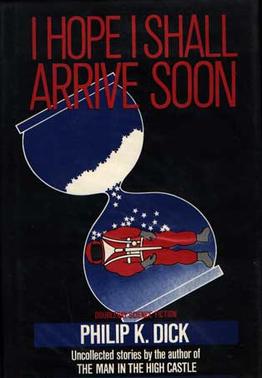
I Hope I Shall Arrive Soon is a book by American writer Philip K. Dick, a collection of 10 science fiction short stories and one essay. It was first published by Doubleday in 1985 and was edited by Mark Hurst and Paul Williams. Many of the stories had originally appeared in the magazines Fantasy and Science Fiction, Worlds of Tomorrow, Amazing Stories, Interzone, Rolling Stone College Papers, The Yuba City High Times, Omni and Playboy.

The Ragged Astronauts is a novel by Bob Shaw published in 1986 by Gollancz. It is the first book in the series Land and Overland. It won the BSFA Award for Best Novel.
Anatomy of Wonder — A Critical Guide to Science Fiction is a reference book by Neil Barron. It covers hundreds of works of science fiction.
Against Infinity is a novel by Gregory Benford published in 1983.

A Storm of Wings is a novel by M. John Harrison published in 1980. It is the second novel in the Viriconium series, following The Pastel City.

Impact events have been a recurring theme in fiction since the 1800s.