
The Hijri calendar, also known in English as the Muslim calendar and Islamic calendar, is a lunar calendar consisting of 12 lunar months in a year of 354 or 355 days. It is used to determine the proper days of Islamic holidays and rituals, such as the annual fasting and the annual season for the great pilgrimage. In almost all countries where the predominant religion is Islam, the civil calendar is the Gregorian calendar, with Syriac month-names used in the Levant and Mesopotamia but the religious calendar is the Hijri one.

Eid al-Fitr is the earlier of the two official holidays celebrated within Islam. While the Qur'an does not mention the celebration of Eid, the religious holiday of Eid al-Fitr is celebrated by Muslims worldwide because it marks the end of the month-long dawn-to-sunset fasting of Ramadan. Some Muslims, however, do not view it as a sacred holiday. Eid al-Fitr falls on the first day of Shawwal in the Islamic calendar; this does not always fall on the same Gregorian day, as the start of any lunar Hijri month varies based on when the new moon is sighted by local religious authorities. The holiday is known under various other names in different languages and countries around the world. The day is also called Lesser Eid, or simply Eid.
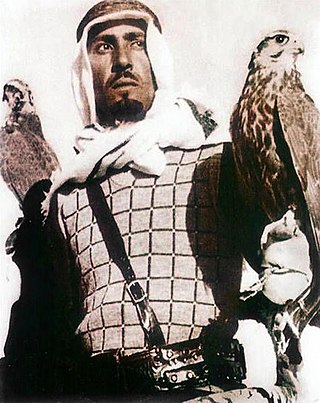
The cultural setting of Saudi Arabia is greatly influenced by the Arab and Islamic culture. The society is in general deeply religious, conservative, traditional, and family-oriented. Many attitudes and traditions are centuries-old, derived from Arab civilization and Islamic heritage. However, its culture has also been affected by rapid change, as the country was transformed from an impoverished nomadic society into a rich commodity producer in just a few years in the 1970s. This change has also been affected by and the result of a number of factors including the communications revolution and external scholarships. The most recent ruler or king of Saudi is King Salman of Saudi Arabia.

The abaya, sometimes also called an aba, is a simple, loose over-garment, essentially a robe-like dress, worn by some women in parts of the Muslim world including North Africa, the Horn of Africa, the Arabian Peninsula and most of the Middle East. Traditional abayas are usually black and may either be a large square of fabric draped from the shoulders or head or a long kaftan. The abaya covers the whole body except the head (sometimes), feet, and hands. It can be worn with the niqāb, a face veil covering all but the eyes. Some women also wear long black gloves, so their hands are covered as well. It is common that the abaya is worn on special occasions, such as Mosque visits, Islamic Holiday celebrations for Eid al-Fitr and Eid al-Adha and also during the Islamic Holy month of Ramadan. The Indonesian traditional dress kebaya gets its name from the abaya.
Shaʽban is the eighth month of the Islamic calendar. It is called the month of "separation", as the word means "to disperse" or "to separate" because the pagan Arabs used to disperse in search of water.

Rajab is the seventh month of the Islamic calendar. The lexical definition of the classical Arabic verb rajaba is "to respect", which could also mean "be awe or be in fear", of which Rajab is a derivative.
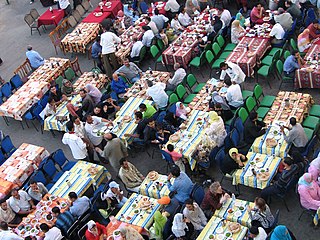
Iftar is the fast-breaking evening meal of Muslims in Ramadan at the time of adhan of the Maghrib prayer.

Harees, jareesh, boko boko, or harisa is a dish of boiled, cracked, or coarsely-ground cracked wheat or bulgur, mixed with meat and seasoned. Its consistency varies between a porridge and a gruel. Harees is a popular dish known throughout the Arab world, and is commonly eaten in Arab states of the Persian Gulf in the month of Ramadan, and in Iraq, Lebanon and Bahrain during Ashura by Shia Muslims.
There are two official holidays in Islam, Eid al-Fitr and Eid al-Adha, which are celebrated by Muslims worldwide. Both holidays occur on dates in the lunar Islamic calendar, which is different from the solar-based Gregorian calendar, so they are observed on different Gregorian dates every year. There are a number of other days of note and festivals, some common to all Muslims, others specific to Shia Islam as a whole or branches thereof.

Arab cuisine is the cuisine of the Arab world, defined as the various regional cuisines of the Arab people, spanning from the Maghreb to the Fertile Crescent and the Arabian Peninsula. These cuisines are centuries old and reflect the culture of trading in ingredients, spices, herbs, and commodities. The regions have many similarities, but also unique traditions. They have also been influenced by climate, cultivation, and mutual commerce.

Mid-Sha'ban is a Muslim holiday observed by Shia and Sunni Sufi Muslim communities on the eve of 15th of Sha'ban — the same night as Shab-e-barat or Laylat al-Bara’ah.

Ramadan is the ninth month of the Islamic calendar, and the month in which the Quran is believed to be revealed to the Islamic prophet Muhammad.

Libyan culture is a blend of many influences, due to its exposure to many historical eras. It involves roots in Berber, African, Turkish and Arab cultures. Libya was an Italian colony for over four decades, which also had a great impact on the country's culture. Libya has managed to keep its traditional folk customs alive today.

The culture of Oman describe the cultural aspects of people living in Oman, which is steeped in the religion of Islam. Oman has its own unique subsect of Islam, known as Ibadhism, however other strands of Islam such as Sunni and Shi'a are also practised. The Islamic month of fasting, Ramadan, and other Islamic festivities are very important events in the Omani culture.

Saudi Arabian cuisine encompasses the cuisines and foods of Saudi Arabia. In spite of the existence of many common dishes, Saudi Arabian dishes vary between regions as the culture itself varies.

Warak ngendog is a mythical creature resembling a rhinoceros carrying eggs on its back. This creature, celebrated during the Dugderan Festival held annually on September 23 a few days before the holiday of Ramadan, is believed to represent three different ethnic groups in Semarang: Javanese, Chinese and Arabian. Its head is like a dragon (Chinese), its body is the combination of buraq and goat (Javanese).
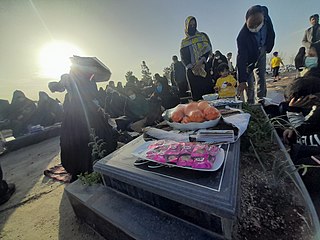
Shab-e-Barat, Barat Night, Cheragh e Barat, Berat Kandili, or Nisfu Syaaban is a cultural celebration celebrated in many South Asian, Central Asian, South East Asian and Middle Eastern Muslim countries, on the 15th night of the month of Sha'ban, the eighth month of the Islamic calendar.
Gargee'an, sometimes spelled as Gerga'oon, is a semiannual celebration, observed primarily in Eastern Arabia. It takes place on the 15th night of the Islamic month of Sha'ban for Shia Muslims and on the 15th night of Ramadan for all sects. It is celebrated by children dressing in traditional attire and going door-to-door to receive sweets and nuts from neighbours, as they sing traditional songs. It’s more of a tradition than a religious affiliation so both Sunni and Shia celebrate it. It is heavily celebrated in Kuwait by most people. The tradition has existed for hundreds of years, and is deeply rooted in some parts of the Gulf culture, especially in Iraq, Kuwait, Bahrain and Saudi Arabia.

The holy month of Ramadan in the United Arab Emirates has its distinctive customs, traditions and rituals that everyone abides by, distinguishing this month from the rest of the year. Ramadan is the month of mercy, kinship, reflection and enjoyment with family and friends. Celebrations and preparations for Ramadan begin on the night of the middle of Sha’ban, known as “Haq al-Laila” in the UAE. The month is filled with entertainment, spiritual, and cultural activities and events that tie into the atmosphere of Ramadan.

