Shams (goddess)

Last updated
Sculpture of a Sabaean priestess raising her hand to intercede with the sun goddess on behalf of a donor. Probably first century. South Arabian - Stele with a Female Bust - Walters 2173.jpg
Sculpture of a Sabaean priestess raising her hand to intercede with the sun goddess on behalf of a donor. Probably first century.

Shams or Shamsum, also called Dhat-Ba' dhanum, is a sun goddess of Arabian mythology. She was the patron goddess of the Himyarite Kingdom . Her name meant shining, sun or brilliant. She was the South Arabian equivalent of the North Arabian sun goddess Nuha (deity).

Himyarite Kingdom former country in ancient Yemen

The Ḥimyarite Kingdom or Ḥimyar, historically referred to as the Homerite Kingdom by the Greeks and the Romans, was a kingdom in ancient Yemen. Established in 110 BCE, it took as its capital the ancient city of Zafar, to be followed at the beginning of the 4th century by what is the modern-day city of Sana'a. The kingdom conquered neighbouring Saba' (Sheba) in c. 25 BCE, Qataban in c. 200 CE, and Haḍramaut c. 300 CE. Its political fortunes relative to Saba' changed frequently until it finally conquered the Sabaean Kingdom around 280. Himyar then endured until it finally fell to invaders from the Kingdom of Aksum in 525 CE.

Nuha is a deity that was worshipped among the Northern Arabian tribes in pre-Islamic Arabia. Associated with the sun, she formed part of a trinity of gods, along with Ruda and Atarsamain. In Southern Arabia, Shams was her equivalent.

Prior to Islam, religion on the Arabian Peninsula focused on local gods, with every tribe and kingdom having their particular protective deities. However, there were also gods common for all Arabs, and the trinity of gods representing the Sun, the Moon and the planet Venus seem to have been worshiped throughout Arabia, though their names, gender and worship differed between regions. Thus, Nuha was the name of the sun goddess in Northern Arabia, while the name of the sun goddess in Southern Arabia was Shams.

Trinity Christian doctrine that God is one God, but three coeternal consubstantial persons

The Christian doctrine of the Trinity holds that God is one God, but three coeternal consubstantial persons or hypostases—the Father, the Son, and the Holy Spirit—as "one God in three Divine Persons". The three Persons are distinct, yet are one "substance, essence or nature" (homoousios). In this context, a "nature" is what one is, whereas a "person" is who one is. Sometimes differing views are referred to as nontrinitarian.

As Nuha, Shams was also worshiped in a trinity alongside the male gods of the Moon and Venus. In Saba', the sun goddess Shams was worshiped with the god of the planet Venus, Athtar, and Almaqah, the god of the Moon. In Hadhramaut, Shams was worshiped with Athtar and the moon god Syn.

Sabaeans Ancient people in south west of the Arabian Peninsula

The Sabaeans or Sabeans were an ancient people speaking Sabaean, an Old South Arabian language, and living in the southern Arabian Peninsula.
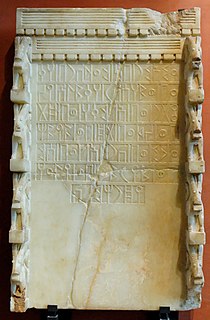
Almaqah deity

Al-maqah or Al-muqh was a progenitor of the ancient Yemeni kingdom of Saba' and the kingdoms of Dʿmt and Aksum in Eritrea and Northern Ethiopia.
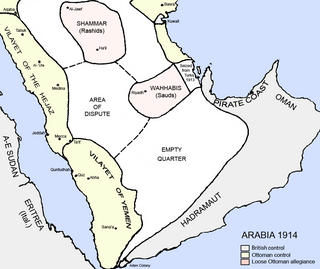
Hadhramaut region of the Arabian Peninsula

Hadramaut, Hadhramaut, Hadramout, Hadramawt or Ḥaḍramūt is a region on the southern end of the Arabian Peninsula. The name is officially retained in the Hadhramaut Governorate of the Republic of Yemen. The people of Hadhramaut are called Hadhrami, and speak Hadhrami Arabic.

Shams was described as the spouse of Athtar. She was given votive offerings in the shape of horses.

In Mesopotamia, Athtar was identified with the goddess Ishtar, and Shams with the sun god Shamash.

Related Research Articles

Religion in pre-Islamic Arabia Religions practiced by Arabs before Islam

Religion in pre-Islamic Arabia included polytheism, Christianity, Judaism, and Iranian religions. Arabian polytheism, the dominant form of religion in pre-Islamic Arabia, was based on veneration of deities and spirits. Worship was directed to various gods and goddesses, including Hubal and the goddesses al-Lāt, Al-‘Uzzá and Manāt, at local shrines and temples such as the Kaaba in Mecca. Deities were venerated and invoked through a variety of rituals, including pilgrimages and divination, as well as ritual sacrifice. Different theories have been proposed regarding the role of Allah in Meccan religion. Many of the physical descriptions of the pre-Islamic gods are traced to idols, especially near the Kaaba, which is said to have contained up to 360 of them.

Aztec mythology collection of myths of Aztec civilization

Aztec mythology is the body or collection of myths of Aztec civilization of Central Mexico. The Aztecs were Nahuatl-speaking groups living in central Mexico and much of their mythology is similar to that of other Mesoamerican cultures. According to legend, the various groups who were to become the Aztecs arrived from the north into the Anahuac valley around Lake Texcoco. The location of this valley and lake of destination is clear – it is the heart of modern Mexico City – but little can be known with certainty about the origin of the Aztec. There are different accounts of their origin. In the myth the ancestors of the Mexica/Aztec came from a place in the north called Aztlan, the last of seven nahuatlacas to make the journey southward, hence their name "Azteca." Other accounts cite their origin in Chicomoztoc, "the place of the seven caves," or at Tamoanchan.

Sin (mythology) god of the moon in Mesopotamian mythology

Sīn or Suen or Nanna was the god of the moon in the Mesopotamian religions of Akkad, Assyria and Babylonia. Nanna is a Sumerian deity, the son of Enlil and Ninlil, and became identified with the Semitic Sīn. The two chief seats of Nanna's/Sīn's worship were Ur in the south of Mesopotamia and Harran in the north. A moon god by the same name was also worshipped in South Arabia.

Ancient Semitic religion encompasses the polytheistic religions of the Semitic peoples from the ancient Near East and Northeast Africa. Since the term Semitic itself represents a rough category when referring to cultures, as opposed to languages, the definitive bounds of the term "ancient Semitic religion" are only approximate.

The religions of the ancient Near East were mostly polytheistic, with some examples of monolatry. Some scholars believe that the similarities between these religions indicate that the religions are related, a belief known as patternism.

Hittite mythology and religion mythology

Hittite mythology and Hittite religion were the religious beliefs and practices of the Hittites, who created an empire centered in what is now Turkey from c. 1600 BCE to 1180 BCE.

A triple deity is three deities that are worshipped as one. Such deities are common throughout world mythology; the number three has a long history of mythical associations. Carl Jung considered the arrangement of deities into triplets an archetype in the history of religion.

Atarsamain was an astral deity of uncertain gender, worshipped in the pre-Islamic northern and central Arabian Peninsula. Worshipped widely by Arab tribes, Atarsamain is known from around 800 BC and is identified in letters of the Assyrian kings Esarhaddon and Assurbanipal. Atarsamain may be identical with Allāt, whose cult was centred on Palmyra.

Attar (god) deity

Aṯtar is an ancient Semitic deity whose role, name, and even gender varied by culture.

Wiccan views of divinity

Wiccan views of divinity are generally theistic, and revolve around a Goddess and a Horned God, thereby being generally dualistic. In traditional Wicca, as expressed in the writings of Gerald Gardner and Doreen Valiente, the emphasis is on the theme of divine gender polarity, and the God and Goddess are regarded as equal and opposite divine cosmic forces. In some newer forms of Wicca, such as feminist or Dianic Wicca, the Goddess is given primacy or even exclusivity. In some forms of Traditional Witchcraft that share a similar duotheistic theology, the Horned God is given precedence over the Goddess.

Ruda is a deity that was of paramount importance in the Arab pantheon of gods worshipped by the North Arabian tribes of pre-Islamic Arabia. The etymology of his name gives the meaning "well disposed" an indication of his function as a protective deity. The oldest reference to Ruda is found in the annals of Esarhaddon who ruled over the Assyrian empire from 681 to 669 BC. The name is transliterated into Latin script from the original Akkadian as Ru-ul-da-a-a-ú and he is mentioned among the gods of the Arabs. Known as Arsu among the Palmyrans, in a later Aramaic inscription, Arsu/Ruda is paired with the Syrian god Resheph, a protective deity for his worshippers from the 3rd millennium BC.

Sumerian religion first religion of Mesopotamia region which is tangible by writing

Sumerian religion was the religion practiced and adhered to by the people of Sumer, the first literate civilization of ancient Mesopotamia. The Sumerians regarded their divinities as responsible for all matters pertaining to the natural and social orders.

Astrolatry is the worship of stars and other heavenly bodies as deities, or the association of deities with heavenly bodies. The most common instances of this are sun gods and moon gods in polytheistic systems worldwide. Also notable is the association of the planets with deities in Babylonian, and hence in Greco-Roman religion, viz. Mercury, Venus, Mars, Jupiter and Saturn.

The Nabataean religion is the form of Arab polytheism practiced in Nabataea, an ancient Arab nation which was well settled by the third century BCE and lasted until the Roman annexation in 106 CE. The Nabateans were polytheistic and worshipped a wide variety of local gods as well as Baalshamin, Isis, and Greco-Roman gods such as Tyche and Dionysus. They worshipped their gods at temples, high places, and betyls. They were mostly aniconic and preferred to decorate their sacred places with geometric designs. Much knowledge of the Nabataeans’ grave goods has been lost due to extensive looting throughout history. They made sacrifices to their gods, performed other rituals and believed in an afterlife.

References