This page will be copied to Wiktionary using the transwiki process. The information in this article appears to be suited for inclusion in a dictionary, and this article's topic meets Wiktionary's criteria for inclusion, has not been transwikied, and is not already represented. It will be copied into Wiktionary's transwiki space from which it can be formatted appropriately. If this page does not meet the criteria, please remove this notice. Otherwise, the notice will be automatically removed after transwiki completes. If this template is placed on a glossary article, it should be removed immediately after the transwiki is completed, and not replaced with {{ TWCleanup }}, which disrupts the encyclopedia to force a point of view on others. |
In a cylinder lock, the shear line (also known as the split line in Australia), is where the inner cylinder ends and the outer cylinder begins. When a break in the pin is reached by picking, the pin will "hang" at the shearline due to the space between the inner and outer cylinder. This "imperfection" in the lock mechanism is an unavoidable defect in the manufacturing process that allows for lock picking. Lock picking is a vital part of the locksmithing process as it can grant non-destructive entry to the lock device thus allowing it to be rekeyed instead of being replaced.
Lock picking is the art of unlocking a lock by manipulating the components of the lock device without the original key.
Rekeying a lock is replacing the old lock pins with new lock pins. Locks are usually re keyed to build master-key systems, make a set of locks share a common key, or to eliminate compromised keys. Sometimes worn pins are replaced with new pins if the old pins become too short to reach the shear-line. The shear-line is the thin line shared by the lock plug and its cylindrical housing. If a pin sits flush with the circumference of the plug it will allow lock rotation. Lock cylinders use different length pins in different combinations to create relatively unique key bitting. Most keys have 5 cuts from bow to tip. If a key has 5 cuts, the lock has 5 pins. Different brand locks each vary in many small ways, this is most true when servicing them. Many manufacturers offer product-specific manuals. Information disclosed in manufacturer manuals is often otherwise difficult to find, as is locksmith material in general.
| This technology-related article is a stub. You can help Wikipedia by expanding it. |
Locksmithing is the science and art of making and defeating locks.
A warded lock is a type of lock that uses a set of obstructions, or wards, to prevent the lock from opening unless the correct key is inserted. The correct key has notches or slots corresponding to the obstructions in the lock, allowing it to rotate freely inside the lock.
Linus Yale Jr. was an American mechanical engineer, manufacturer, and co-founder of the Yale Lock Manufacturing Company. He is best known for his inventions of locks, especially the cylinder lock. His basic lock design is still widely distributed today, and constitutes a majority of personal locks and safes.
The pin tumbler lock is a lock mechanism that uses pins of varying lengths to prevent the lock from opening without the correct key. Pin tumblers are most commonly employed in cylinder locks, but may also be found in tubular pin tumbler locks.
Not to be confused with wafer tumbler lock
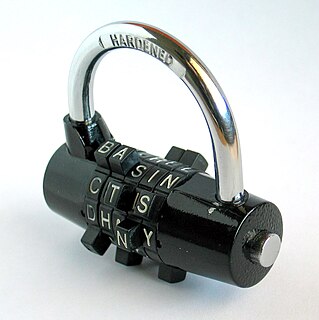
A combination lock is a type of locking device in which a sequence of symbols, usually numbers, is used to open the lock. The sequence may be entered using a single rotating dial which interacts with several discs or cams, by using a set of several rotating discs with inscribed symbols which directly interact with the locking mechanism, or through an electronic or mechanical keypad. Types range from inexpensive three-digit luggage locks to high-security safes. Unlike ordinary padlocks, combination locks do not use keys.
A tubular pin tumbler lock, also known as a circle pin tumbler lock, radial lock, or Ace lock after its original manufacturer, is a variety of pin tumbler lock in which a number of pins are arranged in a circular pattern, and the corresponding key is tubular or cylindrical in shape. Most locks use between six and eight pins, although some use as few as four or as many as ten.
A lock is a mechanical or electronic fastening device that is released by a physical object, by supplying secret information, or by a combination thereof.
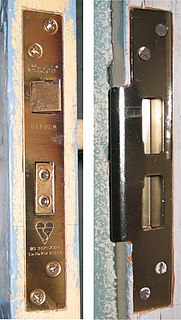
A lever tumbler lock is a type of lock that uses a set of levers to prevent the bolt from moving in the lock. In the simplest of these, lifting the tumbler above a certain height will allow the bolt to slide past.
A mortise lock is a lock that requires a pocket—the mortise—to be cut into the door or piece of furniture into which the lock is to be fitted. In most parts of the world, mortise locks are found on older buildings constructed before the advent of bored cylindrical locks, but they have recently become more common in commercial and upmarket residential construction in the United States. They are widely used in domestic properties of all ages in Europe.
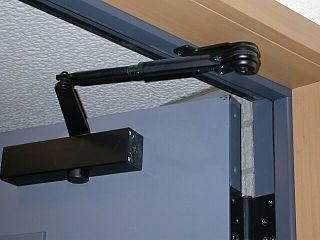
Door furniture or door hardware refers to any of the items that are attached to a door or a drawer to enhance its functionality or appearance.
Safe-cracking is the process of opening a safe without either the combination or the key.
Padlocks are portable locks with a shackle that may be passed through an opening to prevent use, theft, vandalism or harm.
Lock bumping is a lock picking technique for opening a pin tumbler lock using a specially crafted bump key, rapping key or a 999 key. A bump key must correspond to the target lock in order to function correctly.
A wafer tumbler lock is a type of lock that uses a set of flat wafers to prevent the lock from opening unless the correct key is inserted. This type of lock is similar to the pin tumbler lock and works on a similar principle. However, unlike the pin tumbler lock, where each pin consists of two or more pieces, each wafer in the lock is a single piece. The wafer tumbler lock is often incorrectly referred to as a disc tumbler lock, which uses an entirely different mechanism.
The term door security may refer to any of a range of measures used to strengthen doors against door breaching, ram-raiding and lock picking, and prevent crimes such as burglary and home invasions. Door security is used in commercial and government buildings, as well as in residential settings.
The Protector lock was an early 1850s lock design by renowned American locksmith Alfred Charles Hobbs, the first man to be able to pick the six-levered Chubb detector lock at the Crystal Palace Exhibition in the year 1851, which was created with the intent of being a lock that could not be picked.
A magnetic keyed lock or magnetic-coded lock is a locking mechanism whereby the key utilizes magnets as part of the locking and unlocking mechanism. Magnetic-coded locks encompass knob locks, cylinder locks, lever locks, and deadbolt locks as well as applications in other security devices.