
Motor vehicle theft is the criminal act of stealing or attempting to steal a motor vehicle. Nationwide in the United States in 2012, there were an estimated 721,053 motor vehicle thefts, or approximately 229.7 motor vehicles stolen for every 100,000 inhabitants. Property losses due to motor vehicle theft in 2012 were estimated at $4.3 billion.

A distributor is an enclosed rotating shaft used in spark-ignition internal combustion engines that have mechanically-timed ignition. The distributor's main function is to route secondary, or high voltage, current from the ignition coil to the spark plugs in the correct firing order, and for the correct amount of time. Except in magneto systems, the distributor also houses a mechanical or inductive breaker switch to open and close the ignition coil's primary circuit.
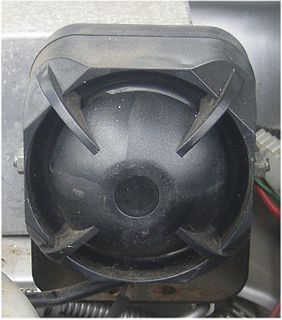
A car alarm is an electronic device installed in a vehicle in an attempt to discourage theft of the vehicle itself, its contents, or both. Car alarms work by emitting high-volume sound when the conditions necessary for triggering it are met. Such alarms may also cause the vehicle's headlights to flash, may notify the car's owner of the incident via a paging system, and may interrupt one or more electrical circuits necessary for the car to start. Although inexpensive to acquire and install, the effectiveness of such devices in deterring vehicle burglary or theft when their only effect is to emit sound appears to be negligible.
Hot-wiring is the process of bypassing a motor vehicle's ignition interlock and thus starting it without the key. It is often utilized during a vehicle theft. However, a legitimate vehicle owner who has lost their vehicle key may also implement this process.
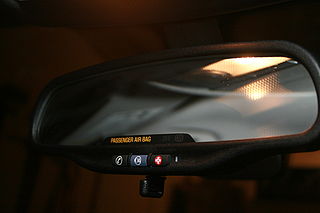
OnStar Corporation is a subsidiary of General Motors that provides subscription-based communications, in-vehicle security, emergency services, hands-free calling, turn-by-turn navigation, and remote diagnostics systems throughout the United States, Canada, China, Mexico, Europe, Brazil, and Argentina. A similar service is known as Opel OnStar in western Europe and ChevyStar in Latin American markets. In September 2011 the president of OnStar stated that the service had more than six million customers. On 9 May 2018, Vauxhall Motors announced that Vauxhall OnStar, alongside Opel OnStar services, will cease to operate after December 31, 2020, following Vauxhall Motors and Opel being purchased from General Motors by Groupe PSA.
On-board diagnostics (OBD) is an automotive term referring to a vehicle's self-diagnostic and reporting capability. OBD systems give the vehicle owner or repair technician access to the status of the various vehicle subsystems. The amount of diagnostic information available via OBD has varied widely since its introduction in the early 1980s versions of on-board vehicle computers. Early versions of OBD would simply illuminate a malfunction indicator light or "idiot light" if a problem was detected but would not provide any information as to the nature of the problem. Modern OBD implementations use a standardized digital communications port to provide real-time data in addition to a standardized series of diagnostic trouble codes, or DTCs, which allow one to rapidly identify and remedy malfunctions within the vehicle.
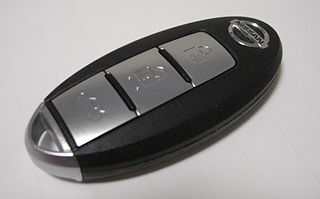
A smart key is an electronic access and authorization system that is available either as standard equipment or as an option in several car models. It was first developed by Siemens in 1995 and introduced by Mercedes-Benz under the name "Key-less Go" in 1998 on the W220 S-Class, after the design patent was filed by Daimler-Benz on May 17, 1997.
An anti-theft system is any device or method used to prevent or deter the unauthorized appropriation of items considered valuable. Theft is one of the most common and oldest criminal behaviours. From the invention of the first lock and key to the introduction of RFID tags and biometric identification, anti-theft systems have evolved to match the introduction of new inventions to society and the resulting theft by others.

A bait car, also called a decoy car, hot car or trap car, is a vehicle used by law enforcement agencies to capture car thieves or thieves who steal items from cars. The vehicles are modified with audio/video surveillance technology, and can be remotely monitored and controlled. Those set up to catch car thieves may include GPS tracking. A "kill switch" may be installed in the vehicle allowing police to remotely disable the engine and lock all doors remotely, preventing escape. A car set up to catch thieves who steal items from cars may be disabled so that it cannot be started and have specially prepared "bait property."
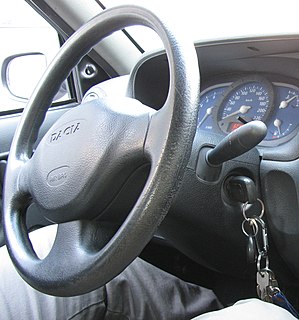
A car key or an automobile key is a key used to open and/or start an automobile. Modern key designs are usually symmetrical, and some use grooves on both sides, rather than a cut edge, to actuate the lock. It has multiple uses for the automobile with which it was sold. A car key can open the doors, as well as start the ignition, open the glove compartment and also open the trunk (boot) of the car. Some cars come with an additional key known as a valet key that starts the ignition and opens the driver's side door, but prevents the valet from gaining access to valuables that are located in the trunk or the glove box. Some valet keys, particularly those to high-performance vehicles, go so far as to restrict the engine's power output to prevent joyriding. Recently, features such as coded immobilizers have been implemented in newer vehicles. More sophisticated systems make ignition dependent on electronic devices, rather than the mechanical keyswitch. A number of these systems, such as KeeLoq and Megamos Crypto have been demonstrated to be weak and vulnerable to cryptanalytic attacks.

A keyless entry system is an electronic lock that controls access to a building or vehicle without using a traditional mechanical key. The term keyless entry system originally meant a lock controlled by a keypad located at or near the driver's door, which required entering a predetermined numeric code. Such systems now have a hidden touch-activated keypad and are still available on certain Ford and Lincoln models.
VIN etching is a countermeasure to motor vehicle theft, that involves etching a vehicle's VIN onto its windows to reduce the value of a stolen vehicle to thieves.
Joyriding is a term used by people to refer to thieving incidents where thieves steal a vehicle, most commonly a car, and drive it with no particular goal other than the pleasure or thrill of doing so. The term "Joy Riding" was coined by a New York judge in 1908.
In motor vehicle theft, a chop shop is a location or business which disassembles stolen vehicles, primarily cars, for the purpose of selling its parts. The term originated from the practice of building a car from two halves by welding them together.

An idiot light, sometimes "tell-tale" or "warning light", is an indicator of malfunction of a system, indicated by a binary (on/off) illuminated light, symbol or text legend.

An ignition switch, starter switch or start switch is a switch in the control system of a motor vehicle that activates the main electrical systems for the vehicle, including "accessories". In vehicles powered by internal combustion engines, the switch provides power to the starter solenoid and the ignition system components, and is frequently combined with the starter switch which activates the starter motor.
An anti-hijack system is an electronic system fitted to motor vehicles to deter criminals from hijacking them. Although these types of systems are becoming more common on newer cars, they have not caused a decrease in insurance premiums as they are not as widely known as other more common anti-theft systems such as alarms or steering locks. It can also be a part of an alarm or immobiliser system. An approved anti-hijacking system will achieve a safe, quick shutdown of the vehicle it is attached to. There are also mechanical anti-hijack devices.
A remote starter is a radio controlled device, which is installed in a vehicle by the factory or an aftermarket installer to preheat or cool the vehicle before the owner gets into it. Once activated, by pushing a button on a special key chain remote, it starts the vehicle automatically for a predetermined time. Different models have keyless entry as well. Most newer vehicles need some kind of bypass module to bypass the factory anti-theft system, so the vehicle can be started without the ignition key in the ignition, this is bypassed only to start the vehicle, which after it is running returns to its original state. For cars with manual transmission additional safety features may need to be added to prevent the car from starting while it's parked in gear. Having a remote starter installed in a vehicle will usually not void the factory warranty when installed properly.
Automotive hacking includes the exploitation of vulnerabilities within the software, hardware, and communication systems of automobiles.