Related Research Articles

A Japanese sword is one of several types of traditionally made swords from Japan. Bronze swords were made as early as the Yayoi period, though most people generally refer to the curved blades made from the Heian period (794–1185) to the present day when speaking of "Japanese swords". There are many types of Japanese swords that differ by size, shape, field of application and method of manufacture. Some of the more commonly known types of Japanese swords are the uchigatana, tachi, ōdachi, wakizashi, and tantō.

Samurai or bushi were members of the warrior class in Japan. Originally provincial warriors who served the kuge and imperial court in the late 12th century, they eventually came to play a major political role until their abolition in the late 1870s during the Meiji era.
A tachi is a type of sabre-like traditionally made Japanese sword (nihonto) worn by the samurai class of feudal Japan. Tachi and uchigatana generally differ in length, degree of curvature, and how they were worn when sheathed, the latter depending on the location of the mei (銘), or signature, on the tang. The tachi style of swords preceded the development of the katana, which was not mentioned by name until near the end of the twelfth century. Tachi were the mainstream Japanese swords of the Kotō period between 900 and 1596. Even after the Muromachi period (1336–1573), when katana became the mainstream, tachi were often worn by high-ranking samurai.
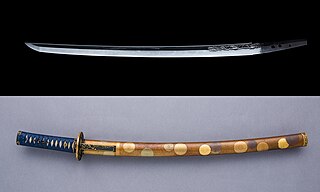
The wakizashi is one of the traditionally made Japanese swords nihontō) worn by the samurai in feudal Japan. Its name refers to the practice of wearing it inserted through one's obi or sash at one's side, whereas the larger tachi sword was worn slung from a cord.

The daishō—"large and small"—is a Japanese term for a matched pair of traditionally made Japanese swords (nihonto) worn by the samurai class in feudal Japan.

Kenjutsu (剣術) is an umbrella term for all (ko-budō) schools of Japanese swordsmanship, in particular those that predate the Meiji Restoration. Some modern styles of kendo and iaido that were established in the 20th century also included modern forms of kenjutsu in their curriculum. Kenjutsu, which originated with the samurai class of feudal Japan, means "methods, techniques, and the art of the Japanese sword". This is opposed to kendo, which means "the way of the sword" and uses a bamboo sword (shinai) and protective armour (bōgu).
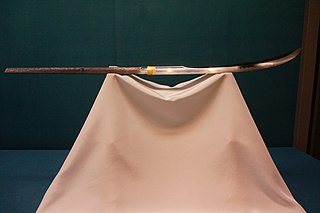
The naginata is a polearm and one of several varieties of traditionally made Japanese blades (nihontō). Naginata were originally used by the samurai class of feudal Japan, as well as by ashigaru and sōhei. The naginata is the iconic weapon of the onna-musha, a type of female warrior belonging to the Japanese nobility. A common misconception is that the Naginata is a type of sword, rather than a polearm.
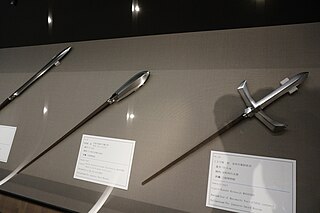
Yari (槍) is the term for a traditionally-made Japanese blade in the form of a spear, or more specifically, the straight-headed spear. The martial art of wielding the yari is called sōjutsu.

A tantō is a traditionally made Japanese knife that were worn by the samurai class of feudal Japan. The tantō dates to the Heian period, when it was mainly used as a weapon but evolved in design over the years to become more ornate. Tantō were used in traditional martial arts and in the seppuku suicide ritual. The term has seen a resurgence in the West since the 1980s as referring to a point style of modern tactical knives, designed for piercing or stabbing, though the style isn't present on any traditional tantō.
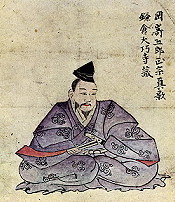
Gorō Nyūdō Masamune was a medieval Japanese blacksmith widely acclaimed as Japan's greatest swordsmith. He created swords and daggers, known in Japanese as tachi and tantō, in the Sōshū school. However, many of his forged tachi were made into katana by cutting the tang (nakago) in later times ("suriage"). For this reason, his only existing works are katana, tantō, and wakizashi. No exact dates are known for Masamune's life. It is generally agreed that he made most of his swords between 1288 and 1328. Some stories list his family name as Okazaki, but some experts believe this is a fabrication to enhance the standing of the Tokugawa family.
Muramasa, commonly known as Sengo Muramasa (千子村正), was a famous swordsmith who founded the Muramasa school and lived during the Muromachi period in Kuwana, Ise Province, Japan.

The ōdachi (大太刀) or nodachi is a type of traditionally made Japanese sword used by the samurai class of feudal Japan. The Chinese equivalent of this type of sword in terms of weight and length is the miaodao or the earlier zhanmadao, and the Western battlefield equivalent is the Zweihänder.

Kabuto is a type of helmet first used by ancient Japanese warriors that, in later periods, became an important part of the traditional Japanese armour worn by the samurai class and their retainers in feudal Japan.

Japanese sword mountings are the various housings and associated fittings that hold the blade of a Japanese sword when it is being worn or stored. Koshirae (拵え) refers to the ornate mountings of a Japanese sword used when the sword blade is being worn by its owner, whereas the shirasaya is a plain undecorated wooden mounting composed of a saya and tsuka that the sword blade is stored in when not being used.
Umetada is a Japanese style of decoration for metal work. It may have been used by silversmiths since the Muromachi period. But in the Momoyama period, a certain Umetada Myoju (1558–1631) emerged to become the founder of the manufacture of so-called "new swords," or shinto, and to rank with Kaneie and Nobuie as a great designer and maker of sword guards. Although he is said to have done metal carving for sword mounts, not a single sword guard that can safely be said to have been carved by him remains. Most of the things that do remain are works in inlay, (zogan) in copper, brass, and shakudo using designs that recall the colorful pictures of the Ogata Kōrin school. Umetada Myoju established the style and the fame of the Umetada name, which flourished greatly after his time. But he was not the first to make sword guards in the Umetada style. Both nameless craftsmen and a certain Mitsutada are known to have done this kind of work before Myoju. It seems likely that was the case with Shoami guards - Umetada guards were first produced in the Muromachi period. Those before Myoju are based on Shoami ideas and are called Ko-Umetada, or old Umetada.
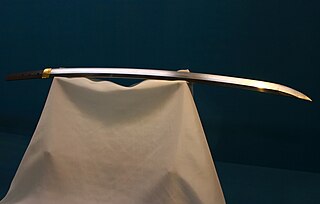
A katana is a Japanese sword characterized by a curved, single-edged blade with a circular or squared guard and long grip to accommodate two hands. Developed later than the tachi, it was used by samurai in feudal Japan and worn with the edge facing upward. Since the Muromachi period, many old tachi were cut from the root and shortened, and the blade at the root was crushed and converted into a katana. The specific term for katana in Japan is uchigatana (打刀) and the term katana (刀) often refers to single-edged swords from around the world.
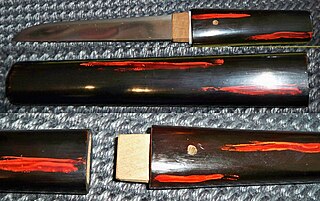
A kaiken is a 20–25 cm (7.9–9.8 in) long, single or double-edged Japanese knife usually without ornamental fittings housed in a plain but lacquered mount.

Scholars agree that Japanese armour first appeared in the 4th century, with the discovery of the cuirass and basic helmets in graves. During the Heian period (794–1185), the unique Japanese samurai armour ō-yoroi and dō-maru appeared. The Japanese cuirass evolved into the more familiar style of body armour worn by the samurai known as the dou or dō, with the use of leather straps (nerigawa), and lacquer for weatherproofing. Leather and/or iron scales were also used to construct samurai armours, with leather and eventually silk lace used to connect the individual scales (kozane) of these cuirasses.

This is the glossary of Japanese swords, including major terms the casual reader might find useful in understanding articles on Japanese swords. Within definitions, words set in boldface are defined elsewhere in the glossary.
References
- ↑ Japanese Sword Fighting: Secrets of the Samurai by Masaaki Hatsumi (2006) p.100
- ↑ Samurai, Warfare and the State in Early Medieval Japan (Warfare and History) by Karl Friday (2003) p.79
- ↑ The Japanese Sword: A Comprehensive Guide (Japanese Arts Library) by Kanzan Sato (1997) p.159
- ↑ The Arts of Japan: Late Medieval to Modern Vol.2 by Seiroku Noma and Glenn T. Webb (2003)
- ↑ Japan-British Exhibition, 1910 Shepherd's Bush, London: Fine Arts Catalogue. Part I.-British Section. Part II.-Japanese Section by Unknown Author (2002) p.246
- ↑ Japanese Crafts: A Complete Guide to Today's Traditional Handmade Objects by Craft Forum Japan (2001) p.153