
Llanes is a municipality of the province of Asturias, in northern Spain. Stretching for about 30 km along the coast at the extreme east of the province, Llanes is bounded to the south by the high ridge of the limestone Sierra del Cuera, which rises to over 1,100 m. The region is part of the Costa Verde of Spain, which is known for its spectacular coastal scenery, with 32 white sand beaches, and mountains covered with a deep green mantle. Llanes lies to the north of the Picos de Europa, a mountain range whose geology is almost entirely of limestone karst.
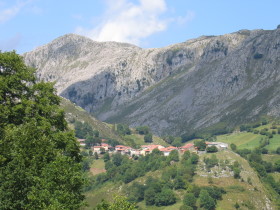
The Battle of El Mazucu was fought between 6 and 22 September 1937, between the Republican and Nationalist armies during the Spanish Civil War as a part of the War in the North campaign. The Republican defence of El Mazucu and the surrounding mountains halted the Nationalist advance into eastern Asturias, despite their forces being outnumbered sevenfold. After weeks of intense fighting over extreme terrain the defenders were eventually overwhelmed, and the Nationalists were then able to link up with their forces advancing from León, leading to the fall of Gijón and the abandonment of Asturias, the last Republican province in North-West Spain.

Cabrales is a municipality in the autonomous community of Asturias, northwestern Spain. It is situated between the Sierra de Cuera and the Picos de Europa, and is a region famous for its Cabrales cheese.
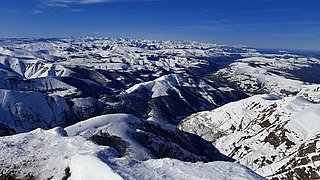
The Cantabrian Mountains or Cantabrian Range are one of the main systems of mountain ranges in Spain. They stretch for over 300 km (180 miles) across northern Spain, from the western limit of the Pyrenees to the Galician Massif in Galicia, along the coast of the Cantabrian Sea. Their easternmost end meets the Sistema Ibérico.

Piloña is a municipality in the province and autonomous community of Asturias, northwestern Spain. Its capital is the town of Infiesto. Piloña is bounded to the north by Villaviciosa and Colunga, to the east by Parres, to the west by Nava and Cabranes, and to the south by Ponga, Caso, Sobrescobio and Laviana. The area is semi-mountainous with many small, but deep and narrow valleys.

Asturian is a West Iberian Romance language spoken in the Principality of Asturias, Spain. Asturian is part of a wider linguistic group, the Asturleonese languages. The number of speakers is estimated at 100,000 (native) and 450,000. The dialects of the Astur-Leonese language family are traditionally classified in three groups: Western, Central, and Eastern. For historical and demographic reasons, the standard is based on Central Asturian. Asturian has a distinct grammar, dictionary, and orthography. It is regulated by the Academy of the Asturian Language. Although it is not an official language of Spain it is protected under the Statute of Autonomy of Asturias and is an elective language in schools. For much of its history, the language has been ignored or "subjected to repeated challenges to its status as a language variety" due to its lack of official status.

Peñamellera Baja is a municipality in the Autonomous Community of the Principality of Asturias, Spain. It is borderered to the north by Llanes and Ribadedeva, to the west by Peñamellera Alta, and to the east and south by the Autonomous Community of Cantabria.

Peñamellera Alta is a municipality in the Autonomous Community of the Principality of Asturias, Spain. It is bordered on the north by Llanes, on the west by Cabrales, on the east by Peñamellera Baja and on the south by the Autonomous Community of Cantabria.
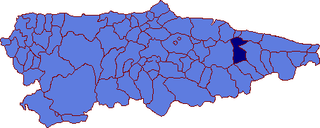
Parres is a municipality in the Autonomous Community of the Principality of Asturias, Spain. It is bordered on the north by Caravia and Ribadesella, on the east by Cangas de Onís, on the west by Piloña and Colunga, and on the south by Amieva.
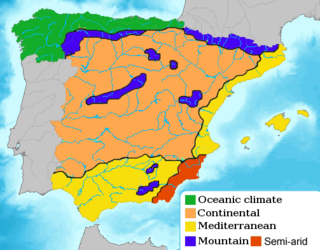
Cantabrian Coast is the name given to a lush natural region in Northern Spain, stretching along the Atlantic coast from the border with Portugal to the border with France. The region includes nearly all of Galicia, Asturias, and Cantabria, in addition to the northern parts of the Basque Country, as well as a small portion of Navarre.
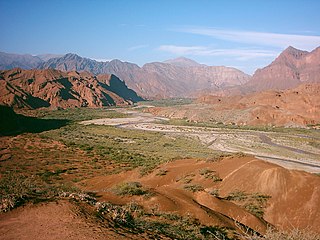
The Calchaquí Valley is an area in the northwestern region of Argentina which crosses the provinces of Catamarca, Tucumán, Jujuy and Salta. It is best known for its contrast of colors and its unique geography that ranges from the mountain desert to the subtropical forest.

A Pontenova is a municipality in the province of Lugo, in the autonomous community of Galicia, Spain. It belongs to the comarca of A Mariña Oriental. It has a population of 3199 and an area of 136 km².

Taramundi is a municipality in the Principality of Asturias, Spain. It neighbors on the north side with San Tirso de Abres and Vegadeo, on the east side with Villanueva de Oscos and Vegadeo, on the south side with Santa Eulalia de Oscos and A Pontenova (Lugo), and on the west side with Lugo.
El Mazucu is a village in the parroquia of Caldueño in the municipality of Llanes, in Asturias, northern Spain. Its population in 2004 was 67, in 25 dwellings.
Cueras is one of 54 parishes in Cangas del Narcea, a municipality within the province and autonomous community of Asturias, in northern Spain.

Sierra de Cuera, is a 30 km long mountain chain of the Cantabrian Mountains. The ridge's highest point is Pico Turbina. This mountain range is located at 6 km from the sea and runs parallel to the coast. It lies within the Cabrales, Llanes, Peñamellera Alta, Peñamellera Baja and Ribadedeva municipal terms.

The Sierra del Sueve is a limestone massif located close to the coast in the east-central area of Asturias, Spain. It is a northern foothill of the Cantabrian Mountains. The range is located in the municipalities of northeast Caravia, Colunga in the northwest, Piloña, Parres and Ribadesella to the east and south.

Nora River is a waterway in the north of Spain, a tributary of the Nalón River that flows through Asturias. It is one of the longest tributaries of Asturias.
