
Simon Alcock (died 1459?) was an English scholastic writer.
Simon Alcock (died 1459?) was an English scholastic writer.
Alcock was educated at the University of Oxford, where he took the degrees of M.A. and D.D. Before 1422 he was presented to the living of West Tilbury in Essex, which he resigned in 1428 for that of Lamarsh in the same county. A prebend in Hereford Cathedral was apparently conferred on Alcock on 25 August 1436; it seems probable that he subsequently became Canon of Lincoln Cathedral, and was buried there on 10 August 1459. Alcock apparently maintained throughout his life his connection with Oxford, and he is still numbered among the benefactors of the libraries of Oriel and Magdalen Colleges. [1]

The University of Oxford is a collegiate research university in Oxford, England. There is evidence of teaching as far back as 1096, making it the oldest university in the English-speaking world and the world's second-oldest university in continuous operation. It grew rapidly from 1167 when Henry II banned English students from attending the University of Paris. After disputes between students and Oxford townsfolk in 1209, some academics fled north-east to Cambridge where they established what became the University of Cambridge. The two 'ancient universities' are frequently jointly referred to as 'Oxbridge'. The history and influence of the University of Oxford has made it one of the most prestigious universities in the world.

West Tilbury is a village on the top of and on the sides of a 30 metres (98 ft) tall river terrace overlooking the river Thames. Part of the modern town of Tilbury is within the traditional parish of West Tilbury.

Essex is a county in the south-east of England, north-east of London. One of the home counties, it borders Suffolk and Cambridgeshire to the north, Hertfordshire to the west, Kent across the estuary of the River Thames to the south, and London to the south-west. The county town is Chelmsford, the only city in the county. For government statistical purposes Essex is placed in the East of England region.
Alcock's works were never printed. According to John Bale, following John Leland, they included commentaries on Peter Lombard's Liber Sententiarum , entitled Expositiones in Sententias Longobardi, and many sermons. This is now doubted. [2]

John Bale was an English churchman, historian and controversialist, and Bishop of Ossory. He wrote the oldest known historical verse drama in English, and developed and published a very extensive list of the works of British authors down to his own time, just as the monastic libraries were being dispersed. His unhappy disposition and habit of quarrelling earned him the nickname "bilious Bale".

John Leland or Leyland was an English poet and antiquary.
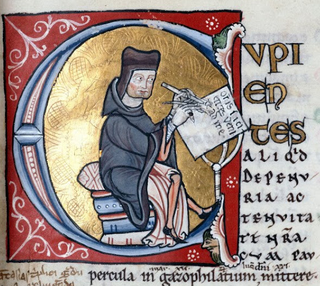
Peter Lombard, was a scholastic theologian, Bishop of Paris, and author of Four Books of Sentences, which became the standard textbook of theology, for which he earned the accolade Magister Sententiarum.
Alcock was author of a Tractatus de modo dividendi thema pro materia sermonis dilatanda, which is preserved among the Harleian MSS., and of a Libellus de arte dictaminis, preserved among the manuscripts of St John's College, Oxford, the colophon of which states it to have been prepared as a lecture "a magistro Symone Alkoke, doctore in theologia, anno Domini Mo cccco 27". Another work in manuscript at St John's College, Oxford, entitled Libellus de arte scribendi epistolas, has also been ascribed to Alcock. [1]

St John's College is a constituent college of the University of Oxford. Founded as a men's college in 1555, it has been coeducational since 1979. Its founder, Sir Thomas White, intended to provide a source of educated Roman Catholic clerics to support the Counter-Reformation under Queen Mary.
Alredus, or Alfred of Beverley,, English chronicler, was sacristan of the church of Beverley in the first half of the twelfth century.
Thomas Bateson, Batson or Betson was an English writer of madrigals in the early 17th century.
Charles Abbott was a British botanist and entomologist.
Nicholas Upton (1400?–1457), was an English cleric, precentor of Salisbury, and writer on heraldry and the art of war.
Ralph Acton, was a supposed English theologian and philosopher, apparently primarily known for his writings, some of which still exist. More recent enquiries suggest that Acton may have been a scribe or, indeed, non-existent.
Adam of Barking, was a Benedictine monk and religious poet who left a number of writings including De Serie Sex Ætatum which runs to 15,000 lines of hexameter. He belonged to the abbey of Sherborne in Dorset.
Matthew Nicholas (1594–1661) was an English Dean of St. Paul's Cathedral, London.
Robert Anton or Anthony was an English poet and satirist.

Francis Beale was an English author. He has been identified tentatively with the student admitted to St John's College, Cambridge of this name in 1640, who graduated B.A. at Magdalene College in 1644.
John Wessington was an English Benedictine who became prior of Durham Abbey.
John Bannard, was an Augustinian friar at Oxford.
Barvitus was a supposed Scottish saint. David E. Thornton suggests that he is a manifestation of the cult of St Findbarr, from north-east Ulster. Barvitus is said to have been the disciple of St Brandan, and his companion in his wanderings.
Sir Simon Baskerville, M.D. (1574–1641) was an English physician.
William Batecumbe or Badecumbe was an English mathematician and astrologer. His work is largely lost: some works of later authors have been attributed to him.
Robert Flemming, was dean of Lincoln.
John Garbrand or Herks (1542–1589) was an English cleric, a prebendary of Salisbury Cathedral and friend of Bishop Jewell.
Richard Butcher (1586/1587–1664) was an English antiquary.
Thomas Bedford was a nonjuror and church historian, the second son of Hilkiah Bedford, the nonjuror.

John Chambre (1470–1549) was an English churchman, academic and physician.
William Buckmaster was an English cleric and academic, three times vice-chancellor of the University of Cambridge.

The public domain consists of all the creative works to which no exclusive intellectual property rights apply. Those rights may have expired, been forfeited, expressly waived, or may be inapplicable.

Sir Leslie Stephen, was an English author, critic, historian, biographer, and mountaineer, and father of Virginia Woolf and Vanessa Bell.

The Dictionary of National Biography (DNB) is a standard work of reference on notable figures from British history, published since 1885. The updated Oxford Dictionary of National Biography (ODNB) was published on 23 September 2004 in 60 volumes and online, with 50,113 biographical articles covering 54,922 lives.