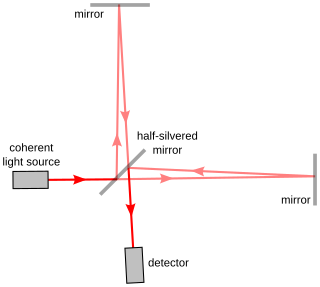
Interferometry is a technique which uses the interference of superimposed waves to extract information. Interferometry typically uses electromagnetic waves and is an important investigative technique in the fields of astronomy, fiber optics, engineering metrology, optical metrology, oceanography, seismology, spectroscopy, quantum mechanics, nuclear and particle physics, plasma physics, biomolecular interactions, surface profiling, microfluidics, mechanical stress/strain measurement, velocimetry, optometry, and making holograms.

In physics, a plasmon is a quantum of plasma oscillation. Just as light consists of photons, the plasma oscillation consists of plasmons. The plasmon can be considered as a quasiparticle since it arises from the quantization of plasma oscillations, just like phonons are quantizations of mechanical vibrations. Thus, plasmons are collective oscillations of the free electron gas density. For example, at optical frequencies, plasmons can couple with a photon to create another quasiparticle called a plasmon polariton.
A biosensor is an analytical device, used for the detection of a chemical substance, that combines a biological component with a physicochemical detector. The sensitive biological element, e.g. tissue, microorganisms, organelles, cell receptors, enzymes, antibodies, nucleic acids, etc., is a biologically derived material or biomimetic component that interacts with, binds with, or recognizes the analyte under study. The biologically sensitive elements can also be created by biological engineering. The transducer or the detector element, which transforms one signal into another one, works in a physicochemical way: optical, piezoelectric, electrochemical, electrochemiluminescence etc., resulting from the interaction of the analyte with the biological element, to easily measure and quantify. The biosensor reader device connects with the associated electronics or signal processors that are primarily responsible for the display of the results in a user-friendly way. This sometimes accounts for the most expensive part of the sensor device, however it is possible to generate a user friendly display that includes transducer and sensitive element. The readers are usually custom-designed and manufactured to suit the different working principles of biosensors.
A protein microarray is a high-throughput method used to track the interactions and activities of proteins, and to determine their function, and determining function on a large scale. Its main advantage lies in the fact that large numbers of proteins can be tracked in parallel. The chip consists of a support surface such as a glass slide, nitrocellulose membrane, bead, or microtitre plate, to which an array of capture proteins is bound. Probe molecules, typically labeled with a fluorescent dye, are added to the array. Any reaction between the probe and the immobilised protein emits a fluorescent signal that is read by a laser scanner. Protein microarrays are rapid, automated, economical, and highly sensitive, consuming small quantities of samples and reagents. The concept and methodology of protein microarrays was first introduced and illustrated in antibody microarrays in 1983 in a scientific publication and a series of patents. The high-throughput technology behind the protein microarray was relatively easy to develop since it is based on the technology developed for DNA microarrays, which have become the most widely used microarrays.

Surface plasmon resonance (SPR) is a phenomenon that occurs where electrons in a thin metal sheet become excited by light that is directed to the sheet with a particular angle of incidence, and then travel parallel to the sheet. Assuming a constant light source wavelength and that the metal sheet is thin, the angle of incidence that triggers SPR is related to the refractive index of the material and even a small change in the refractive index will cause SPR to not be observed. This makes SPR a possible technique for detecting particular substances (analytes) and SPR biosensors have been developed to detect various important biomarkers.

In biochemistry and pharmacology, a ligand is a substance that forms a complex with a biomolecule to serve a biological purpose. The etymology stems from Latin ligare, which means 'to bind'. In protein-ligand binding, the ligand is usually a molecule which produces a signal by binding to a site on a target protein. The binding typically results in a change of conformational isomerism (conformation) of the target protein. In DNA-ligand binding studies, the ligand can be a small molecule, ion, or protein which binds to the DNA double helix. The relationship between ligand and binding partner is a function of charge, hydrophobicity, and molecular structure.
Biacore was a life science products company based in Sweden. In June 2006 Biacore was sold for $390 million and became a product brand under GE Healthcare life Sciences, which became Cytiva in April 2020.
Smart ligands are affinity ligands selected with pre-defined equilibrium, kinetic and thermodynamic parameters of biomolecular interaction.

Surface plasmons (SPs) are coherent delocalized electron oscillations that exist at the interface between any two materials where the real part of the dielectric function changes sign across the interface. SPs have lower energy than bulk plasmons which quantise the longitudinal electron oscillations about positive ion cores within the bulk of an electron gas.
Reflectometric interference spectroscopy (RIfS) is a physical method based on the interference of white light at thin films, which is used to investigate molecular interaction.
In biochemistry, the conformation–activity relationship is the relationship between the biological activity and the chemical structure or conformational changes of a biomolecule. This terminology emphasizes the importance of dynamic conformational changes for the biological function, rather than the importance of static three-dimensional structure used in the analysis of structure–activity relationships.

Bio-layer interferometry (BLI) is an optical biosensing technology that analyzes biomolecular interactions in real-time without the need for fluorescent labeling. Alongside Surface Plasmon Resonance, BLI is one of few widely available label-free biosensing technologies, a detection style that yields more information in less time than traditional processes. The technology relies on the phase shift-wavelength correlation created between interference patterns off of two unique surfaces on the tip of a biosensor. BLI has significant applications in quantifying binding strength, measuring protein interactions, and identifying properties of reaction kinetics, such as rate constants and reaction rates.
There are many methods to investigate protein–protein interactions which are the physical contacts of high specificity established between two or more protein molecules involving electrostatic forces and hydrophobic effects. Each of the approaches has its own strengths and weaknesses, especially with regard to the sensitivity and specificity of the method. A high sensitivity means that many of the interactions that occur are detected by the screen. A high specificity indicates that most of the interactions detected by the screen are occurring in reality.
A ligand binding assay (LBA) is an assay, or an analytic procedure, which relies on the binding of ligand molecules to receptors, antibodies or other macromolecules. A detection method is used to determine the presence and amount of the ligand-receptor complexes formed, and this is usually determined electrochemically or through a fluorescence detection method. This type of analytic test can be used to test for the presence of target molecules in a sample that are known to bind to the receptor.
An electro-switchable biosurface is a biosensor that is based on an electrode to which a layer of biomolecules has been tethered. An alternating or fixed electrical potential is applied to the electrode which causes changes in the structure and position (movement) of the charged biomolecules. The biosensor is used in science, e.g. biomedical and biophysical research or drug discovery, to assess interactions between biomolecules and binding kinetics as well as changes in size or conformation of biomolecules.
Surface plasmon resonance microscopy (SPRM), also called surface plasmon resonance imaging (SPRI), is a label free analytical tool that combines the surface plasmon resonance of metallic surfaces with imaging of the metallic surface. The heterogeneity of the refractive index of the metallic surface imparts high contrast images, caused by the shift in the resonance angle. SPRM can achieve a sub-nanometer thickness sensitivity and lateral resolution achieves values of micrometer scale. SPRM is used to characterize surfaces such as self-assembled monolayers, multilayer films, metal nanoparticles, oligonucleotide arrays, and binding and reduction reactions. Surface plasmon polaritons are surface electromagnetic waves coupled to oscillating free electrons of a metallic surface that propagate along a metal/dielectric interface. Since polaritons are highly sensitive to small changes in the refractive index of the metallic material, it can be used as a biosensing tool that does not require labeling. SPRM measurements can be made in real-time, such as measuring binding kinetics of membrane proteins in single cells, or DNA hybridization.
Multi-parametric surface plasmon resonance (MP-SPR) is based on surface plasmon resonance (SPR), an established real-time label-free method for biomolecular interaction analysis, but it uses a different optical setup, a goniometric SPR configuration. While MP-SPR provides same kinetic information as SPR, it provides also structural information. Hence, MP-SPR measures both surface interactions and nanolayer properties.
Glycan arrays, like that offered by the Consortium for Functional Glycomics (CFG), National Center for Functional Glycomics (NCFG) and Z Biotech, LLC, contain carbohydrate compounds that can be screened with lectins, antibodies or cell receptors to define carbohydrate specificity and identify ligands. Glycan array screening works in much the same way as other microarray that is used for instance to study gene expression DNA microarrays or protein interaction Protein microarrays.
Focal molography is a biophysical method for robust and sensitive detection of biomolecular interactions in a label-free manner. The new method enables biomolecular interaction analysis in complex biological samples without the use of additional fluorescent labels. Molography widens the analytic scope of biomolecular interaction analysis techniques in a broad range of applications, e.g. label-free trace analysis of a targeted molecule in complex samples, such as blood sera, bioreactor fluid or cell culture media. Contrary to refractometric methods for label-free biomolecular interaction analysis, such as surface plasmon resonance (SPR) and reflectometric interference spectroscopy (RIfS), molography allows quantification of molecular interactions in living cells in real time.
Grating-coupled interferometry (GCI) is a biophysical characterization method mainly used in biochemistry and drug discovery for label-free analysis of molecular interactions. Similar to other optical methods such as surface plasmon resonance (SPR) or bio-layer interferometry (BLI), it is based on measuring refractive index changes within an evanescent field near a sensor surface. After immobilizing a target to the sensor surface, analyte molecules in solution which bind to that target cause a small increase in local refractive index. By monitoring these refractive changes over time characteristics such as kinetic rates and affinity constants of the analyte-target binding, or analyte concentrations, can be determined.


