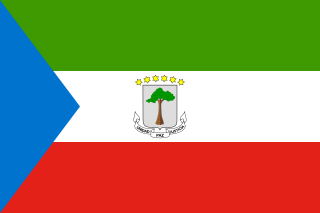
Equatorial Guinea, officially the Republic of Equatorial Guinea, is a country on the west coast of Central Africa, with an area of 28,000 square kilometres (11,000 sq mi). Formerly the colony of Spanish Guinea, its post-independence name evokes its location near both the Equator and the Gulf of Guinea. As of 2021, the country had a population of 1,468,777.
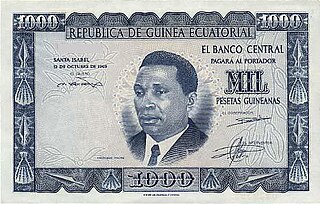
The economy of Equatorial Guinea has traditionally been dependent on commodities such as cocoa and coffee, but is now heavily dependent on petroleum due to the discovery and exploitation of significant oil reserves in the 1980s. In 2017, it graduated from "Least Developed Country" status, the only Sub-Saharan African nation that managed to do so besides Botswana.

The Armed Forces of Equatorial Guinea consists of approximately 2,500 service members. The army has almost 1,400 soldiers, the police 400 paramilitary men, the navy 200 service members, and the air force about 120 members. There is also a gendarmerie, but the number of members is unknown. The Gendarmerie is a new branch of the service in which training and education is being supported by the French Military Cooperation in Equatorial Guinea. Military appointments are all reviewed by President Teodoro Obiang, and few of the native militiamen come from outside of Obiang's Mongomo-based Esangui clan. Obiang was a general when he overthrew his uncle, Francisco Macías Nguema.

Malabo is the capital of Equatorial Guinea and the province of Bioko Norte. It is located on the north coast of the island of Bioko. In 2018, the city had a population of approximately 297,000 inhabitants.
Equatorial Guinea is divided into two regions and eight provinces. The newest province is Djibloho, created in 2017 with its headquarters at Ciudad de la Paz, the country's future capital.

The Bubi people are a Bantu ethnic group of Central Africa who are indigenous to Bioko Island, Equatorial Guinea. Once the majority group in the region, the population experienced a sharp decline due to war and disease during Portuguese expeditions. By the end of Spanish colonial rule in the mid 20th century, and after substantial intermarriage with newly introduced populations, such as Afro-Cubans, Krio people, Portuguese people and Spaniards, the Bubi people, again, experienced a great decline in number. Seventy-five percent perished due to tribal/clan rooted political genocide during a civil war that led to Spanish Guinea's independence from Spain. This, too, sparked mass exodus from their homeland with most of the exiles and refugees immigrating into Spain. The indigenous Bubi of Bioko Island have since co-existed with non-indigenous Krio Fernandinos; and members of the Fang ethnic group, who have immigrated in large numbers from Río Muni. Once numbering approximately 3 million, the Bubi currently number around 100,000 worldwide.
Sofitel Hotels & Resorts are a French hotel chain of luxury hotels based in Paris, France, and owned by Accor since 1980.

Luba is the second-largest town on Bioko in Equatorial Guinea, a port for the logging industry on the island's west coast beneath volcanic peaks. Attractions in Luba include several beaches and a colonial hospital.
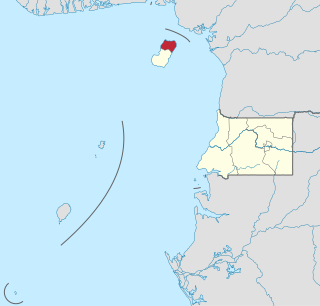
Bioko Norte is the second-most populated of the eight provinces of Equatorial Guinea, after the Wele-Nzas province. Both the provincial capital, Rebola, and the national capital, Malabo are located here. Heavily forested with little urban development, the southern central part includes part of the Parque Nacional del Pico Basilé, a 330 square kilometres (130 sq mi) national park which was established in 2000. On the northeast coast is a hotel run by the Sofitel chain.

Pico Basilé, located on the island of Bioko, is the tallest mountain of Equatorial Guinea. With an altitude of 9,878 ft, it is the summit of the largest and highest of three overlapping basaltic shield volcanoes which form the island. From the summit, Mt. Cameroon can be seen to the northeast. Pico Basilé lies close to the city of Malabo. The very top is used as a broadcast transmitting station for RTVGE and microwave relay station for various communication networks.

SEGESA is the national electricity company of Equatorial Guinea, with its head offices in Malabo, Equatorial Guinea. It is the sole operator of the electricity sector of Equatorial Guinea. The company was created in November 2001 by a merger of the national rural electrification company SONER and the national electricity corporation ENERGE. In 2013 the company was reorganized into three units: SEGESA Comercial for distribution and sales, SEGESA Generación for generation activities and SEGESA Transmisión for transmission. The three units are overseen by SEGESA Holding.
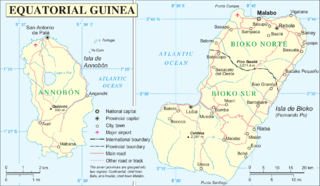
The Insular Region of Equatorial Guinea comprises the former Spanish territory of Fernando Po, together with Annobón island, the latter formerly part of the Spanish territory of Elobey, Annobón, and Corisco, which was located in the Gulf of Guinea and in the Corisco Bay.
According to Article 3 of the Constitution of Equatorial Guinea, the country is divided for administrative and economic purposes into regions, provinces, districts, and municipalities. In practice, the provinces serve as the first-level administrative divisions. Municipalities are subdivided into village councils and neighbourhood communities. Many of the sub-municipal entities are grouped into urban districts, which remain subordinate to municipalities and are distinct from districts proper.

Aeroflot Flight 418 was an international passenger flight operated by a Tupolev Tu-154A, registered CCCP-85102, that was operating the second leg of a scheduled Luanda–Malabo–N'Djamena–Tripoli–Moscow passenger service. The plane crashed on into a mountain near Malabo Airport on Bioko Island, Equatorial Guinea on 1 June 1976.
Narcisse Ekanga Amia is a former professional footballer who played as a midfielder. Born in Cameroon, he made eight appearances for the Equatorial Guinea national team.
Djibloho – Ciudad de la Paz, formerly Oyala, is a city in Equatorial Guinea that is being built to replace Malabo as the national capital. Established as an urban district in Wele-Nzas in 2015, it is now the administrative headquarters of Djibloho, Equatorial Guinea's newest province created in 2017, and is located near the town of Mengomeyén. In 2017, the city was officially renamed Ciudad de la Paz.
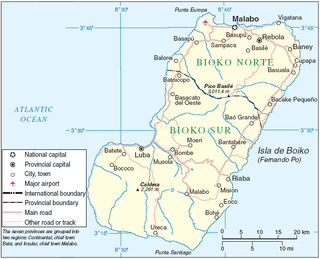
Bioko is an island 32 km (20 mi) off the west coast of Africa and the northernmost part of Equatorial Guinea. Its population was 335,048 at the 2015 census and it covers an area of 2,017 km2 (779 sq mi). The island is part of the Cameroon line of volcanoes and is located off the Cameroon coast, in the Bight of Biafra portion of the Gulf of Guinea. Its geology is volcanic; its highest peak is Pico Basile at 3,012 m (9,882 ft). Malabo, on the north coast of the island, is the capital city of Equatorial Guinea.

The Navy of Equatorial Guinea is the maritime component of the Armed Forces of Equatorial Guinea. Its main functions are anti-piracy operations in the Gulf of Guinea and protecting the offshore oil and gas assets of the nation. The Navy has around 200 personnel.
Malabo Mosque also known as Malabo Central Mosque is a mosque in Malabo, Equatorial Guinea. It is the largest mosque in Equatorial Guinea and can accommodate two thousand people.


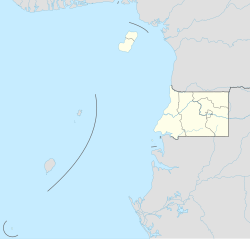
 Equatorial Guinea
