
Stingrays are a group of sea rays, a type of cartilaginous fish. They are classified in the suborder Myliobatoidei of the order Myliobatiformes and consist of eight families: Hexatrygonidae, Plesiobatidae, Urolophidae (stingarees), Urotrygonidae, Dasyatidae, Potamotrygonidae, Gymnuridae and Myliobatidae . There are about 220 known stingray species organized into 29 genera.
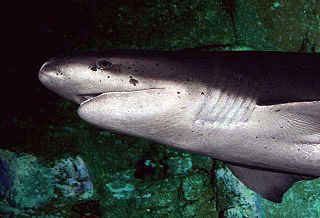
The Hexanchiformes are a primitive order of sharks, numbering just seven extant species in two families. Fossil sharks that were apparently very similar to modern sevengill species are known from Jurassic specimens.

A sawshark or saw shark is a member of a shark order bearing a unique long, saw-like rostrum edged with sharp teeth, which they use to slash and disable their prey. There are eight species within the Pristiophoriformes, including the longnose or common sawshark, shortnose sawshark, Japanese sawshark, Bahamas sawshark, sixgill sawshark, African dwarf sawshark, Lana's sawshark and the tropical sawshark.
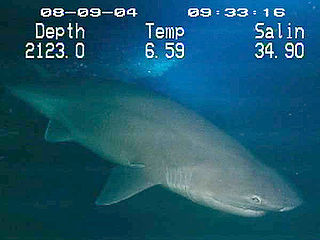
Cow sharks are a shark family, the Hexanchidae, characterized by an additional pair or pairs of gill slits. Its 37 species are placed within the 10 genera: Gladioserratus, Heptranchias, Hexanchus, Notidanodon, Notorynchus, Pachyhexanchus, Paraheptranchias, Pseudonotidanus, Welcommia, and Weltonia.

The prickly shark is one of the two species of sharks in the family Echinorhinidae, found in the Pacific Ocean over continental and insular shelves and slopes, and in submarine canyons. Bottom-dwelling in nature, it generally inhabits cool waters 100–650 m (330–2,130 ft) deep, but it also frequently enters shallower water in areas such as Monterey Bay off California. This stocky, dark-colored shark grows up to 4.0 m (13.1 ft) long, with two small dorsal fins positioned far back on its body and no anal fin. It is characterized by a dense covering of thorn-like dermal denticles, hence its common name.
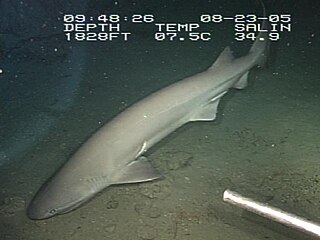
The bluntnose sixgill shark, often simply called the cow shark, is the largest hexanchoid shark, growing to 20 ft (6.1 m) in length. It is found in tropical and temperate waters worldwide and its diet is widely varied by region.
The sixgill sharks are a genus, Hexanchus, of deepwater sharks in the family Hexanchidae. These sharks are characterized by a broad, pointed head, six pairs of gill slits, comb-like, yellow lower teeth, and a long tail. The largest species can grow up to 8 m long and weigh over 600 kg (1320 lb). They are continental shelf-dwelling and abyssal plain scavengers with a keen sense of smell and are among the first to arrive at carrion, together with hagfish and rattails. They show a characteristic rolling motion of the head when feeding.

The bigeyed sixgill shark is a cow shark of the family Hexanchidae. Its dorsal surface has a brownish-gray color, and is sharply separated from the light coloring of its ventral surface. The eyes are a fluorescent green while the shark is alive. The body of this shark is small, slim, and fusiform in shape. As the name suggests, this shark has six gill slits, unusual among most shark species. The head is narrow and somewhat flattened, and the mouth contains 5 rows of large, comb-shaped teeth. This shark's single dorsal fin is pushed back towards the caudal fin, and is behind the pelvic fins. The upper caudal fin is much longer than the lower, with a deep notch near the tip. All fins have thin white margins on the edge. In juveniles, the upper caudal fin has a black tip.

The sixgill stingray is a species of stingray and the only extant member of the family Hexatrygonidae. Although several species of sixgill stingrays have been described historically, they may represent variations in a single, widespread species. This flabby, heavy-bodied fish, described only in 1980, is unique among rays in having six pairs of gill slits rather than five. Growing up to 1.7 m (5.6 ft) long, it has a rounded pectoral fin disc and a long, triangular, and flexible snout filled with a gelatinous substance. It is brownish above and white below, and lacks dermal denticles.

The sixgill sawshark, Pliotrema warreni is a sawshark of the family Pristiophoridae. Presence of 6 pairs of gill slits highlights this genus among sharks; outside Hexanchiformes order, Pliotrema is the only shark genus with more than 5 gill slits. Unlike other sawsharks, the barbs on this shark's rostrum continue onto the sides of the head. Its barbels are also closer to its mouth than in other species. At maximum, females can reach over 136 cm long, and males can reach over 112 cm long.

The wildlife of Algeria is composed of its flora and fauna. Mountains, chotts, wetlands, and grassy desert-like regions all support a wide range of wildlife. The most commonly seen animals include the wild boars, jackals, and gazelles, although it is not uncommon to spot fennecs and jerboas. Leopards and cheetahs are seldom seen.
Pristiophorus is a genus of sawsharks found in the Pacific, Atlantic and Indian oceans. Members of this genus differ from the Sixgill Sawshark (Pliotrema warreni) in having five gill slits. Their rostral sawteeth lack prominent transverse ridges on the basal ledges, and the large teeth are not posteriorly serrated.

Polyopisthocotylea is a subclass of parasitic flatworms in the class Monogenea.
Protocotyle euzetmaillardi is a species of monogenean of the family Hexabothriidae.

Cybersixgill is an Israeli B2B cyber intelligence company that analyses and monitors the deep web and dark web for threat intelligence. The company was founded in 2014 and is headquartered in Tel Aviv, Israel.
The Atlantic sixgill shark is a rare species of hexanchid shark found in the Atlantic Ocean at depths that are greater than 300 meters. These depths are known as mesopelagic and bathypelagic in tropical and temperate waters around the world. The Atlantic sixgill shark is very similar to other species of sixgill in terms of its growth rate in deep sea waters. It is believed that this is due to the abiotic and biotic factors in relation to the depths at which they are found. It was formerly described as its own species, but was synonymised with the bigeye sixgill shark. However, a study published in 2019 resurrected the species on the basis of molecular data. The species can be physically differentiated from the bluntnose sixgill shark by its much smaller size and position of the dorsal fin in relation to the caudal fin. The Atlantic sixgill shark becomes sexually mature at around 1.40 to 1.75 meters. They do not reach lengths much greater than 180 cm.

Legends of the Deep: Deep-Sea Sharks is a 2015 British nature documentary programme made for BBC Television, first shown in the UK on BBC Four on 19 July 2015. The programme is narrated by Sir David Attenborough.
