
A role-playing game is a game in which players assume the roles of characters in a fictional setting. Players take responsibility for acting out these roles within a narrative, either through literal acting or through a process of structured decision-making regarding character development. Actions taken within many games succeed or fail according to a formal system of rules and guidelines.
Dragon Quest, previously published as Dragon Warrior in North America until 2005, is a Japanese role-playing video game's franchise created by Armor Project, Bird Studio and Sugiyama Kobo to its publisher Enix, with all of the involved parties co-owning the copyright of the series since then. The games are published by Square Enix since its inception, with localized remakes and ports of later installments for the Nintendo DS, Nintendo 3DS, and Nintendo Switch being published by Nintendo outside of Japan. With its first game published in 1986, there are eleven main-series games, along with numerous spin-off games. In addition, there have been numerous manga, anime and novels published under the franchise, with nearly every game in the main series having a related adaptation.

A role-playing video game, commonly referred to as a role-playing game (RPG) or computer role-playing game (CRPG), is a video game genre where the player controls the actions of a character immersed in some well-defined world, usually involving some form of character development by way of recording statistics. Many role-playing video games have origins in tabletop role-playing games and use much of the same terminology, settings and game mechanics. Other major similarities with pen-and-paper games include developed story-telling and narrative elements, player character development, complexity, as well as replay value and immersion. The electronic medium removes the necessity for a gamemaster and increases combat resolution speed. RPGs have evolved from simple text-based console-window games into visually rich 3D experiences.

The Slime series is a spinoff series of games from Dragon Quest featuring its Slime character. Three games have been released, the second of which, Dragon Quest Heroes: Rocket Slime, has been released in North America.
A gamebook is a work of printed fiction that allows the reader to participate in the story by making choices. The narrative branches along various paths, typically through the use of numbered paragraphs or pages. Each narrative typically does not follow paragraphs in a linear or ordered fashion. Gamebooks are sometimes called choose your own adventure books or CYOA after the influential Choose Your Own Adventure series originally published by US company Bantam Books. Gamebooks influenced hypertext fiction.
A programming game is a video game that incorporates elements of computer programming, enabling the player to direct otherwise autonomous units within the game to follow commands in a domain-specific programming language, often represented as a visual language to simplify the programming metaphor. Programming games broadly fall into two areas: single-player games where the programming elements either make up part of or the whole of a puzzle game, and multiplayer games where the player's automated program is pitted against other players' programs.
The following outline is provided as an overview of and topical guide to video games:

Dragon Quest Heroes: Rocket Slime is an action-adventure game developed by Tose and published by Square Enix for the Nintendo DS handheld video game console. It is the sequel to Slime MoriMori Dragon Quest: Shōgeki no Shippo Dan for the Game Boy Advance. It was first released in Japan, and later in North America. It is a spin-off of the Dragon Quest series.
Sim RPG Maker is a series of tactical role-playing game software and spinoff of the long-running RPG Maker series, although the name is not a direct translation of the original name which would be "Simulation RPG Maker".
TimeLords is a set of time travel role-playing games by Greg Porter and published by Blacksburg Tactical Research Center (BTRC). The first two editions used a custom d20-based game system; the most recent edition uses the EABA system from BTRC.
RPG Maker, known in Japan as RPG Tsukūru, is a series of programs for the development of role-playing video games (RPGs) with story-driven elements, created by the Japanese group ASCII, succeeded by Enterbrain. The Japanese name, Tsukūru, is a pun mixing the Japanese word tsukuru (作る), means "make" or "create", with tsūru (ツール), the Japanese transcription of the English word "tool".
JumpStart Typing is a personal computer game intended to teach typing skills to kids aged seven to ten. The game reuses the cast of JumpStart Adventures 3rd Grade: Mystery Mountain.
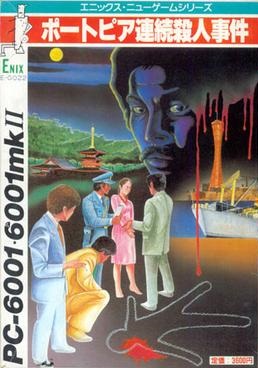
The Portopia Serial Murder Case is an adventure game designed by Yuji Horii and published by Enix. It was first released on the NEC PC-6001 in June 1983, and has since been ported to other personal computers, the Nintendo Famicom, mobile phone services and most recently, Windows as Square Enix showing off their natural language processing technology.
Kodu Game Lab, originally named Boku, is a programming integrated development environment (IDE) by Microsoft's FUSE Labs. It runs on Xbox 360 and Microsoft Windows XP, Windows Vista, Windows 7, Windows 8, Windows 10 And Windows 11. It was released on the Xbox Live Marketplace on June 30, 2009. A Windows version is available to the general public for download from Microsoft's FUSE web portal.

RPG Maker VX is a version of PC program RPG Maker series. It has been superseded by RPG Maker VX Ace, which is an improved and enhanced version of RPG Maker VX. Both RPG Maker VX and RPG Maker VX Ace are developed by Enterbrain, following its predecessor, RPG Maker XP. RPG Maker VX follows the naming pattern present in previous RPG Maker releases by having a suffix based on the Windows versions the software was designed for.

Troy Christensen is an American author and game designer. Based in Grand Rapids, Michigan, he is an established figure in the role-playing game community.
Isekai is a genre of speculative fiction. It includes novels, light novels, films, manga, anime and video games that revolve around a displaced person or people who are transported to and have to survive in another world, such as a fantasy world, virtual world, or parallel universe. Isekai is one of the most popular genres of anime, and Isekai stories share many common tropes – for example, a powerful protagonist who is able to beat most people in the other world by fighting. This plot device typically allows the audience to learn about the new world at the same pace as the protagonist over the course of their quest or lifetime. If the main characters are transported to a game-like world, the genre can overlap with LitRPG.

Kewala's Typing Adventure is a 1996 Australian educational typing-themed video game, featuring a koala protagonist named Kewala. It was developed by Sydney-based software company Typequick, and localised by Japan Data Pacific for the Japanese market. The game was renamed Typequick for Students in 1997 and, by 2002, was called Success With Typing for Students.

Typequick Pty Ltd is an Australian courseware company specialising in the development of computer-based touch-typing tutor systems of the same name. The first Typequick program was developed by Noel McIntosh's AID Systems in conjunction with Blue Sky Industries in 1982, as a tool for teaching typing skills among users of new micro computers. The Sydney-based company of the same name was founded by McIntosh in 1985, after buying out the founders and acquiring the software.

