
Smyrna is the former name of Izmir, Turkey.
Contents
Smyrna may also refer to:
Smyrna is the former name of Izmir, Turkey.
Smyrna may also refer to:

Seneca may refer to:

Smyrna was an Ancient Greek city located at a strategic point on the Aegean coast of Anatolia. Due to its advantageous port conditions, its ease of defence, and its good inland connections, Smyrna rose to prominence. Since about 1930, the city's name has been İzmir.
Apollodorus was a popular name in ancient Greece. It is the masculine gender of a noun compounded from Apollo, the deity, and doron, "gift"; that is, "Gift of Apollo." It may refer to:
Dion may refer to:
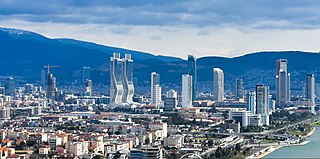
İzmir Province is a province and metropolitan municipality of Turkey in western Anatolia, situated along the Aegean coast. Its capital is the city of İzmir, which is in itself composed of the province's central 11 districts out of 30 in total. To the west, it is surrounded by the Aegean Sea, and it encloses the Gulf of Izmir. Its area is 11,891 square kilometres, and its population is 4,462,056 (2022). Neighboring provinces are Balıkesir to the north, Manisa to the east, and Aydın to the south. The traffic code of the province is 35.
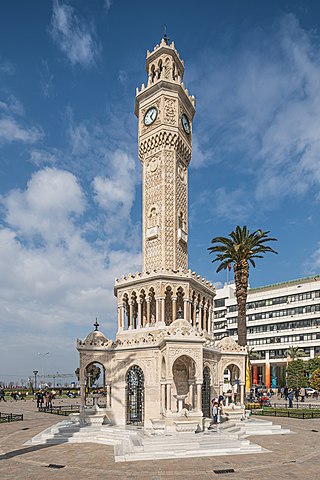
İzmir is a metropolitan city on the west coast of Anatolia, and capital of İzmir Province. It is the third most populous city in Turkey, after Istanbul and Ankara, and the largest urban agglomeration on the Aegean Sea.
Euclid generally refers to the ancient Greek mathematician Euclid of Alexandria, who wrote a work on geometry called the Elements.
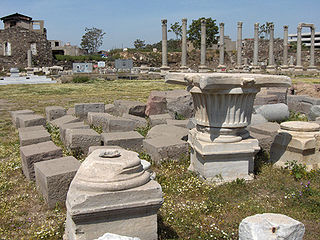
Aeolis, or Aeolia, was an area that comprised the west and northwestern region of Asia Minor, mostly along the coast, and also several offshore islands, where the Aeolian Greek city-states were located. Aeolis incorporated the southern parts of Mysia, and is bounded by it to the north, Ionia to the south, and Lydia to the east.
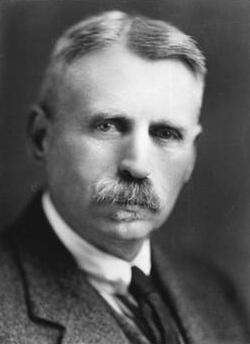
George Horton was a member of the United States diplomatic corps who held several consular offices in Greece and the Ottoman Empire between 1893 and 1924. During two periods he was the U.S. Consul or Consul General at Smyrna, 1911–1917 and 1919–1922. The first ended when the U.S. entered World War I and diplomatic relations with the Ottoman Empire were terminated. The second covered Greek administration of the city during the Greco-Turkish War. The Greek administration of Smyrna was appointed by the Allied Powers following Turkey's defeat in World War I and the seizure of Smyrna.

Aydın is a city in and the seat of Aydın Province in Turkey's Aegean Region. The city is located at the heart of the lower valley of Büyük Menderes River at a commanding position for the region extending from the uplands of the valley down to the seacoast. The city forms the urban part of the Efeler district, with a population of 259,027 in 2022. Aydın city is located along a region which was famous for its fertility and productivity since ancient times. Figs remain the province's best-known crop, although other agricultural products are also grown intensively and the city has some light industry.
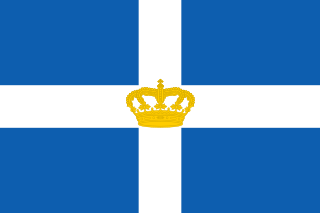
The city of Smyrna and surrounding areas were under Greek military occupation from 15 May 1919 until 9 September 1922. The Allied Powers authorized the occupation and creation of the Zone of Smyrna during negotiations regarding the partition of the Ottoman Empire to protect the ethnic Greek population living in and around the city. The Greek landing on 15 May 1919 was celebrated by the substantial local Greek population but quickly resulted in ethnic violence in the area. This violence decreased international support for the occupation and led to a rise in Turkish nationalism. The high commissioner of Smyrna, Aristeidis Stergiadis, firmly opposed discrimination against the Turkish population by the administration; however, ethnic tensions and discrimination remained. Stergiadis also began work on projects involving resettlement of Greek refugees, the foundations for a university, and some public health projects. Smyrna was a major base of operations for Greek troops in Anatolia during the Greco-Turkish War (1919–1922).

Buca is a municipality and district of İzmir Province, Turkey. Its area is 178 km2, and its population is 522,404 (2022). It is the biggest district of İzmir Province as terms of population. It covers the southeastern part of the agglomeration of İzmir and the adjacent countryside.
Chrysostomos (golden-mouthed) was a common epithet for orators. Chrysostomos or Chrysostom may refer to:
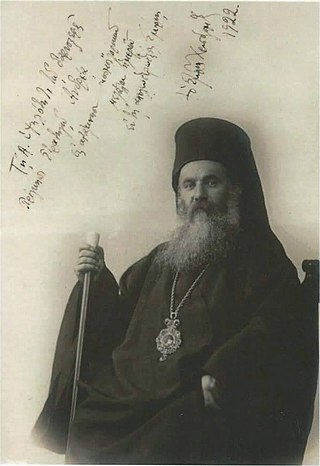
Chrysostomos Kalafatis, also known as Saint Chrysostomos of Smyrna, Chrysostomos of Smyrna and Metropolitan Chrysostom, was the Greek Orthodox metropolitan bishop of Smyrna (İzmir) between 1910 and 1914, and again from 1919 until his death in 1922. He was born in Triglia in the then Ottoman Empire in 1867. He aided the Greek campaign in Smyrna in 1919 and was subsequently killed by a lynch mob after Turkish troops occupied the city at the end of the Greco-Turkish War of 1919–1922. He was declared a martyr and a saint of the Eastern Orthodox Church by the Holy Synod of the Church of Greece on 4 November 1992.

The burning of Smyrna destroyed much of the port city of Smyrna in September 1922. Eyewitness reports state that the fire began on 13 September 1922 and lasted until it was largely extinguished on 22 September. It began four days after the Turkish military captured the city on 9 September, effectively ending the Greco-Turkish War, more than three years after the Greek landing of troops at Smyrna. Estimated Greek and Armenian deaths resulting from the fire range from 10,000 to 125,000.

The Greek landing at Smyrna was a military operation by Greek forces starting on May 15, 1919 which involved landing troops in the city of Smyrna and surrounding areas. The Allied powers sanctioned and oversaw the planning of the operation and assisted by directing their forces to take over some key locations and moving warships to the Smyrna harbor. During the landing, a shot was fired on the Greek 1/38 Evzone Regiment and significant violence ensued with Greek troops and Greek citizens of Smyrna participating. The event became important for creating the three-year-long Greek Occupation of Smyrna and was a major spark for the Greco-Turkish War (1919–1922).
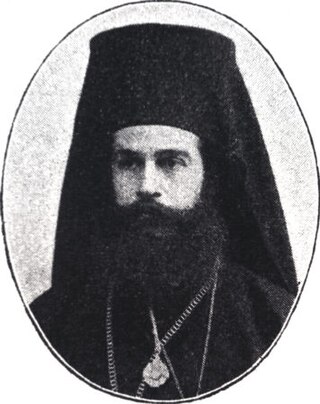
Ambrosios Pleiathidis also known as Ambrosios of Moschonisia was the Greek Orthodox metropolitan bishop of Moschonisia, in modern Turkey, from February to September 1922. He was executed by the Turkish Army at the end of the Greco-Turkish War (1919-1922).
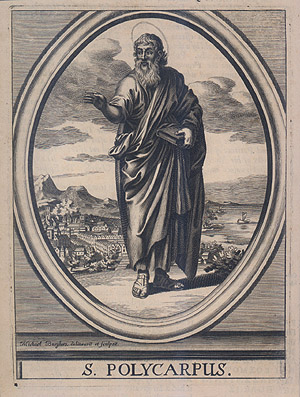
The Metropolis of Smyrna is an ecclesiastical territory (diocese) of the Ecumenical Patriarchate of Constantinople, modern Turkey. The Christian community of Smyrna was one of the Seven Churches of Asia, mentioned by Apostle John in the Book of Revelation. It was initially an archbishopric, but was promoted to a metropolis during the 9th century. Although the local Christian element was reduced during the 14th and 15th centuries, it retained its ecclesiastical autonomy continuously until 1922.

Old Smyrna is an ancient Greek exonym first known to have been applied by Strabo to a city of the endonym Σμύρνα, Smyrna. It had existed at the same location on the Bay of Smyrna, Turkey, since prehistoric times. Old Smyrna experienced what was termed dioecism (dioikismos), the removal of a city from its subordinate constituents, the reverse of synoecism, at the hands of its Lydian conquerors under their king, Alyattes, in 585 BC, in the Archaic Period of Greece. It is mentioned by Herodotus. Such a procedure, which was standard among the ancient Greeks, razes the center of the city and distributes the population to komai, or "villages,". Apparently they did not suffer andrapodismos, the massacre of the men and the sale of the women and children into slavery, but were allowed to live komedon, "in villages," albeit without a polis of their own.