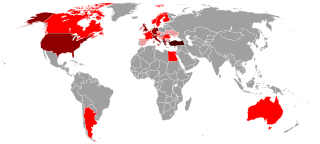
The Albanians are an ethnic group native to the Balkan Peninsula who share a common Albanian ancestry, culture, history and language. They are the main ethnic group of Albania and Kosovo, and they also live in the neighboring countries of North Macedonia, Montenegro, Greece, and Serbia, as well as in Italy, Croatia, Bulgaria, and Turkey. Albanians also constitute a large diaspora with several communities established across Europe and the other continents.

Polyphony is a type of musical texture consisting of two or more simultaneous lines of independent melody, as opposed to a musical texture with just one voice (monophony) or a texture with one dominant melodic voice accompanied by chords (homophony).

Korçë is the eighth most populous city of Albania and the seat of Korçë County and Korçë Municipality. The total population of the city is 51,152 and 75,994 of Korçë municipality, in a total area of 806 km2 (311 sq mi). It stands on a plateau some 850 m (2,789 ft) above sea level, surrounded by the Morava Mountains.

Albanian culture or the culture of Albanians is a term that embodies the artistic, culinary, literary, musical, political and social elements that are representative of ethnic Albanians, which implies not just Albanians of the country of Albania but also Albanians of Kosovo, North Macedonia and Montenegro, where ethnic Albanians are a native population. Albanian culture has been considerably shaped by the geography and history of Albania, Kosovo, parts of Montenegro, parts of North Macedonia, and parts of Northern Greece, traditional homeland of Albanians. It evolved since ancient times in the western Balkans, with its peculiar language, pagan beliefs and practices, way of life and traditions. Albanian culture has also been influenced by the Ancient Greeks, Romans, Byzantines and Ottomans.
Cham Albanians or Chams, are a sub-group of Albanians who originally resided in the western part of the region of Epirus in southwestern Albania and northwestern Greece, an area known among Albanians as Chameria. The Chams have their own particular cultural identity within Albanian sub-groups. A number of Chams contributed to the Albanian national identity and played an important role in starting the renaissance of the Albanian culture in the 19th century. The Chams speak their own dialect of the Albanian language, the Cham Albanian dialect, which is a Southern Tosk Albanian dialect and one of the two most conservative ones; the other being Arvanitika.

The music of Albania is associated with the country of Albania and Albanian communities. Music has a long tradition in the country and is known for its regional diversity, from the Ghegs in the North to the Tosks in the South. It is an integral part of the national identity, strongly influenced by the country's long and turbulent history, which forced Albanians to protect their culture from their overlords by living in rural and remote mountains.

Vlorë County is one of the 12 counties of Albania with the city of Vlorë being the county capital. The county spans 2,706 square kilometres (1,045 sq mi) and has a total population of 146,681 people as of 2023. It borders the counties of Fier and Gjirokastër, as well as the Adriatic and Ionian Sea. Greece borders Vlorë to the south.
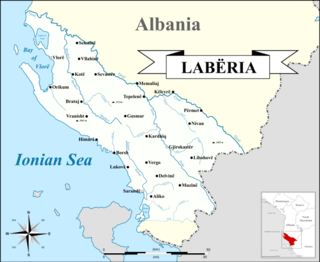
Labëria is a historic region that is roughly situated in southwestern Albania. Its inhabitants are known as Labs and its boundaries reach from Vlorë to Himara in the south, to the Greek border near Sarandë, incorporating the Kurvelesh region of Gjirokastër District and extending east to the city of Tepelenë.
Muhaxhir and Muhaxher are Ottoman Albanian communities that left their homes as refugees or were transferred, from Greece, Serbia and Montenegro to Albania, Kosovo and to a lesser extent North Macedonia during and following various wars.
The polyphonic song of Epirus is a form of traditional folk polyphony practiced among Albanians, Aromanians, Greeks and ethnic Macedonians in southern Albania and northwestern Greece. The polyphonic song of Epirus is not to be confused with other varieties of polyphonic singing, such as the yodeling songs of the region of Muotatal, or the Cantu a tenore of Sardinia. Scholars consider it an old tradition, which either originates from the ancient Greek and Thraco-Illyrian era, or the Byzantine era, with influences from Byzantine music. The Albanian Iso-Polyphony – which is recognized as cultural heritage by UNESCO – is considered to have its roots in the in the many-voiced vajtim, the southern Albanian traditional lamentation of the dead. The Greek project Polyphonic Caravan, which aims at researching, safeguarding and promoting the Epirus polyphonic song since 1998, was inscribed in the UNESCO Intangible Cultural Heritage List of Good Safeguarding Practices in 2020.

The Myzeqe is a plain in the Western Lowlands of Albania. The Myzeqe is the largest and widest plain, measured by area, in the Lowlands.

The Autonomous Republic of Northern Epirus was a short-lived, self-governing entity founded in the aftermath of the Balkan Wars on 28 February 1914, by the local Greek population in southern Albania.

Independent Albania was proclaimed on 28 November 1912. This chapter of Albanian history was shrouded in controversy and conflict as the larger part of the self-proclaimed region had found itself controlled by the Balkan League states: Serbia, Montenegro and Greece from the time of the declaration until the period of recognition when Albania relinquished many of the lands originally included in the declared state. Since the proclamation of the state in November 1912, the Provisional Government of Albania asserted its control over a small part of central Albania including the important cities of Vlorë and Berat.
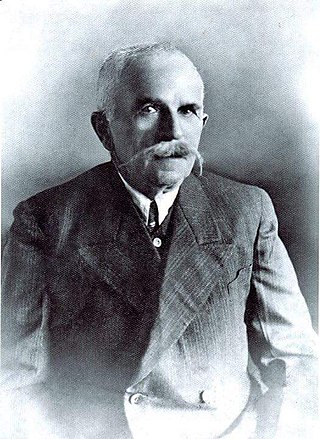
Sali Butka, was an Albanian nationalist figure, revolutionary kachak, poet, and one of the delegates of the city of Korçë to the Albanian National Congress of Lushnjë. He was a well-known leader of an armed çeta band of Albanian fighters during the early 1900's.
The Song of Çelo Mezani is an Albanian polyphonic folk song. It is considered to be the best-known Cham Albanian song. The song increased the awareness in Albania about the Chameria region and its history.
The regions of Albania—apart from the official present and historical administrative divisions—include the following:
Iso-Polyphony is a traditional part of Albanian folk music and, as such, is included in UNESCO's intangible cultural heritage list. Albanian Iso-Polyphony is considered to have its roots in the many-voiced vajtim, the southern Albanian traditional lamentation of the dead. The instrumental expression of the Albanian Iso-Polyphony evolved into the Albanian kaba.

Southern Albania is one of the three NUTS-2 Regions of Albania.
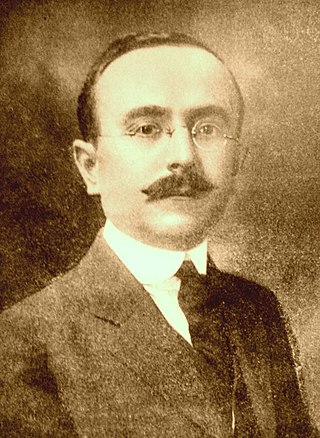
Kol Tromara (1882–1945) was an Albanian nationalist and political figure of the first half of the 20th century.
The fyell brezi, also known as fyell shoke or fyell bariu is an aerophone end-blown instrument traditionally played throughout Albania and other Albanian inhabited lands. The instrument is commonly associated with shepherds of the Albanian highlands, commonly referred to as the Dukagjin highlands.