
The Communist International (Comintern), also known as the Third International, was an international organization founded in 1919 that advocated world communism, and which was led and controlled by the Communist Party of the Soviet Union. The Comintern resolved at its Second Congress in 1920 to "struggle by all available means, including armed force, for the overthrow of the international bourgeoisie and the creation of an international Soviet republic as a transition stage to the complete abolition of the state". The Comintern was preceded by the dissolution of the Second International in 1916.

The Anti-Comintern Pact, officially the Agreement against the Communist International was an anti-Communist pact concluded between Nazi Germany and the Empire of Japan on 25 November 1936 and was directed against the Communist International (Comintern). It was signed by German ambassador-at-large Joachim von Ribbentrop and Japanese ambassador to Germany Kintomo Mushanokōji. Italy joined in 1937, but it was legally recognised as an original signatory by the terms of its entry. Spain and Hungary joined in 1939. Other countries joined during World War II.
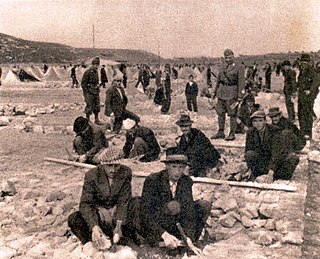
The Rab concentration camp was one of several Italian concentration camps. It was established during World War II, in July 1942, on the Italian-occupied island of Rab.
Robert Henry Winborne Welch Jr. was an American businessman, political organizer, and conspiracy theorist. He was wealthy following his retirement from the candy business and used his wealth to sponsor anti-communist causes. He co-founded the John Birch Society (JBS), an American extreme right-wing political advocacy group, in 1958 and tightly controlled it until his death. He was highly controversial and criticized by liberals, as well as some conservatives, including William F. Buckley Jr, only after being an early donor to Buckley’s National Review in the 1950s.

Monticiano is a town and comune on the right bank of the Val di Merse, Province of Siena, Tuscany, central Italy. The town is situated on the Colline Metallifere. One of its frazioni, Bagni di Petriolo, is popular for its thermal waters.

The occupation of Greece by the Axis Powers began in April 1941 after Nazi Germany invaded the Kingdom of Greece to assist its ally, Italy, in their ongoing war that had started in October 1940. Following the conquest of Crete, the entirety of Greece was occupied starting in June 1941. The occupation of the mainland lasted until Germany and its ally Bulgaria withdrew under Allied pressure in early October 1944, with Crete and some other Aegean islands being surrendered to the Allies by German garrisons in May and June 1945, after the end of World War II in Europe.

World War II in the Kingdom of Yugoslavia began on 6 April 1941, when the country was invaded and swiftly conquered by Axis forces and partitioned among Germany, Italy, Hungary, Bulgaria and their client regimes. Shortly after Germany attacked the USSR on 22 June 1941, the communist-led republican Yugoslav Partisans, on orders from Moscow, launched a guerrilla liberation war fighting against the Axis forces and their locally established puppet regimes, including the Axis-allied Independent State of Croatia (NDH) and the Government of National Salvation in the German-occupied territory of Serbia. This was dubbed the National Liberation War and Socialist Revolution in post-war Yugoslav communist historiography. Simultaneously, a multi-side civil war was waged between the Yugoslav communist Partisans, the Serbian royalist Chetniks, the Axis-allied Croatian Ustaše and Home Guard, Serbian Volunteer Corps and State Guard, Slovene Home Guard, as well as Nazi-allied Russian Protective Corps troops.

In late February 1948, the Communist Party of Czechoslovakia (KSČ), with Soviet backing, assumed undisputed control over the government of Czechoslovakia through a coup d'état. It marked the onset of four decades of the party's rule in the country.
Spartaco Landini was an Italian football defender and later a manager.
Spartaco Bandinelli was an Italian boxer. He was born and died in Velletri.
In the May 1947 crises, also referred to as the exclusion crises, the Communists were excluded from government in Italy and France. The crises contributed to the start of the Cold War in Western Europe.

Spartaco Schergat was an Italian military frogman during World War II.
The Lega trotskista d'Italia of Trotskyist League of Italy is an Italian Trotskyist group. It is the Italian section of the International Communist League, or "Spartacist" tendency within international Trotskyism.

Left communism, or the communist left, is a position held by the left wing of communism, which criticises the political ideas and practices espoused by Marxist–Leninists and social democrats. Left communists assert positions which they regard as more authentically Marxist than the views of Marxism–Leninism espoused by the Communist International after its Bolshevization by Joseph Stalin and during its second congress.
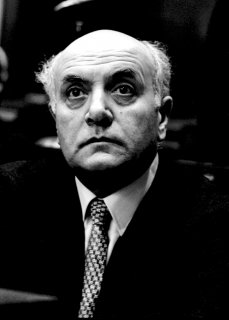
Eurocommunism was a trend in the 1970s and 1980s within various Western European communist parties which said they had developed a theory and practice of social transformation more relevant for Western Europe. During the Cold War, they sought to reject the influence of the Soviet Union and the Communist Party of the Soviet Union. The trend was especially prominent in Italy, Spain, and France.

Anti-fascism is a political movement in opposition to fascist ideologies, groups and individuals. Beginning in European countries in the 1920s, it was at its most significant shortly before and during World War II, where the Axis powers were opposed by many countries forming the Allies of World War II and dozens of resistance movements worldwide. Anti-fascism has been an element of movements across the political spectrum and holding many different political positions such as anarchism, communism, pacifism, republicanism, social democracy, socialism and syndicalism as well as centrist, conservative, liberal and nationalist viewpoints.

Giovanni Berta was an Italian fascist militant of the Florentine Squadrismo, later killed by communist militants during the Pignone clashes in Florence.
Rinascita was a political and cultural magazine published in Rome, Italy, between 1944 and March 1991. It was one of the media outlets of Italian Communist Party (PCI).
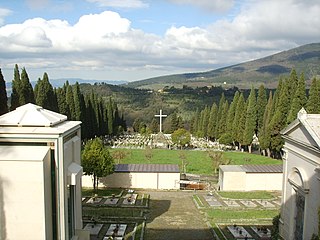
The Cimitero di Trespiano is a cemetery along the Via Bolognese near Florence, Italy, named after the hamlet of Trespiano in the hills north of Fiesole.
The Molat concentration camp was an Italian concentration camp, established during World War II, by Fascist Italy on the island of Molat and was subordinate to the Italian Ministry of the Interior.


