Spatini sauce mix

Last updated
Spatini sauce
Spatini.jpg
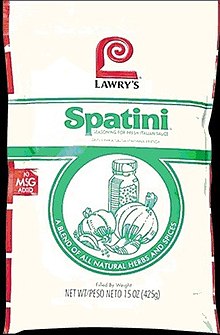
Commercial-sized 15 oz. Spatini package
Type Seasoning mix
Place of originUnited States
Region or statePhiladelphia, Pennsylvania
Created byRussell G. Lakoff and Harry Seidman
Invented1952
Main ingredientsSalt, sugar, onion, potato starch, spices (including red pepper, turmeric, black pepper), corn maltodextrin, garlic, beet (color), dextrose, yeast extract, guar gum, and carrot

Spatini sauce mix is a dry, packaged seasoning mix produced by Lawry's. [1] Originally developed in 1952 to be added to other ingredients (such as crushed tomatoes or tomato puree, and ground meat) to make an Italian-style "spaghetti sauce", it is also used variously to make a dip, in meatloaf, to season meatballs, and more.

Contents

Its formulation includes (in descending order by weight) salt, sugar, onion, potato starch, spices (including red pepper, turmeric, black pepper), corn maltodextrin, garlic, beet (for color), dextrose, yeast, guar gum, and carrot. [2]

The mix was manufactured and distributed originally by Spatini Co., subsequently by Unilever and its subsidiary Lipton Foods, prior to Lawry's, a subsidiary of spice giant McCormick Co.

History

Spatini spaghetti sauce mix was originally developed and marketed by Russell G. Lakoff and Harry Seidman of Overbrook Hills, Pennsylvania, who registered their business in Philadelphia as Spatini Co. on September 4, 1952, [3] selling the dry powdered mix packaged in boxes of three packets.

The Spatini Co. also manufactured a brown gravy mix that was sold under the Spatini brand. [4] In 1962, Spatini spaghetti sauce added a version with tomatoes already included, [5] which was discontinued.

Lipton, an Englewood Cliffs, New Jersey, subsidiary of Unilever, purchased Spatini Co. in 1976, and took over the manufacture, distribution, and marketing of the Spatini brand. Unilever shifted it from Lipton to its subsidiary Lawry's line in the mid-1980s, [6] [ better source needed ] and Lawry's continued to promote and sell Spatini spaghetti sauce mix for home consumers, and introduce new recipes using the mix for commercial users. [7]

Retail manufacturing of Spatini spaghetti sauce mix for home consumers ended in January 2007, [8] but it continues to be manufactured and distributed commercially for restaurant and institutional use [9] by Lawry's, which was sold by Unilever to McCormick & Company in 2008. [6] [ better source needed ]

Ingredients

At some point prior to the 1980s ingredients in earlier versions of Spatini spaghetti sauce included (in descending order by weight) sugar, salt, dehydrated onions, potato starch, spices and herbs, artificial color (beet and carrot powder), egg white powder, whey, monosodium glutamate (flavor enhancer), natural flavor, and vegetable gum. [6] [ better source needed ] In the 1980s, Spatini spaghetti sauce listed ingredients as sugar, salt, dehydrated onion, potato starch, spices, natural flavors (contains dairy), garlic powder, maltodextrin, beet powder (for color), autolyzed yeast extract, and guar gum. In 2017, the listed ingredients for Spatini spaghetti sauce include salt, sugar, onion, potato starch, spices (including red pepper, turmeric, black pepper), corn maltodextrin, garlic, beet (color), dextrose, yeast extract, guar gum, and carrot. [10] In 2022 the formulation was salt, sugar, onion, potato starch, spices (including red pepper, turmeric, black pepper), corn maltodextrin, garlic, beet (for color), dextrose, yeast, guar gum, and carrot. [2]

Nutritional information

The commercial version of Spatini spaghetti sauce mix lists a serving size of two teaspoons or six grams, which seasons a half cup when prepared. One serving contains 20 calories, 620 milligrams of sodium (26% Daily Value), 2 grams of sugars, 4 grams of carbohydrates (1% Daily Value), with no fat, protein, cholesterol, or fiber. [10]

Marketing

Spatini spaghetti sauce began to emphasize television advertising in 1964, when the company shifted its advertising agency from Weightman, Inc., to Firestone-Rosen, Inc. [11] Because Firestone-Rosen had conflicting assignments from the Ronzoni company, [12] Spatini moved its account to Ron Bloomberg Advertising in 1969, [13] after which Spatini was advertised on broadcast media [14] by singing the words "Spatini spaghetti sauce" to the tune of "La donna è mobile" from the opera Rigoletto . [15] [16]

Related Research Articles

<span class="mw-page-title-main">Pesto</span> Sauce made from basil, pine nuts, parmesan, garlic, and olive oil

Pesto is a sauce that traditionally consists of crushed garlic, European pine nuts, coarse salt, basil leaves, and hard cheese such as Parmigiano-Reggiano or Pecorino Sardo, all blended with olive oil. It originated in Genoa, the capital city of Liguria, Italy.
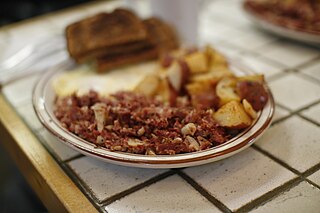
<span class="mw-page-title-main">Hash (food)</span> Culinary dish of chopped meat, potatoes, and fried onions

Hash is a culinary dish consisting of chopped meat, potatoes, and fried onions. The name is derived from French: hacher, meaning "to chop". It originated as a way to use up leftovers. In the U.S. by the 1860s, a cheap restaurant was called a "hash house" or "hashery."

<span class="mw-page-title-main">Remoulade</span> Mayonnaise-based cold sauce

Rémoulade is a cold sauce. Although similar to tartar sauce, it is often more yellowish, sometimes flavored with curry, and sometimes contains chopped pickles or piccalilli. It can also contain horseradish, paprika, anchovies, capers and a host of other items.

<span class="mw-page-title-main">Seasoned salt</span> Table salt blended with herbs and spices

Seasoned salt is a blend of table salt, herbs, spices, other flavourings, and sometimes monosodium glutamate (MSG). It is sold in supermarkets and is commonly used in fish and chip shops and other take-away food shops. Seasoned salt is often the standard seasoning on foods such as chicken, french fries, deep-fried seafood, and potatoes.
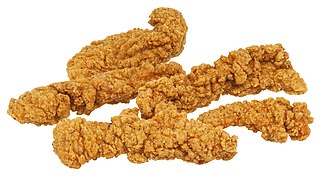
<span class="mw-page-title-main">Buttermilk Crispy Tenders</span> Food sold by the fast food chain McDonalds

Crispy Tenders were chicken strips sold by the international fast food restaurant chain McDonald's in the United States and Canada. They were introduced in early 1998 for a limited time and offered again in early 2002 and late 2003 and then permanently starting in 2004. In the UK, they were launched on the "Pound Saver Menu", which offers various menu items for £0.99.

<span class="mw-page-title-main">Czech cuisine</span> Culinary traditions of the Czech Republic

Czech cuisine has both influenced and been influenced by the cuisines of surrounding countries and nations. Many of the cakes and pastries that are popular in Central Europe originated within the Czech lands. Contemporary Czech cuisine is more meat-based than in previous periods; the current abundance of farmable meat has enriched its presence in regional cuisine. Traditionally, meat has been reserved for once-weekly consumption, typically on weekends.
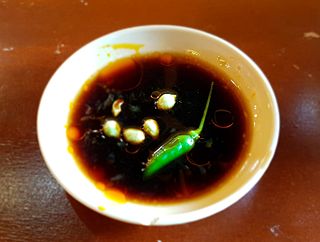
<span class="mw-page-title-main">Philippine condiments</span> Condiments used in Filipino cuisine

The generic term for condiments in the Filipino cuisine is sawsawan. Unlike sauces in other Southeast Asian regions, most sawsawan are not prepared beforehand, but are assembled on the table according to the preferences of the diner.

<span class="mw-page-title-main">Shake 'n Bake</span> Flavored bread crumb–style coating

Shake 'n Bake is a seasoned bread crumb coating originally marketed to mimic the flavor and texture of Southern fried chicken. Introduced in 1965 by General Foods, it is currently made under the Kraft Heinz brand.
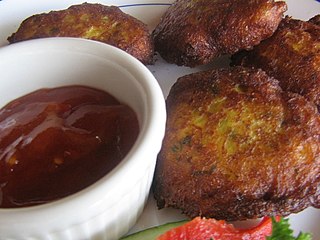
<span class="mw-page-title-main">Chili sauce and paste</span> Condiment prepared with chili peppers

Chili sauce and chili paste are condiments prepared with chili peppers.

<span class="mw-page-title-main">Instant soup</span>

Instant soup is a type of soup designed for fast and simple preparation. Some are homemade, and some are mass-produced on an industrial scale and treated in various ways to preserve them. A wide variety of types, styles and flavors of instant soups exist. Commercial instant soups are usually dried or dehydrated, canned, or treated by freezing.

<span class="mw-page-title-main">Javanese cuisine</span> Cuisine of the Javanese people

Javanese cuisine is the cuisine of Javanese people, a major ethnic group in Indonesia, more precisely the province of Central Java, Yogyakarta and East Java.

<span class="mw-page-title-main">Tunisian cuisine</span> Culinary traditions of Tunisia

Tunisian cuisine, the cuisine of Tunisia, consists of the cooking traditions, ingredients, recipes and techniques developed in Tunisia since antiquity. It is mainly a blend of Mediterranean and native Punics-Berber cuisine. Historically, Tunisian cuisine witnessed influence and exchanges with many cultures and nations like Italians, Andalusians, French and Arabs.
<span class="mw-page-title-main">Meatball</span> Dish of ground meat rolled into a ball

A meatball is ground meat rolled into a ball, sometimes along with other ingredients, such as bread crumbs, minced onion, eggs, butter, and seasoning. Meatballs are cooked by frying, baking, steaming, or braising in sauce. There are many types of meatballs using different types of meats and spices. The term is sometimes extended to meatless versions based on vegetables or fish; the latter are also commonly known as fishballs.

<span class="mw-page-title-main">Heinz Sandwich Spread</span> Sandwich spread

Heinz Sandwich Spread is a blend of salad cream and relish manufactured by Heinz and popular in the Netherlands and Britain. It is classified by the manufacturer as a sauce or relish. The relish ingredients are Spirit Vinegar, Sugar, Cabbage, Rapeseed Oil, Water, Carrots, Gherkins, Modified Cornflour, Salt, Onions, Egg Yolks, Red Peppers, Mustard, Stabilisers - Guar Gum and Xanthan Gum, Spice Extracts, Spices, Herb Extract, Flavourings, Colour - Riboflavin, VEGETABLES 35%. The salad cream base results in a more tart flavour than similar mayonnaise-based sandwich spreads found in the United States.

<span class="mw-page-title-main">Bumbu (seasoning)</span> Indonesian spice blends

Bumbu is the Indonesian word for a blend of spices and for pastes made from these blends, and it commonly appears in the names of spice mixtures, sauces and seasoning pastes. The official Indonesian language dictionary describes bumbu as "various types of herbs and plants that have a pleasant aroma and flavour — such as ginger, turmeric, galangal, nutmeg and pepper — used to enhance the flavour of the food."

<span class="mw-page-title-main">Ginataang manok</span> Filipino chicken soup

Ginataang manok is a Filipino chicken soup made from chicken in coconut milk with green papaya and other vegetables, garlic, ginger, onion, patis or bagoong alamang, and salt and pepper. It is a type of ginataan. A common variant of the dish adds curry powder or non-native Indian spices and is known as Filipino chicken curry.
References

  1. "Spatini Details". TrademarkBank. Retrieved June 10, 2017.
  2. 1 2 Spatini, at Lawry's (2022)
  3. "Spatini Co". CompaniesPA. Retrieved September 25, 2016.
  4. "Philadelphia's Spatini Co. Appoints Firestone-Rosen". Sponsor. Sponsor Publications. 18: 56. 1964. ISBN   0-19533-553-8 . Retrieved September 25, 2016.
  5. "New Products: Spatini Mix with Tomatoes". Super Market Merchandising. Super Market Publishing Company. 27: 93. 1962. Retrieved September 25, 2016.
  6. 1 2 3 Pollard, Garland (September 14, 2010). "Fan of Spatini Speaks Out". BrandlandUSA. Retrieved June 10, 2017.
  7. "New Recipes for Spatini". Restaurant Business. 83: 56. 1984. Retrieved September 25, 2016.
  8. Marcus, Erica (March 21, 2007). "Burning Questions: Can this sauce be duplicated?". Newsday . Archived from the original on June 15, 2020. Retrieved September 15, 2016. Alt URL
  9. Rothman, Julie (July 6, 2010). "Recipe: Shortcut Lasagna - A reader was looking for a lasagna recipe she got off a Spatini spaghetti sauce mix box". The Seattle Times . Retrieved June 8, 2017.
  10. 1 2 "Lawrys Spaghetti Sauce, Spatini". McCormick for Chefs. Retrieved June 10, 2017.
  11. "Agency appointments..." (PDF). Broadcasting . July 6, 1964. p. 42. Retrieved June 10, 2017.
  12. "Directory". Editor & Publisher . 102: 67. 1969. Retrieved June 10, 2017.
  13. "Business briefly". Broadcasting . 1969. p. 26. Retrieved June 10, 2017.
  14. "Selling Sounds". Billboard . March 14, 1970. p. 29. Retrieved June 10, 2017.
  15. Greenwald, Helen M., ed. (2014). The Oxford Handbook of Opera. Oxford University Press. p. 948. ISBN   9780195335538 . Retrieved June 10, 2017.
  16. Sorba, Carlotta (November 2009). "Attila and Verdi's historical imagination". Cambridge Opera Journal. 21 (3): 341–348. doi:10.1017/S0954586710000145.