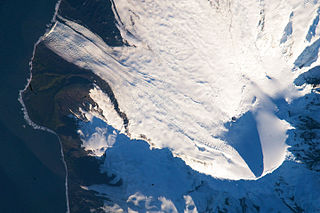
The Territory of Heard Island and McDonald Islands is an Australian external territory comprising a volcanic group of barren Antarctic islands, about two-thirds of the way from Madagascar to Antarctica. The group's overall size is 372 square kilometres (144 sq mi) in area and it has 101.9 km (63 mi) of coastline. Discovered in the mid-19th century, the islands have been an Australian territory since 1947 and contain the country's only two active volcanoes. The summit of one, Mawson Peak, is higher than any mountain on the Australian mainland. The islands lie on the Kerguelen Plateau in the Indian Ocean.

The Arctic Archipelago, also known as the Canadian Arctic Archipelago, is a group of islands north of the Canadian mainland.
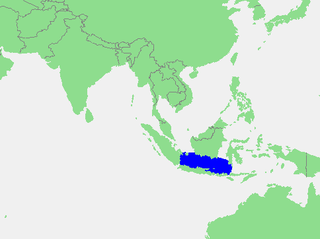
The Java Sea is an extensive shallow sea on the Sunda Shelf. It lies between the Indonesian islands of Borneo to the north, Java to the south, Sumatra to the west, and Sulawesi to the east. Karimata Strait to its northwest links it to the South China Sea.

HMCS Alberni was a Flower-class corvette that served in the Royal Canadian Navy (RCN) during the Second World War. She served in several theatres of the war. She was sunk in 1944.
Saddle Point is a rocky point separating Corinthian Bay and Mechanics Bay on the north coast of Heard Island in the Antarctic.

Baudissin Glacier is a tidewater glacier on the north side of Heard Island. in the southern Indian Ocean. Located 1 nautical mile (1.9 km) west of Challenger Glacier, Baudissin Glacier is 1.5 nautical miles (2.8 km) wide and flows into the western part of Corinthian Bay. The terminus of Baudissin Glacier is located at the western side of Corinthian Bay, at Sealers Cove. To the east of Baudissin Glacier is Challenger Glacier, whose terminus is located at the eastern side of Corinthian Bay, close west to Saddle Point. To the south of Baudissin Glacier is Schmidt Glacier, and to the northwest is Atlas Cove. Kildalkey Head is west of Schmidt Glacier. To the south of Schmidt Glacier is Vahsel Glacier, whose terminus is at South West Bay, between Erratic Point and Cape Gazert. Immediately south of Vahsel Glacier is Allison Glacier. Click here to see a map of Baudissin Glacier and the northwestern coast of Heard Island.
Downes Glacier is a broad tidewater glacier on the north side of Heard Island in the southern Indian Ocean. It flows north on both sides of Cape Bidlingmaier to the north coast of Heard Island. To the east of Downes Glacier is Ealey Glacier, whose terminus is located close southeast of Cape Bidlingmaier. To the west of Downes Glacier is Challenger Glacier, whose terminus is located at the eastern side of Corinthian Bay, close west to Saddle Point. Saddle Point separates Downes Glacier from Challenger Glacier.
Vahsel Glacier is a glacier on the northwestern side of Heard Island in the southern Indian Ocean. It flows west into South West Bay, between Erratic Point and Cape Gazert. Immediately to the north of Vahsel Glacier is Schmidt Glacier, whose terminus is located between Mount Drygalski and North West Cornice. To the south of Vahsel Glacier is Allison Glacier, whose terminus is located south of Cape Gazert, which separates Allison Glacier from Vahsel Glacier. Click here to see a map of Vahsel Glacier and the northwestern coast of Heard Island.
Ealey Glacier is a glacier, flowing northeast from the lower slopes of the Big Ben massif to the northeast side of Heard Island in the southern Indian Ocean. Its terminus is located close southeast of Cape Bidlingmaier, between Melbourne Bluff and North Barrier. The glacier terminates in ice cliffs. To the southeast of Ealey Glacier is Compton Glacier, whose terminus is located at Compton Lagoon, between Gilchrist Beach and Fairchild Beach. To the west of Ealey Glacier is Downes Glacier, whose terminus is located at Mechanics Bay, between Saddle Point and Cape Bidlingmaier.
Cape Gazert is a cape at the western end of the rocky promontory which forms the south side of South West Bay, on the west side of Heard Island in the southern Indian Ocean. This feature was known to American sealers as "Green Point", as shown by Captain H.C. Chester's 1860 sketch map and other sealer maps of the period. The present name was applied by the First German Antarctica Expedition when they landed at the feature in February 1902, after Doctor Hans Gazert, medical officer with the expedition, and it has become established in international usage.
Corinthian Bay is a bay, which is 3 miles (5 km) wide and recedes 1.5 miles (2.4 km), entered between Rogers Head and Saddle Point on the north coast of Heard Island in the southern Indian Ocean. The name appears on an early chart compiled by American sealers. It was probably given by Captain Erasmus Darwin Rogers, American whaler and sealer, after his vessel Corinthian in which he made the first landing on Heard Island in March 1855. Nearby features include Corinth Head.
Erratic Point is a small, moss-covered point at the head of South West Bay, 1.3 nautical miles (2.4 km) northeast of Cape Gazert, on the west side of Heard Island in the southern Indian Ocean. The First German Antarctica Expedition in 1902 charted a cape in this vicinity, from the summit of Mount Drygalski, and applied the name "Kap Lerche." In November 1929 the British Australian and New Zealand Antarctic Research Expedition under Douglas Mawson charted a small point in this position and applied the name "Erratic Point" because of the large number of massive erratic boulders encountered there. The Australian National Antarctic Research Expedition was unable to find any significant feature in this immediate area during their 1948 survey of the island, hence the name Erratic Point was retained by them for this small point.
Dovers Moraine is a band of coarse glacial moraine, extending in a north-south direction for 1.5 nautical miles (3 km), deposited at the east end of the main mass of Heard Island immediately east of Stephenson Glacier. It was surveyed in 1948 by the Australian National Antarctic Research Expeditions, and named by them for Robert G. Dovers, geologist and chief surveyor with the party. Small settlements were occupied near both ends of this morainal belt by American sealers engaged in the extraction of oil from elephant seals during the 1858–82 period.
Budd Peak is a peak, 2,315 metres (7,600 ft) high, 1.7 nautical miles (3.1 km) southeast of Mawson Peak on Heard Island. The peak was mapped by Australian National Antarctic Research Expeditions (ANARE) in 1948, and named by the Antarctic Names Committee of Australia for G.M. Budd, ANARE officer-in-charge on Heard Island in 1954, and leader of the 1963 ANARE Heard Island expedition.
Fremantle Peak is a peak, 2,375 metres (7,800 ft) high, standing 0.4 nautical miles (0.7 km) northeast of the Dome, near the summit of Heard Island. It was surveyed in 1948 by the Australian National Antarctic Research Expeditions, and named by them after the port of Fremantle, the final point of embarkation for the expedition.
Spit Bay is an open bight formed by the northeast coastline of Heard Island and Spit Point, the east extremity of the island. The name derives from the conspicuous Elephant Spit which forms the south and east shore of the bight, and may have been given by American sealers at Heard Island in the period following their initiation of sealing there in 1855. The name appears on a chart by the British utilized many names then in use by the sealers. Heard Island and McDonald Islands are located in the Southern Ocean, approximately 1,700 km (1,100 mi) from the Antarctic continent and 4,100 km (2,500 mi) southwest of Perth. As the only volcanically active subantarctic islands, they "open a window into the earth", thus providing the opportunity to observe ongoing geomorphic processes and glacial dynamics. The distinctive conservation value of Heard and McDonald – one of the world’s rare pristine island ecosystems – lies in the complete absence of alien plants and animals, as well as human impact.
The geography of the Heard Island and McDonald Islands (HIMI) refers to the geography of Heard Island and the McDonald Islands, one of the most remote places on earth. The islands belong to Australia and are located 4,000 kilometres (2,485.5 mi) southwest of the mainland in the Southern Ocean. These subantarctic islands were transferred to Australia by the United Kingdom in 1947. They lie between Madagascar and Antarctica.