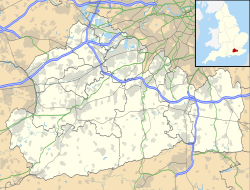
It is recorded in the Domesday Book that a priest was present in Shepperton in 1087, and a church is first mentioned in 1157.[4] The present building is thought to date from 1614, with the tower added a century later.[5][6]
The main body of the church is thought to date from 1614 and was a reconstruction following destruction of an earlier building by flood some years earlier.[5] (The church is located on the north bank of the River Thames.) However, it is thought that some 12th and 13th century work is incorporated in the present structure.[6]
The tower, added circa. 1710 reputedly at the suggestion of Queen Anne, is built in Thames Valley brick and houses the church clock, installed in 1769.[5] The tower also contains a 6 cwt ring of six bells hung for English-style change ringing.[7] The heaviest five bells date from 1877 and were cast by John Warner & Sons, while the lightest bell (the "treble") dates from 1979 and was cast by the Whitechapel Bell Foundry.[8]
The church building has been the subject of several restoration projects in the 21st century. In the 2010s, the south transept underwent a significant restoration,[9] while in 2024 the top portion of the tower was dismantled and rebuilt.[10]
This page is based on this Wikipedia article Text is available under the CC BY-SA 4.0 license; additional terms may apply. Images, videos and audio are available under their respective licenses.