
The PS Medway Queen is a paddle driven steamship, the only mobile estuary paddle steamer left in the United Kingdom. She was one of the "little ships of Dunkirk", making a record seven trips and rescuing 7,000 men in the evacuation of Dunkirk.

Havengore is a former hydrographic survey launch, originally launched in 1956 for service with the Port of London Authority (PLA). After her withdrawal from service and sale in 1995, she was re-registered as a passenger vessel for up to 40 passengers. Based on the River Thames, Havengore has also served as a ceremonial vessel. She is best known for carrying the body of Sir Winston Churchill as part of his state funeral in 1965.

The MV Cartela is an excursion vessel operating on the Derwent River in Hobart, Tasmania, Australia. She is now Australia's oldest continuously-licensed passenger vessel, although there are several older vessels still in service that have been restored after lengthy periods in dereliction.

Baltimore is a preserved steam-powered tugboat, built in 1906 by the Skinner Shipbuilding Company of Baltimore, Maryland. She is formerly the oldest operating steam tugboat in the United States, but at present does not hold an operating license issued by the US Coast Guard, so is unable to leave her dock at the Baltimore Museum of Industry on Key Highway, Baltimore. Her hull is not capable of operating on open water. Baltimore was built and operated as a harbor inspection tug, capable of acting as a municipal tugboat for city barges, as well as an official welcoming vessel and VIP launch, an auxiliary fireboat, and as a light icebreaker.

HMS Ardent was a wooden Alecto-class paddle sloop, and the fourth ship of the Royal Navy to use the name. She was launched on 12 February 1841 at Chatham and spent much of her career on the West Coast of Africa engaged in anti-slavery operations. One of the ship's company, Gunner John Robarts, was awarded the Victoria Cross for the destruction of Russian food stores in the Crimean War. She was scrapped in 1865.

TID was a standardized British design for a tugboat drawn up and built during the Second World War. One hundred and eighty two were built for the Ministry of War Transport.

John H Amos is a paddlewheel tugboat built in Scotland in 1931. The last paddlewheel tug built for private owners, now owned by the Medway Maritime Trust. She is one of only two surviving British-built paddle tugs, the other being Eppleton Hall preserved at the San Francisco Maritime National Historical Park in San Francisco, California.
Empire Byng was a 7,832 GRT heavy lift ship which was built in 1944 for the Ministry of War Transport (MoWT). Completed in May 1945, she was sold in 1951 and renamed Peter Dal II. Further sales saw her renamed Benwyvis, Southern Comet and Marites. In November 1970, she ran aground at Manila Bay in Typhoon Patsy. Marites was scrapped in 1972.
Empire Charmian was a 7,513 GRT heavy lift ship which was built in 1943 by Vickers-Armstrongs, Barrow in Furness. She was built for the Ministry of War Transport (MoWT). In 1951 she was sold into merchant service and renamed Vercharmian. After running aground in 1961, she was scrapped in 1962.

ST Cervia was built in 1946 as a seagoing tug for use as a fleet auxiliary by Alexandra Hall & Company Ltd of Aberdeen, Scotland. Today she is a floating Museum still undergoing restoration in Ramsgate, Kent.

Richard Dunston was a shipbuilder on the Humber, England. The company started building wooden barges miles from the sea and evolved to pioneer fully welded steel ships of a single design. The yard is now closed, although the name continues in a ship repair yard.

Mayflower is a steam tug built in Bristol in 1861 and now preserved by Bristol Museums Galleries & Archives. She is based in Bristol Harbour at M Shed. She is the oldest Bristol-built ship afloat, and is believed to be the oldest surviving tug in the world.

The Thames Diamond Jubilee Pageant was a parade on 3 June 2012 of 670 boats on the Tideway of the River Thames in London as part of the celebrations of the Diamond Jubilee of Elizabeth II. The Queen, Prince Philip and other members of the Royal Family were aboard vessels that took part in the parade. The parade was organised by the Thames Diamond Jubilee Foundation, and funded by private donations and sponsorship. The pageant master was Adrian Evans.
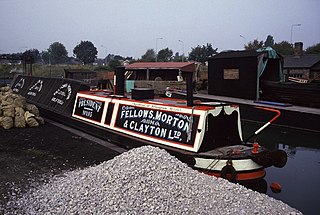
President is a historic, steam-powered narrowboat, built in 1909 by Fellows Morton & Clayton (FMC) at their dock at Saltley, Birmingham, England. It is now owned by the Black Country Living Museum, where it is based. President is registered by National Historic Ships as part of the National Historic Fleet.

SB Centaur is a wooden Thames sailing barge, built in Harwich, Essex, England in 1895. She was used to carry various cargoes, mainly grain, for the next 60 years. During the First World War she carried food and coal to the French Channel ports. During the Second World War Centaur was damaged when sailing to assist with the Dunkirk Evacuation. She did war work for the duration of the conflict.
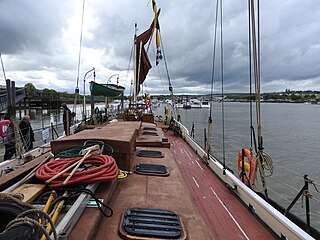
Kitty is a wooden Thames sailing barge in the bowsprit class of 65 tons. She was built in Harwich in 1895. She is No. 209 on the National Historic Ships Register.

The Phoenician is a wooden Thames sailing barge constructed in Sittingbourne in 1922. She was derigged after an accident in 1940. She left trade in 1973. In the 1980s, she was re-rigged to her original specification.

Mirosa is a Thames barge which was built in 1892. From 1892 until 1947, she sailed under the name Ready when the name was sold to Trinity House for a lightship support vessel. Under her new name, she traded until 1955. Mirosa has never had an engine.
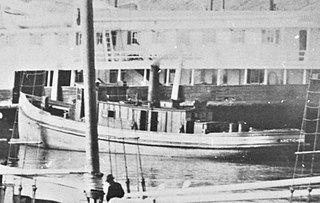
The Arctic was a wooden hulled tugboat that worked on the Great Lakes of North America from 1881 to 1930. In 1930 the Arctic was stripped of her machinery, and abandoned at Manitowoc, Wisconsin. On June 22, 2018, the remains of the Arctic were listed on the National Register of Historic Places.
Charkieh was an iron screw steamer launched in 1865. Built at Leamouth near London, she was purchased by the Khedivate of Egypt as a mail steamer. She was in a collision in the River Thames in 1872 and was eventually wrecked off Greece in 1900.


