
Stephan Noller (born January 6, 1970) is a German internet-entrepreneur, founder and CEO of the nugg.ad predictive behavioral targeting company, and former chairman of the IAB Europe Policy Committee. [1]
Stephan Noller (born January 6, 1970) is a German internet-entrepreneur, founder and CEO of the nugg.ad predictive behavioral targeting company, and former chairman of the IAB Europe Policy Committee. [1]
Stephan Noller studied psychology at the University of Cologne, earning honors with distinction for his thesis "Mental Models and Web Navigation". In professional publications and research studies Noller concentrated on theories as to what conclusions could be drawn from users' online behavior. His roots come from Fraunhofer Society, [2] where he worked on machine learning algorithms to predict user's interests and demographics out of behavioral data. After developing a new process for measuring internet coverage for the industry association AGOF while working at TNS Emnid, he created an online advertising targeting system based on automated profiling for TNS Infratest in 2006: Predictive Behavioral Targeting by nugg.ad. Besides continually developing this system, he was also active for United Internet Media, and published portals such as web.de (named TGP) and gmx.de.
The Predictive Behavioral Targeting system became the first targeting system to be granted the data privacy seal of The Independent Centre for Privacy Protection (ULD) in Schleswig-Holstein, Germany, and was also granted the EuroPriSe seal [3] (funded by the European Commission under its eTEN programme) in 2009 for using a preceding anonymization process that filtered IP addresses reliably, compliant with the central data austerity criterion of data protection. The German government awarded Noller and Richard Hutton a patent for the system in February 2015. [4] The company nugg.ad was sold to Deutsche Post DHL in 2010. [5]
In 2009, Noller was elected chairman of the IAB Europe Policy Committee, where he represented the interests of the European internet industry to political committees at the continent level, influenced market developments, and responded to challenges to data privacy caused by data-driven internet business models. On 14 April 2011, the committee headed a broad coalition of associations, companies, and tech providers of the European online industry in presenting a self-regulation model to the public; [6] it addressed the loophole regarding the realization of the ePrivacy directive towards the European Commission[ clarification needed ] and sought to bring more transparency and control to consumers regarding online behavioral advertising.
In appreciation of his activities and work, Noller was awarded the "Best Personality" award at the 2012 Marketing and Interactive Excellence Awards Europe. [7] Since 2012 he is a columnist for the leading data driven-advertising blog ExchangeWire. [8] From 2013 to 2019 he was appointed to the Council of Advisors on Digital Economy to the Federal Ministry of Economics and Energy, the "Beirat Junge Digitale Wirtschaft", [9] and to the Rheinland Palatine's state Council for Digital Development and Culture. [10]
In 2014 Noller Co-founded the company Ubirch GmbH that offers a system for device security based on cryptography and blockchain technology. The company implemented ways of securing medical data records and making the verifiable for third parties in a privacy friendly way. The technology was used during the Covid pandemic to secure Covid test-results and vaccination status records. [11] In a consortium with IBM, govdigital and Bechtle Ubirch is running the system behind the german national digital covid vaccination pass system.[ citation needed ]
Digital display advertising is online graphic advertising through banners, text, images, video, and audio. The main purpose of digital display advertising is to post company ads on third-party websites. A display ad is usually interactive, which allows brands and advertisers to engage deeper with the users. A display ad can also be a companion ad for a non-clickable video ad.
Online advertising, also known as online marketing, Internet advertising, digital advertising or web advertising, is a form of marketing and advertising that uses the Internet to promote products and services to audiences and platform users. Online advertising includes email marketing, search engine marketing (SEM), social media marketing, many types of display advertising, and mobile advertising. Advertisements are increasingly being delivered via automated software systems operating across multiple websites, media services and platforms, known as programmatic advertising.
Audience measurement calculates how many people are in an audience, usually in relation to radio listenership and television viewership, but also in relation to newspaper and magazine readership and, increasingly, web traffic. The term is sometimes used with regard to practices that help broadcasters and advertisers determine who is listening, rather than how many people are listening. In some parts of the world, the resulting numbers are referred to as audience share; in other places, the broader term market share is used. This broader meaning is also known as audience research. Measurements are broken down by media market, which corresponds to large and small metropolitan areas.
Comscore, Inc. is an American-based global media measurement and analytics company providing marketing data and analytics to enterprises; media and advertising agencies; brand marketers and publishers.
Mobile advertising is a form of advertising via mobile (wireless) phones or other mobile devices. It is a subset of mobile marketing, mobile advertising can take place as text ads via SMS, or banner advertisements that appear embedded in a mobile web site.

Digital marketing is the component of marketing that uses the Internet and online-based digital technologies such as desktop computers, mobile phones, and other digital media and platforms to promote products and services. Its development during the 1990s and 2000s changed the way brands and businesses use technology for marketing. As digital platforms became increasingly incorporated into marketing plans and everyday life, and as people increasingly used digital devices instead of visiting physical shops, digital marketing campaigns have become prevalent, employing combinations of search engine optimization (SEO), search engine marketing (SEM), content marketing, influencer marketing, content automation, campaign marketing, data-driven marketing, e-commerce marketing, social media marketing, social media optimization, e-mail direct marketing, display advertising, e-books, and optical disks and games have become commonplace. Digital marketing extends to non-Internet channels that provide digital media, such as television, mobile phones, callbacks, and on-hold mobile ringtones. The extension to non-Internet channels differentiates digital marketing from online marketing.
A click path or clickstream is the sequence of hyperlinks one or more website visitors follows on a given site, presented in the order viewed. A visitor's click path may start within the website or at a separate third party website, often a search engine results page, and it continues as a sequence of successive webpages visited by the user. Click paths take call data and can match it to ad sources, keywords, and/or referring domains, in order to capture data.

Quantcast is an American technology company, founded in 2006, that specializes in AI-driven real-time advertising, audience insights and measurement. It has offices in the United States, Canada, Australia, Singapore, United Kingdom, Ireland, France, Germany, Italy, and Sweden.
The Interactive Advertising Bureau (IAB) is an American advertising business organization that develops industry standards, conducts research, and provides legal support for the online advertising industry. The organization represents many of the most prominent media outlets globally, but mostly in the United States, Canada and Europe.
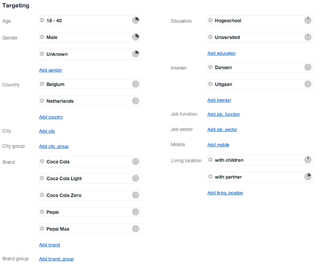
Targeted advertising is a form of advertising, including online advertising, that is directed towards an audience with certain traits, based on the product or person the advertiser is promoting.
Adtech AG is a German–American digital marketing company that retails products to manage, serve and evaluate online advertising campaigns. The company was founded in 1998 in Frankfurt, Germany, and was acquired by web portal AOL on May 15, 2007. The company was merged into the Oath Inc. brand, as a subsidiary of Verizon Communications.

NebuAd was an American online advertising company based in Redwood City, California, with offices in New York and London and was funded by the investment companies Sierra Ventures and Menlo Ventures. It was one of several companies which originally developed behavioral targeting advertising systems, and sought deals with ISPs to enable them to analyse customer's websurfing habits in order to provide them with more relevant, micro-targeted advertising. Phorm was a similar company operating out of Europe. Adzilla and Project Rialto also appear to be developing similar systems.
Behavioral retargeting is a form of online targeted advertising by which online advertising is targeted to consumers based on their previous internet behaviour. Retargeting tags online users by including a pixel within the target webpage or email, which sets a cookie in the user's browser. Once the cookie is set, the advertiser is able to show ads to that user elsewhere on the internet via an ad exchange.

The Network Advertising Initiative is an industry trade group founded in 2000 that develops self-regulatory standards for online advertising. Advertising networks created the organization in response to concerns from the Federal Trade Commission and consumer groups that online advertising — particularly targeted or behavioral advertising — harmed user privacy. The NAI seeks to provide self-regulatory guidelines for participating networks and opt-out technologies for consumers in order to maintain the value of online advertising while protecting consumer privacy. Membership in the NAI has fluctuated greatly over time, and both the organization and its self-regulatory system have been criticized for being ineffective in promoting privacy.
A supply-side platform (SSP) or sell-side platform is a technology platform to enable web publishers and digital out-of-home (DOOH) media owners to manage their advertising inventory, fill it with ads, and receive revenue. Many of the larger web publishers of the world use a supply-side platform to automate and optimize the selling of their online media space.
Real-time bidding (RTB) is a means by which advertising inventory is bought and sold on a per-impression basis, via instantaneous programmatic auction, similar to financial markets. With real-time bidding, advertising buyers bid on an impression and, if the bid is won, the buyer's ad is instantly displayed on the publisher's site. Real-time bidding lets advertisers manage and optimize ads from multiple ad-networks, allowing them to create and launch advertising campaigns, prioritize networks, and allocate percentages of unsold inventory, known as backfill.
Do Not Track legislation protects Internet users' right to choose whether or not they want to be tracked by third-party websites. It has been called the online version of "Do Not Call". This type of legislation is supported by privacy advocates and opposed by advertisers and services that use tracking information to personalize web content. Do Not Track (DNT) is a formerly official HTTP header field, designed to allow internet users to opt-out of tracking by websites—which includes the collection of data regarding a user's activity across multiple distinct contexts, and the retention, use, or sharing of that data outside its context. Efforts to standardize Do Not Track by the World Wide Web Consortium did not reach their goal and ended in September 2018 due to insufficient deployment and support.
AdChoices is a self-regulatory program for online interest-based advertising that exists in the United States, Canada and across Europe. The program calls for advertising companies to establish and enforce responsible privacy practices for interest-based advertising, aimed to give consumers enhanced transparency and control. Companies adhere to a set of principles that are enforced by accountability programs.

The Digital Advertising Alliance of Canada (DAAC) is a Canadian non-profit trade association.
Rich LeFurgy is an American advertising consultant and investor. The founding chairman of the Interactive Advertising Bureau, he left a senior position at a Madison Avenue agency in 1995, becoming one of the first advertising executives to shift from traditional to digital media. Described as the "godfather of internet advertising standards," LeFurgy was central to the development and adoption of the standards that guide online advertising.